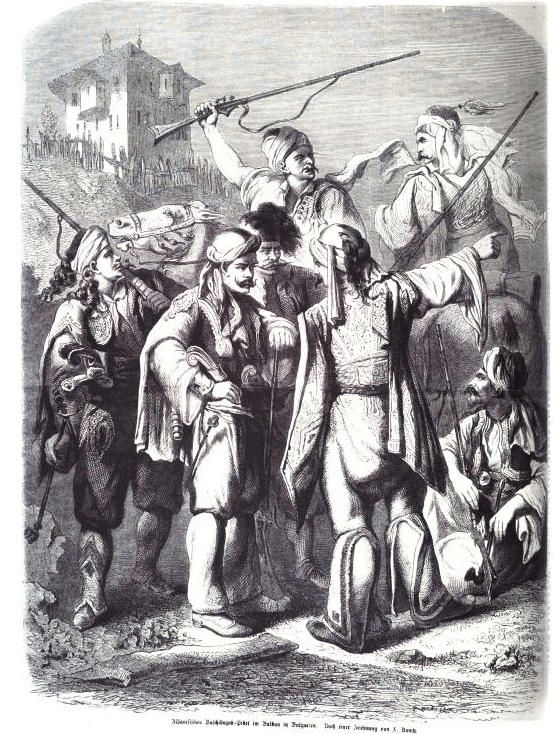

On page 114 of James J. Reids “Crisis of the Ottoman Empire: Prelude to Collapse 1839-1878” we can read that the Albanian irregular troops taught the Greek brigands or “klephtés” the idea of “honor” or “Besa”.
Cited:
“A number of modern studies have examined the issue of banditry and brigandage in relation to irregular military formations. The most important work for a study of the 19th century is that of John Koliopoulos. He thought that brigands in particular originated in the Ottoman Empire, and Ottoman Greece in particular as a consequence of the Empire’s socioeconomic malaise after the 16th century.
He placed the growth of an irregular soldiery within the vortex of geographical conditions that enabled a military formation assisted in its development by social and economic conditions. “The nature of the terrain combined with foreign conquest and rule in modern times pro-duced in continental Greece a class of men of arms, a fairly distinct military class, which was destined to play a very important role in the war of the 1820s, as well as in the subsequent military events and political developments.
Of particular interest in his book is his discussion about the kinship principle and the idea of honor associated with family and band. Greek irregulars had interacted with Albanian irregular soldiers over decades and centuries so that one can see the influence of the Albanian notion of bésa on Greek brigands [klephtés] and mercenary soldiers.
“In the unequal battle to win a living, the honour and prestige of the family had to be preserved, because humiliation before others was considered a sign of weakness and failure of the family as a whole. Obligations of family members to one another were exclusive, and distrust between unrelated families was virtually obligatory.”
Source
Crisis of the Ottoman Empire: Prelude to Collapse 1839-1878. James J. Reid, p. 114.

 Balkan Academia