
Dr. Nexhat Çoçaj. Translation Petrit Latifi
Abstract
This study explores the arrival, settlement, and gradual assimilation of Albanian Orthodox and Vlach communities—known locally as Gogs—in Prizren from the 18th to the 20th century. Drawing on oral histories, archival traces, and cultural memory, it highlights their origins in southern Albania (Korça, Voskopoja, Ioannina) and examines their role as skilled craftsmen who significantly contributed to Prizren’s urban reconstruction. Initially marginalized by Ottoman authorities due to their faith, these communities nonetheless integrated linguistically and socially with local Albanians. Over time, however, due to religious isolation, lack of support from Albanian clergy, and strategic Serbian church policies, many Orthodox Albanians and Vlachs became Serbized through marriage, employment pressures, and church influence. Their historical presence, once visible in language, craftsmanship, and religious practices, has largely disappeared from official records, raising important questions about Serbias Orthodox assimilationist policies against Albanians and Albanian heritage.
About the arrival and settlement of Albanian Orthodox and Vlachs in Prizren
From the beginning, I must emphasize that the reason for dealing with this topic is a note by Mitrush Kutel, who describes his visit to Prizren on May 22, 1943. In this note titled “Among the Dead and the Living” Kutel describes the touching events of an Orthodox mother, who, while mourning over her son’s grave, mentions a Serbian word and an Albanian word “sino – biro!”. On the other hand, my interest in the old crafts in the city of Prizren, shows me that among the most famous crafts were the Gogs, mainly coming from Southern Albania and some from Chameria.
Although the phenomenon of the displacement of Orthodox Christians from Korça and other Albanian regions to Macedonia and Kosovo has been studied very little by Albanian scholars until recent years. According to contemporary evidence, the main cause of the displacement of Albanian and Vlach Orthodox Christians to Kosovo and elsewhere was the punitive measures of the Turkish military garrisons against supporters of the Greek uprisings, for which the Turks later “burned the Bazaar of Korça, Voskopoja, while the local feudal lords, the inhabitants of these areas, to escape the harsh punishments, fled and settled wherever possible.”
A portion of these Orthodox Christians also settled in Prizren, in fact a large number of these displaced people were old craftsmen from the Korça District, but there were also those who came from Ioannina and other areas. The memory of the people of Prizren, the settlement of Albanian and Vlach Orthodox in Prizren, justifies that Mehmet Pasha Rrotulla, the mutasarif of Prizren, allegedly accepted them for the purpose of renovations after the destruction of the city in 1820.
Based on the memory of the Prizren people, but also on the basis of the data, the Albanian and Vlach Orthodox, who came from the South of Albania, were initially settled in the area of the sub-castle, in order for the settlers and their families to be more easily used for the interests of the Turkish administration.
Despite the fact that the Orthodox newcomers had come as craftsmen, the Turkish administration did not show sufficient care for the fate of these newcomers and initially they were used as if they were exiles, since they were of a different faith. The newcomers from Korça and the surrounding area, due to their rapid socialization in everyday life, as good connoisseurs of rare crafts, and in particular, they made a name for themselves as masons, began to be called gogë by the administration and the population of Prizren, regardless of their national affiliation, Albanian or Vlach.
The masons in the Albanian language were called gogë, based on which profession the residents of the newcomer community also received the nickname gogë. The Albanians also called the Cincars and all the non-Serb Orthodox who lived in Prizren “gogs”.
In this way, the Gogs who came to Prizren, some of them who had arrived earlier at the end of the 18th century and others at the beginning of the second decade of the 19th century, found themselves faced with great challenges and started life from scratch. They began to settle in Prizren in the second half of the 18th century, initially with the profession of bricklayer and other crafts.
While Branislav Nushic, for whom the memory of Prizren residents also reveals that he was an Albanian Orthodox and that his grandfather was called Bardh Nusha from Voskopoja, emphasizes that “Today’s Vlachs arrived in the 1920s from Voskopoja, Janina, Monastery and Bjelica of Ohrid.”
Since they had made a name for themselves as renowned masons, renovating the walls of the fortress, which at that time was used by the Ottoman Empire’s army, and repairing mosques, sewers and roads, they enjoyed the support of the mutasarif Mahmut Pasha Rrotulla, who allowed them to build an Orthodox church in the locality where they had settled, since the existing Albanian Catholic and Serbian Orthodox churches did not meet their needs, namely they did not allow them to perform prayers in the Albanian and Vlach languages as they were accustomed to in the country they came from.
While the Albanian Catholic church, although it used the same language as the Albanian Orthodox, did not open its door to them, perhaps also encouraged by the Turkish government of the time, while the Serbian church did not meet their language requirements and remained far from their traditions.
The church they built was named “The Church of the Saviour”, which later became the Church of St. Spas. This church was repeatedly attacked and destroyed by the Serbs, who did not want it to function in their language. “The Church of St. Spas or the Church of the Gogs (of the Vlachs), as the people say, has its own history. The Serbs burned it down several times during the Turkish period, because the Vlachs did not accept the Serbian language in the church.”

Photo by Auguste Léon taken in 1913, showing Orthodox altars in the courtyard of the church of Saint Saviour (Spasit)
Mitrush Kuteli, continuing his report, added that “there are some old graves there with Greek inscriptions that can serve as historical documents to prove that the majority of the Serbian population of Prizren is in reality an Albanian-Romanian population Serbized through the church and which once wanted to live its own national life.” The Gogs’ cemetery was originally located near their church. “Behind the church of Saint Spas there was an Orthodox cemetery and later they were joined by the Serbian cemetery (since 1924 where they are still today above the University of Prizren Complex).
For the Church of St. Spas, the memory of the old Prizren residents emphasizes that it was built after 1926 by the Gogs who came, while the Serbian history of this church claims that it is ancient and belongs to the early Middle Ages, built between 1333 and 1335, and in 1348 it was given to the Monastery of the Holy Archangels. In 1869, the Serbian church started a battle with the Cincaré people regarding the antiquity of the Church of St. Spas, and in this way the Gogs cut off relations with the Serbian church and took a priest from Janina named Lazar.
This temple served the Vlachs until 1912, when with the Serbian occupation of Prizren, the church of Saint Spas was taken over by the Serbs and since then it has served as a Serbian church. From 1953 to 1957, defensive works were carried out in this church and the church came under state protection, since the Serbian church in the center of Prizren became functional, where it is still today in Shatërvan, it served to lose traces that the church of Saint Spas was an Albanian church.
The Albanian Orthodox and Vlach-Gogs are remembered as good craftsmen in the memory of the people of Prizren.
During meetings with the elderly people of Prizren, memories of the old Gog craftsmen are preserved, although fragmentary. The elderly people of Prizren, who in various ways also remember the Orthodox craftsmen, but also based on the stories they have heard from their family members, are convinced that the majority of the Prizren craftsmen were Orthodox Albanians, who communicated in Albanian, namely in the language that the market demanded.
The Gogs generally spoke Albanian and dealt mainly with Albanians, for this reason they went on pilgrimages to Albanian villages for months. For example, when Tereziu went to a village in the winter, he would not return home for months, and if he were a Serb, he would not be able to stay in the same village as the Albanians, and the Serbs were educated and did not do much with crafts, because they were involved in the administration of the time.
Antoni continues to recall conversations with some of his peers of the Albanian Orthodox faith, who had told him that we were forced to do crafts, because the conditions did not allow us to get educated and occupy positions in the administration, until we converted to Serbs.
Aleksandër Jovani, later Jovanović, was an Albanian merchant, for whom I have the impression that he knew very little Serbian, since he communicated only in Albanian. Aleksandër Jovë’s family, even dressed differently from the Serbs, but also had traditions different from the Serbs. In Prizren he was known as an Albanian craftsman and I have the impression that everyone knew him as an Albanian, while his son Kica, who later became a footballer, declared that he was Serbian and not Albanian.
Teofil Stefan (Stefanovic) the switchman, a master of typewriters and scales in the shop of the Halveti tekke, knew Albanian and considered himself an Orthodox from the South of Albania. He was open with our family, almost every time he came to our holidays and we went to his. Many times he told us that it was better with you than to be with the Serbs, with whom we could not agree for who knows how long.
Byrhamedini continues to remember the time when Teofil considered the Halveti tekke his second home and came with his whole family for visits. With Teofil’s family until his children married Serbs, we communicated only in Albanian, because we had the same traditions. “I remember that the Gog craftsmen wore clothes that were very different from the Serbs. It didn’t differ much from our Prizren clothes, especially until the fifties.
But later everything changed. But Teofili never changed, he always said he was Albanian and that’s what he wanted us to call him.”He is married to a Serb and the children have Serbian roots. Teofili’s son Dragan, a dentist, although he knows Albanian, has not spoken Albanian to healthcare workers.
There were many Orthodox craftsmen in Prizren, but some of them stood out, such as Stefan Peçi (Peçenović), who was known as the best opingaxhiu in Prizren and the surrounding area. I don’t believe anyone knew him otherwise than as a devout Albanian, but time forced him to marry a Serb and create his own Serbian family, while he declared himself Albanian until the end.
Eshtref Kuki also remembers Ustain Harallambi Toska, later called Toskiq, who was a perfect craftsman of the Prizren tinsmith trade, while his sons were converted into true Serbs.
In the Prizren community, the Samarxhiu Vangjel is remembered as a good craftsman and very communicative with Albanians, who later changed his surname and took the surname Slav and was called Vangjel Tasić. His son Jovica knew Albanian, but communicated with a host, since he was married to a Serb.
In Prizren, there were many other Orthodox Albanians, who were engaged in various crafts, and who later converted to Serbs, but a great influence on their conversion was also the Muslim and Catholic clergy, who almost never gave them the support they needed to defend their national identity.
The personality of the tinsmith Stefan is also well remembered in the memory of many Prizren citizens. The tinsmith Stefan had a son, Sreckin, and three daughters. All four of Stefan’s children married Serbs and thus converted while Stefan was alive with his wife, who declared themselves Albanians.
There are many stories about the tinsmith Stefan in Prizren, which talk about his disappointment that his children had converted to Serbs. Agim Paca tells a very interesting detail about Stefan’s wife Rozen, who at a moment when her husband, Stefan, fell ill, took all her valuable assets (liras and money) and sheltered them in the house of Nuri Llausha, namely in the room of Nuri’s wife at Shefkinazi, in order to prevent the Serbian sons-in-law from taking her husband’s property.
“I remember like today, when as a child my mother and I went to Aunt Shefkinaze’s for dinner and as soon as we entered the room she started telling my mother how Aunt Roza had brought the family’s wealth in a box to keep at home, so that her daughters, who loved their father Stefan more for his wealth than for his father, would not find it.”
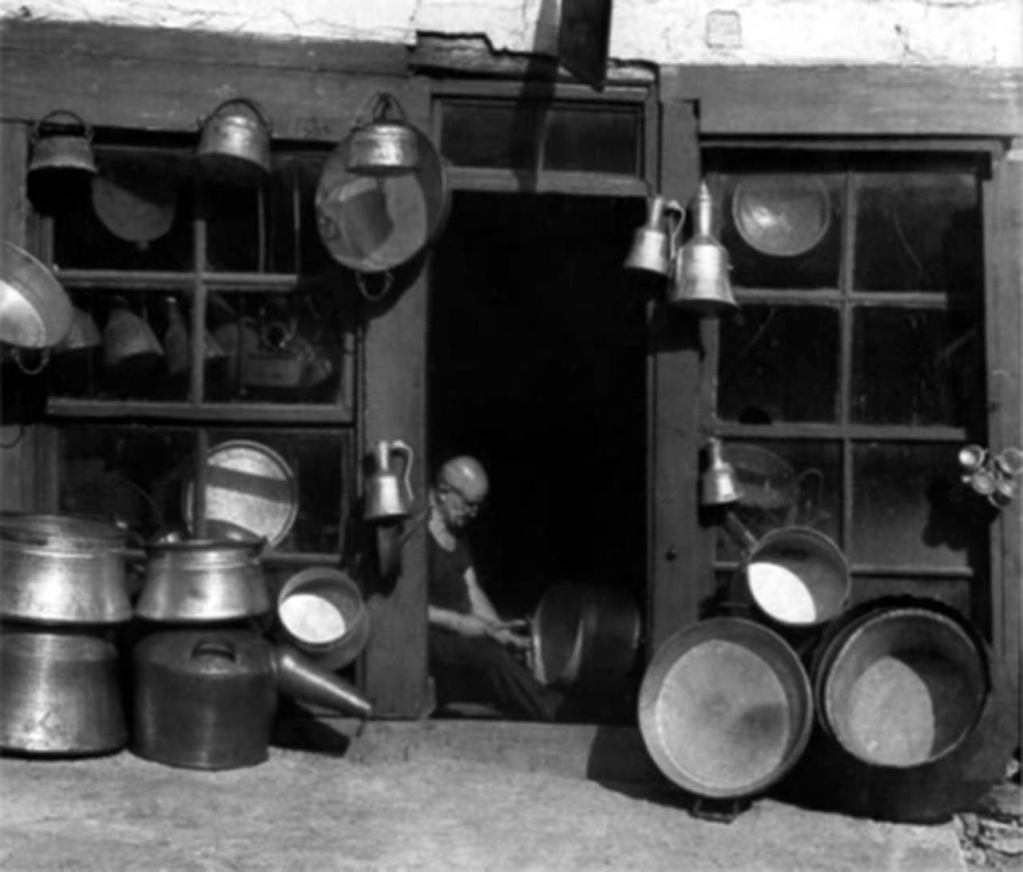
Stefan, an Orthodox, a craftsman.
Dragan Janiqi (janiçijević), who during the time of Albania was educated in the Albanian language as an Albanian student, was the child of a well-known leatherworker in the Tabakëve neighborhood. While Bubi Jani Furra (Furjanović) was a baker by profession and was until recently, during our childhood, known as Jani’s bakery, even though Bubi’s father had died.
Even the butcher Sotir Tili, who later took the surname Tiliq, was an Orthodox Albanian who communicated only in Albanian, even though his family was mixed through the marriages of his children and relatives with Serbs.
Orthodox craftsmen until World War II, like Albanian craftsmen, were known more by profession, which in fact they were known as samarxhi, konoxhi, kallajxhi, terezi, etc. Such was the surname of Velo Kajllajxhiu, who worked with this surname almost until the end of his life as a guard of the church of Shën Premta. According to the memories of Prizren residents, Velo had told his friends that his grandfather had come to Prizren as a tinsmith and that Velo’s father had also taken up this profession, while he himself did not.
Enver continues the story about Velo, who was employed at the Institute for the Protection of Monuments in Prizren, who wanted to preserve the church of Shën Premta, because he told him that it was an Albanian Orthodox church, while he very eagerly went to the Serbian church in Shatërvan, or when he went against his will for the sake of his family, who had already converted to Serbs.
Until the Gogs are remembered as Albanians in the memory of the people of Prizren
That the Gogs were not Serbs is acknowledged by Serbian scholars themselves, especially those who studied before World War II, when Serbian politics had taken a stance that it would no longer recognize the Albanian nationality of all Orthodox and Vlachs living in Prizren. In the forties of the 19th century, the Greek patriarchs in Prizren committed themselves to introducing their language not only in the church, but also in the school.
This was made possible by the arrival of some Gogs and Cincarés from the Ioannina District, who knew Greek in addition to Albanian. During this time, Filip Sotiri was among the first teachers. From 1848 to 1860, the priest of this community was Lazar Naum Petri, also from the Ioannina District. In 1876, the teacher of the Gogs community was Jani Todori, later Todorovic, born in Prizren, who was a student of the aforementioned teachers.
The elderly people of Prizren remember the war years, when many Albanian language teachers came to Kosovo from Albania to teach Albanian students the Albanian language, which until then was forbidden, or could only be learned secretly. “In 1942, when the teacher Myfit Shehu from Tirana came to our school, and in our class, that is, the second grade, several Albanian and Vlach Orthodox students were also registered, to attend lessons in Albanian, a language that they still spoke in their homes.
In my class that year was Spasa Nikolla, later Nikolić, and the daughter of the Albanian Orthodox priest, who later married an Orthodox man in Skopje.” According to Xhemal Hereni, there were also Albanian and Vlach Orthodox students who attended classes in Albanian in other classes, but he does not remember their names, since many of them later changed their surnames and married Serbs and did not express willingness to meet with their classmates.

Even Skënder Cena, who was a student of teachers who came from Albania, remembers the time when even the students of Orthodox craftsmen learned Albanian in school and did not study in Serbian schools. With me in the class was Llaza Spasi, who later changed his surname to Spasić, whom I met several times later, but after he married a Serb and his children did not know Albanian, he felt ashamed to meet us Albanians.
If until the eve of World War II there was data, however poor, on the Albanian Orthodox or Gogs, with the 1948 census and until today, the Albanian Orthodox community or Gogs, the Cincats as they were once called, no longer exist in the communities’ rubrics. If a family declared itself as it felt itself, that is, Albanian Orthodox, or even Vlach, it could only be recorded in the “others” rubric. In the 1948 census, according to Serafin Nikolic, only 35 Turks declared themselves in Prizren that year, while in 1953 and 1961 the rubrics for declaration were: Serbs, Albanians, Turks, Montenegrins and others.
According to their beliefs, the Gogs were Orthodox, just like the Serbs, but they differed both in terms of traditions and in terms of their proximity to the Albanians. “The unwillingness of the Albanians of both faiths to enter into marital relations, faced with a great challenge in life, found support in the Serbs, who, with the aim of conversion, began to marry the Albanian Orthodox and give them daughters and take them for sons.” In this regard, we can say that the lack of religious tolerance led the Orthodox to convert to Serbs.
I remember that many of the Geg artisans openly admitted that they were of Albanian origin. Among them, I can single out Luigj Brisku – a butcher who communicated with the residents only in Albanian. He married a Serbian and his children spoke Serbian. Luigj was a butcher in the Prizren hospital and communicated with Albanian residents.
Gjoka Brisku, the driver at the hospital, did not know Albanian, except for a few words like an ordinary citizen, but not that he felt Albanian or of Albanian origin. Selajdin Krasniqi also tells about Andrea Kosta, an administrator at the hospital, adding that during communications Andrea declared that he was Albanian, who spoke Albanian and that in the Tosk dialect, and I even remember that he said that their language is easier and purer than that of the Gegs. He also married a Serbian, but he never stopped communicating in Albanian.
Until recently, Orthodox Albanians and Vlachs were distinguished from Serbs, in addition to their different traditions, clothing and their special language, since none of them knew Serbian well until World War II. This happened due to the fact that Orthodox Albanian craftsmen, those Vlachs and some Chinese craftsmen spoke the language of Prizren, while when they communicated among themselves they spoke a mixed language such as Albanian with Greek and later Slavic overtones.
Regarding the Gog language, which is different from Serbian, many other Prizren residents also remember, who remember when they were children and listened to the Vlach women, talking among themselves in the streets and alleys of Prizren. Professor Vedat Kiseri remembers some of the sentences that had left an impression on him since he was a child:
– And you saw the video? And what about the wall?
– Damllaga, you’re welcome!(The dammla has drowned him!
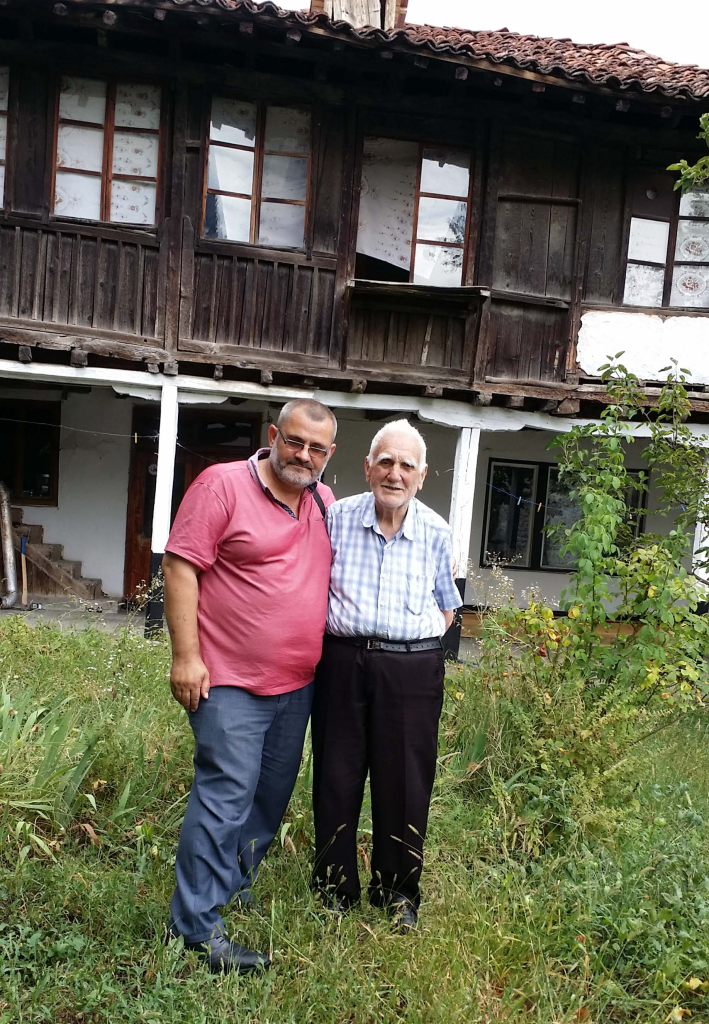
Xhemal Hereni outside of his house.
Vedat Kisieri remembers his long association with the secretary of the SHLP in Prizren, Spasa Nikolla, who later took the surname Nikolić, and his mother, as they called Toço Mona, who communicated only in Albanian, since she did not know a word of Serbian. After his mother died, Spasoja married a Serb from Vojvodina and in this way his family also became Serbized, although he continued to speak Albanian with us education workers and students, he was eventually forced to side with the Serbs.
This path of Serbization was also followed by many other Orthodox Albanian and Vlach families, since those families did not find an agreement regarding the exchange of marriages with Albanians, because in this way they gradually left. In Prizren, but also in Rahovec, many elderly people remember Kosta Vazura, an Orthodox from Elbasan, who had also come with his father as a craftsman and had settled in Rahovec, who told the people of Rahovec that the Albanians are to blame for why my children are written as Serbs.
Kosta Vazura’s two sons, Nikolla Ivica Vazura, although they were registered as Serbs, and were promoted as Serbs, they knew that they were of Albanian origin and could speak Albanian very well. Even Nikolla Vazura, as a judge, who had also managed to be the president of the District Court, pronounced sentences on Albanians accused of irredentism less than Albanian judges.
Many other elderly people from Prizren also have this opinion, because they remember many stories that the Serbs did not believe him. Eshref Kuki remembers a moment when, during the war in 1999, he went to court to ask for help and met Judge Dushan, who told him, “Stop asking for Nikola because he is Albanian and we no longer trust him, but ask for favors, not from him.”
Stanisha Miha, later Stanislav Mihić, whom Prizren residents know by the pseudonym Takushi, worked in Prizren as the first taxi driver, who until 1948 maintained the Tirana – Prizren line. He knew the Albanian language better than any Prizren resident and communicated in Albanian. I remember that his daughters also communicated in Albanian, but after they married Serbs, they also became Serbized.
Aleksandër Toska (Toskiq), a medical technician, had such luck, after he married a Serb, his children became Serbized, but as long as he lived, he communicated in Albanian. Even the sick never realized that Aleksandr was not Albanian. He was a medical technician dedicated to his profession and served Albanian patients with great kindness, especially the poor.
Conclusion
The year 1974, the year of the approval of the constitution for Kosovo, signaled the hope that some of the Orthodox in Prizren could overcome religious “tolerance” and the marriage of those few Orthodox who still felt Albanian could begin, but unfortunately nothing happened since religious tolerance did not soften and then came the year 1981, which finally sank their hope of continuing to preserve the Albanian and Vlach identity.
The lack of religious tolerance of the Albanians, or the jealous and overly rigid protection of the Islamic and Catholic faith, influenced the Serbian church and politics to exploit this weakness of the Albanians, the Albanian Orthodox and Vlachs, primarily through marriages with Serbian girls and the taking of Albanian and Vlach Orthodox girls for the sons of the Prizren Serbs.
On the other hand, immediately after these actions, the lure of the Orthodox with employment in state institutions, especially after 1948. Employment for them was necessary, because after the sixties, the old crafts, which were engaged in by Orthodox craftsmen, began to disappear and no longer bring profits.
The descendants of the Albanian Orthodox, for whom the memory of the people of Prizren remembers where their homes were, what language and traditions they had, after they were Serbized, they were forced in one way or another, in order to be equal to other Serbs, to behave and act against the Albanians. Thus, many of the sons of the Serbized Orthodox, joined the ranks of the Serbian police and army, who killed and burned the homes of Albanians. Therefore, when the Serbs left Prizren, respectively after the entry of NATO and the KLA, their families also moved to Serbia.
Let this initiative serve historians to seriously deal with this topic, which is both interesting and challenging, because such phenomena have accompanied our history at every stage of social developments. And finally, I want to emphasize that the mistakes of the Albanians have forced the Albanian Orthodox to convert and then to fight against their compatriots, just to occupy positions in the environment and circle in which they lived and where they now live. Perhaps one day the descendants of these Orthodox will remember and write a verse about their origins, as Branislav Nushiqi did.
Footnotes
1 Mitrush Kuteli, In Prizren among the dead and the living, published in the cultural magazine “Jeta e Re” 1995, p. 663.
2 Petraq Pepo, Codex of Korça and Selasfor, Tirana, 1981, p. 13.
3 Oral information, August 2017 by Enver Batiu, historian, born in 1945.
4 Petar Kostič, Educational – cultural life of Orthodox Serbs in Prizren and its surroundings in the 19th century and the beginning of the 20th century, Skopje, 1933, p. 23.
5 Petar Kostič, Educational – cultural life of Orthodox Serbs in Prizren and its surroundings in the 19th century and the beginning of the 20th century, Skopje, 1933, p. 23.
6 Oral information of Eshref Kuki, born in 1938 in Prizren, given to the author in August 2017.
7 Brasnillav Nušiš, Razni spisi, Beoigrad, 1936, st. 256.
8 Esat Haskuka, Analyses of the functions of Prizren throughout the centuries, Prizren, 2003, p. 124.
9 Mitrush Kuteli, Cited work, p.662.
10 Mitrush Kuteli, Po aty, p.662.
11 Mihajlo Čemerikić, Prizren and the surrounding area 1019 – 1941, Beograd, 2003, st.66.
12 See more broadly Petar Kostič, Crkveni život, Beograd, 1928, pp. 72-96.
13 Petar Kostič, Prosvetno – kulturni život pravoslavni serba u Prizrenu i gejui okolini u XIX veku i poćetkom XX veka, Skpje, 1933, st.7.
14 Roksanda Timotijević, Crkva Sveti Spasa u Prizrenu, published in Starine Kosova VI -VII, Pristina, 1973, pg. 66-67.
15 Oral data in August 2017 of Anton Franë Çuperian, born in 1930.
16 Oral data in August 2017 of Iljaz Shani Llausha, born in 1932.
17 Oral data in August 2017 of Byrhamedin Bedredin Shehu, born in 1935.
18 Oral data in August 2017 of Byrhamedin Bedredin Shehu, born in 1935.
19 Oral data in August 2017 of Selajdin Ramadan Krasniqi, born in 1948.
20 According to the memory of the people of Prizren, the difference between this name was whether it was with the letter f or v. If it was pronounced Stefan, it was understood that it was Albanian Orthodox, while if it was pronounced and written as Stevan, it was understood that it was Slavic Orthodox, recalls Prof. Vedat Kiseri, who had learned it from Spasde Nikolla, an employee at the Higher Pedagogical School in Prizren.
21 Oral data in August 2017 by Eshref Isuf Kuki, born in 1938.
22 Oral data in August 2017 by Besnik Krajku, born in 1942.
23 Oral data in August 2017 by Agim Paca, born in 1952.
24 Oral data in August 2017 by Kolë Gjon Delhysa, born in 1941.
25 Oral data in August 2017 by Selajdin Ramadan Krasniqi, born in 1948.
26 Oral data in August 2017 by Enver Batiu – historian, born in 1945.
27 Petar Kostič, Prosvetno – kulturni život pravoslavni serba u Prizrenu i čegovoj okolini u XIX veku i poćetkom XX veka, Skopje, 1933, st.6-7.
28 Petar Kostič, Educational and cultural life of Serbian Orthodox Christians in Prizren and its surroundings in the 19th century and the beginning of the 20th century, Skopje, 1933, p.7.
29 Oral testimony in August 2017 by Xhemal Hereni, born in 1930.
30 Oral testimony in August 2017 by Skender Cena, born in 1934.
31 Serafin S. Nikolič, Prizren from the Middle Ages to the Modern Age, Prizren, 1998, p. 370-371.
32 Oral statement in August 2017 of Anton Franë Çuperian, born in 1930.
33 Oral statement in August 2017 of Selajdin Ramadan Krasniqi, born in 1948.
34 Oral statement in August 2017 of Selajdin Ramadan Krasniqi, born in 1948.
35 Oral statement in August 2017 of Xhemal Hereni, born in 1930.
36 Oral statement in August 2017 of Vedat Adil Kiseri, born in 1946.
37 Oral statement in August 2017 of Ethem Rogova, born in 1946.
38 Oral statement in August 2017 of Selajdin Ramadan Krasniqi, born in 1948.
39 Oral statement in August 2017 of Selajdin Ramadan Krasniqi, born in 1948.
Article


 Balkan Academia