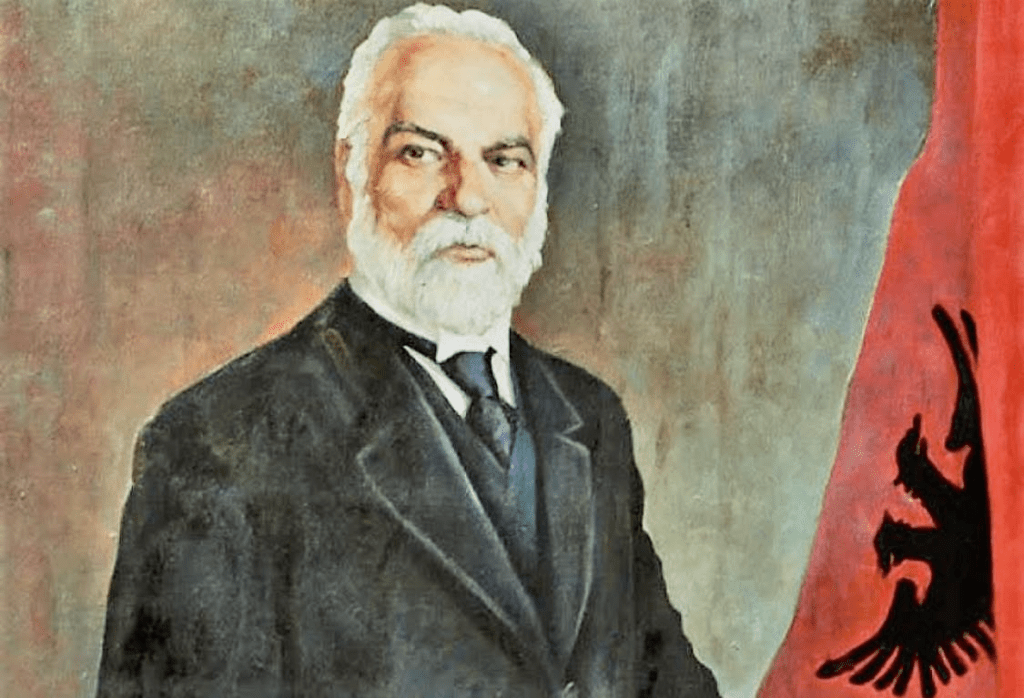

by Shefqet Cakiqi-Llapashtica. Translation Petrit Latifi
From the book: “THE FOUNDER OF ISMAIL QEMALI’S LEADERSHIP” author Evarist Beqiri.
Ismail Qemali’s grandfather, Ismail Bey Vlora, was treacherously murdered in the “Ioannina Massacre (January 5, 1829), along with 18 of his followers, in the Ioannina Castle by the Grand Vizier, Mehmet Reshit Pasha (Darbehori – “the defeated”). The murder of this great Albanian leader was carried out by the Turks in order to put an end to the anti-Turkish movement in Southern Albania.
The severed head of Ismail Vlora was taken to Istanbul and exhibited in its squares. According to historian Dritan Egro, a document was found on the lifeless body of Ismail Qemali’s grandfather, which is preserved in the Istanbul archives. In this document he speaks of the project of Albanian independence, following the example of Greek independence.
The vision of Albanian independence had deep roots in the Vlora family, involving at least three generations of it in this project. Ismail Bey Vlora was killed, but he was not defeated. His vision of an independent Albania was realized by his grandson Ismail Qemal Vlora.
The uprising of 1847, centered in Labëri, marks the first political action where the need for political unity of all Albanians was publicly manifested in order to achieve separation from the Ottoman state and to establish a state of all Albanians. The program clearly expressed the necessity of uniting Albanians of all faiths. In this uprising, for the first time, the demand for the unification of all Albanian lands in an autonomous Albania appeared.
Ismail Qemali’s father was one of the main leaders of this movement, therefore, as a result of the Vlora family’s resistance to the Tanzimat reforms, his father, Mahmud Bey Vlora, his uncle Muhamet (Mehmet) Bey and his cousins Selim Pasha and Mustafa Pasha, were exiled to Konya.
The 1847 uprising, centered in Labëria, which broke out against the measures envisaged by the Tanzimat, should be considered the last Albanian attempt to secede from the Ottoman Empire. Subsequently, seeing the aggressiveness of the neighbors who sought to expand into lands historically inhabited by Albanians, the local elite gave up their attempts to secede from the Ottoman Empire.
Mahmud bey Vlora, son of Ismail bey Vlora and father of Ismail Qemali, one of the organizers of this uprising, in 1853-4, sided with the Ottoman troops in Thessaly to stop the advance of the Greek army, which launched an offensive outside the borders of the independent state, taking advantage of the Ottoman army’s engagement in the Crimean War.
Under these conditions, for the first time, the Albanians felt threatened by their neighbors and the Albanian elite was pushed towards forced choices for a political and military alliance, between the Ottoman Empire and its neighbors (Egro, 2015).
According to Eqrem Vlora, in 1854, because the Ottoman government did not keep its word to pay the volunteers gathered by Mahmud Vlora to defend Ioannina from the Greeks, he also lost all his wealth. For this reason, Ismail Qemali spent a very difficult youth and although, thanks to his excellent intelligence and rare abilities, he reached an important position in the Ottoman Empire, deep in his consciousness the hatred against the Turks always remained alive.”
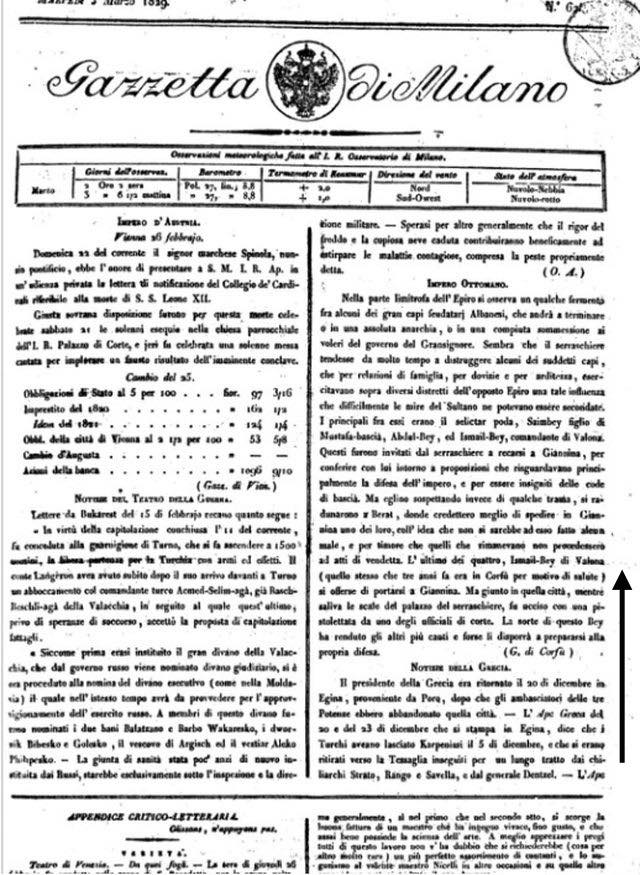
Two, from a series of articles in the European press regarding the event that gave the first and decisive blow to the first attempt for the independence of Albania. The Milan Gazette (March, 1829) and the Florence Gazette (no. 29, March 7, 1829), in their writings that we are publishing for the first time, reflected the treacherous murder of Ismail Bey Vlora, in Ioannina, on January 5, 1829. In the same period, the same news was also reflected by several other European newspapers, such as the Piemontese Gazette, the Brescian Provincial Gazette, the Courrier D’Orient, etc.
Newspaper sources



 Balkan Academia