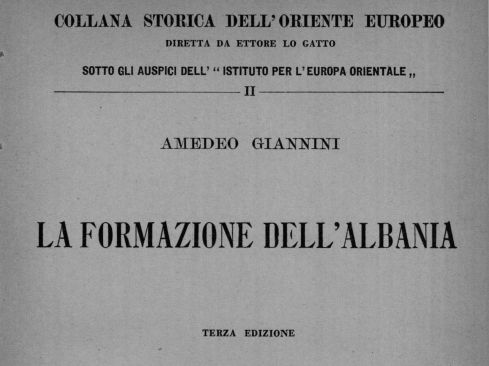

In an important passage from Amadeo Giannini’s La Formazione dell’Albania, the author describes how Greek irredentists associated with the Megali Idea sought to classify the entire Orthodox population of Albania as “Greek.” Giannini notes that this strategy operated partly through the administrative framework of the Ottoman Empire, in which all members of the Orthodox Christian community were registered under the Rum millet. Within this system, however, the term Rum did not signify ethnic Greek identity; it simply denoted adherence to the Eastern Orthodox faith.
This religiously based classification created space for political reinterpretation. Greek national activists attempted to equate the Rum designation with Greek nationality, thereby subsuming Orthodox Albanians into a broader Hellenist expansionist narrative. Such efforts risked obscuring the existence of a distinct Albanian Orthodox population, whose identity was shaped not only by religious affiliation but also by language, regional traditions, and developing national consciousness.
Cited:
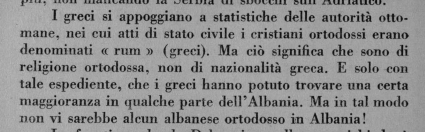
“The Greeks rely on statistics from the Ottoman authorities, in whose civil records Orthodox Christians were referred to as “Rum” (Greeks). But this means that they are of Orthodox religion, not of Greek nationality. And only by this means have the Greeks been able to find a certain majority in some parts of Albania. But in this way, there would be no Orthodox Albanians in Albania!”
Source
“LA FORMAZIONE DELL’ALBANIA” Amadeo Giannini, p.54. OLLANA STORICA DELL’ ORIENTE EUROPEO DIRETTA DA ETTORE LO GATTO SOTTO GLI AUSPICI DELL’ “ ISTITUTO PER L ’ EUROPA ORIENTALE. http://asa.archiviostudiadriatici.it/islandora/object/libria:35183/datastream/PDF/content/libria_35183.pdf


 Balkan Academia