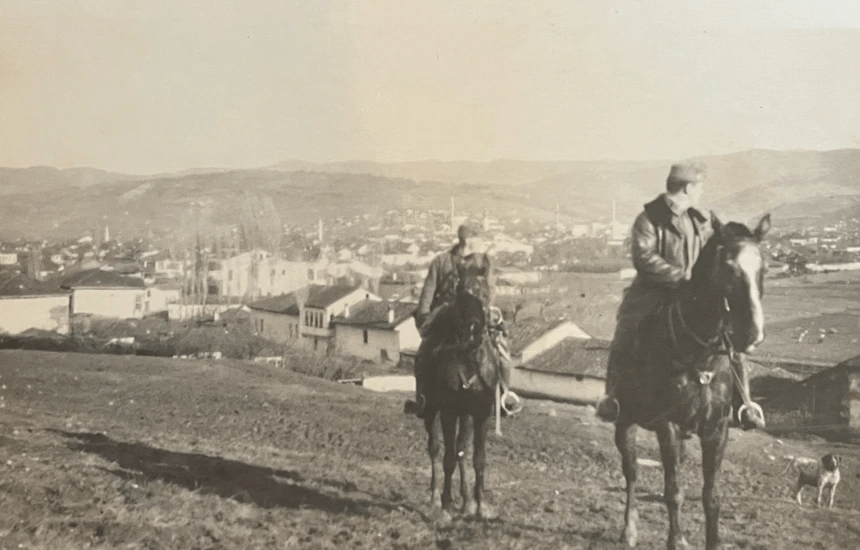

by Skënder Latifi. Translation Petrit Latifi
According to the Serbian census of 1912, which, according to the testimony of police inspector Milorad A. Vujčić, was organized by the police authorities in cooperation with representatives of the local government, Pristina had 18,174 inhabitants. In Pristina in the 1920s, 17 of its inhabitants had Romanian (Cincarë) as their native language, 9 Russian, 5 Polish, 4 German, 3 Czech, 3 French, 2 Slovenian, 1 Italian and 1,433 Pristina residents spoke unknown languages. According to the last census of 1924, Pristina had 2,928 houses with 14,760 inhabitants. So, in a period of 12 years, the current capital of Kosovo had 3,414 fewer inhabitants
The Bulgarian Prefect of Pristina who “had previously lived as an Albanian”
The Prefect of Pristina in the years 1917 – 1918 was Arseni Jovkov (1882 – 1924) from Struga, but before he exercised this function he had emigrated to Bulgaria. Jovkov, in addition to speaking Albanian, on one occasion stated that he had previously lived as an Albanian, which suggests that the Prefect of Pristina would have been a Bulgarianized Albanian, just as many Orthodox Albanians from the present-day areas of North Macedonia were assimilated over the years.
Among the numerous materials archived in the State Archives of Bulgaria in Sofia are those of Bulgarian researchers who, by order of the Bulgarian Army Headquarters, visited the “new territories”, as they called the occupied countries, for the purpose of research. They had stayed in Pristina in the summer and autumn of 1916.
“On August 28, 1916, I returned from Janjev to Pristina and the next morning I spent looking around the city: I visited the main mosque ‘Sultan Fati Mehmed’, which is a large building built in 865 according to the Hijri or 1513 AD,” wrote the researcher Vasil Zllatarski.
He then presented other details from the visit. “In the courtyard of this mosque there are ancient inscriptions (fragments), while the only church ‘St. Nicholas’ is a new building from the beginning of the 19th century with a beautiful iconostasis and carpentry work done by masters from Dibrova.
The motifs and compositions worked by these masters are taken from the Holy Scriptures, such as those in the church ‘Sveti Spas’, in Skopje, and apparently all of these were worked by the same masters of Galishnik, which is chronologically confirmed. According to the Bulgarian deputy bishop of Pristina, the church was built in 1827, while the iconostasis of Skopje dates from 1824.
There is also a mural painting in the church, but it is completely new, from 1902, with Serbian inscriptions on it.” Let us remember that the Albanian masters of Dibra and Reka e Madhe were among the most famous in all the Balkans with their works in churches.
Prof. Zllatarski, like the Serbian journalists, did not miss the opportunity to visit some of the famous places in Kosovo at that time.
“On the afternoon of the same day, I drove to the graves of the Turkish heroes of the Battle of Kosovo in 1389: first to the grave of the Grand Vizier of Sultan Murat in Gazimestan and to that of Sulejman Bajraktar, located on a hill five kilometers northwest of Pristina, from where the heights of Kopaonik are visible.
The graves are located in a round building, which was erected on the site where the two aforementioned personalities fell. I saw that the condition of the buildings was bad and apparently they were not maintained, because the floors were completely rotten, next to the tomb there was also a small building for receiving guests. On the north side, next to the tomb itself, there is a special harem of the hoxha, who guards the tomb of Sultan Murat.
The hoxha is called Ismail Haxhiu, whose family has been taking care of the tomb for almost 150 years. In the same courtyard are the graves of Hafez Pasha (probably the governor of Thessaloniki), Rifat Pasha, Hoxha Ali, the father of the current Hoxha and his brother”, Zllatarski concluded.
“After the First Balkan War, about 2,000 Albanians and Turks emigrated from the city of Prishtina to Anatolia. The majority were emigrants from Prokuplje, Niš and other areas of “old Serbia!”, wrote Stefan Dimitrov, adding that “emigration and displacement have not ceased even today and it is expected that it will continue to do so in the future.
The explanation of the emigration of the population to the Pristina District is found to some extent in the mutual relations between the individual nationalities, on the one hand, and on the other, in the relations of the various regimes established with the two main national groups of the local population.
I have said above that between the Albanians and Serbs of the Pristina District there reigns a great antagonism and it is not of recent times. In the last three years, the Serbian government has took care to strengthen the Serbian element here everywhere, especially in the Pristina Region. For this purpose, the Serbian government was helped by the Serbs of Leskoc, Prokuplje and other Serbian areas, and this government especially helped in purchasing land from Albanians, which were often at negligible prices”.
The researcher Stefan Dimitrov then described several concrete cases of the behavior of the Serbian occupying power towards the local Albanians. “During the Serbian regime, the Albanians in these places could not enjoy the freedom of the right to education, they had no national or even religious rights. The Serbian government treated the Albanians here as Serbs ‘of the Muslim faith’.
Serbian murders, looting and taxing Albanians
But what most angered the Albanians against the Serbian government was the unimaginable economic oppression to which they were subjected. Despite the thefts, looting, murders and tortures that occurred every day on the Albanian population, the taxes imposed by the Serbs were unbearable, in some cases they even exceeded the income of the properties from which they were collected.
Thus, the wealthy citizen of Pristina Shukri Ramadani had to pay 910 dinars in tax for his properties in Cërkvenovodića (near Obiliq), while the income from these properties amounted to only 660 dinars. The same Shukri Ramadani paid 6,500 dinars in taxes for one of his mills.
How the Albanian population was being oppressed through high taxes can be judged by the fact that in 1914, the Municipality of Pristina (the city with the 4 small villages around it) had to pay 400,000 dinars in taxes, and there were even cases, like the one with Hysen Efendi, the representative of the great landowner Fuad Pasha, who submitted a request to the Serbian government that in exchange for paying taxes it could receive all the blessings obtained from the cultivated lands,” Dimitrov concluded.
“The Albanians of Pristina speak in their homes Turkish…”
“The majority population in Pristina is Albanian, but most of them still feel Turkish. Pristina Albanians speak Turkish in their homes, while the speech of Kosovo Serbs differs greatly from that of the Serbs of Šumadija and is closer to northern Macedonian speech and contains many pure Bulgarian words, which Šumadija Serbian does not recognize,” wrote Prof. Atanas Ishirkov, who also provided data on the capital of Kosovo.
“Prishtina is located far from the railway, because the influential Albanians in this city did not want it nearby. Pristina has about 3,000 houses with a population of 15,960 inhabitants. Of these, 11,486 are Albanians, 4,164 are Serbs and 328 are Jews.
There are beautiful old mosques in the city built 300-500 years ago, and there is also a beautiful government mansion here,” concluded Ishirkov, who is one of the rare people who has without hesitation presented the number of Albanian residents in the capital of Kosovo, which unfortunately, as a result of unprecedented circumstances, has changed in the following years.
In twelve years, 3,414 residents “disappeared” from Pristina
Based on the Serbian census of 1912, which, according to the testimony of police inspector Milorad A. Vujčić, was organized by the police authorities in cooperation with representatives of the local government, Pristina had 18,174 residents, while according to the Bulgarian census of 1917, the capital of Kosovo, as mentioned above, had 15,960 residents.
So during the two occupations, the capital of Kosovo had lost 2,214 inhabitants, which, considering the wars that had taken place, namely massacres, expulsions, burnings and destruction of material goods, is hard to believe in this figure.
While in the official census of 1921, two years after the end of World War I, Pristina had 14,338 inhabitants. However, even during this census, as a result of the coercive circumstances imposed by the government, the majority of Pristina residents declared themselves as Turks.
Those registered had to declare their religious and linguistic affiliation as stipulated by the rules of the census organized by the existing state of the Kingdom of Serbs, Croats and Slovenes. In the relevant census, 9,684 Pristina residents declared themselves Muslims, 4,191 were Orthodox, 322 were Israelis, 124 were Roman Catholics and 17 Pristina residents declared themselves Evangelicals.
While 7,115 Pristina residents had chosen Turkish as their mother tongue, 4,325 Serbo-Croatian, 1,421 Pristina residents still had not given up their mother tongue – Albanian. In Pristina of the twenties, 17 of its residents had Romanian (Cincarët) as their mother tongue, 9 Russian, 5 Polish, 4 German, 3 Czech, 3 French, 2 sSlovenian, 1 Italian and 1,433 Prishtina residents spoke unknown languages. While eight years later, according to the last census of 1924, Prishtina had 2,928 houses with 14,760 inhabitants. So in a time frame of 12 years, the current capital of Kosovo had 3,414 fewer inhabitants.
Source

 Balkan Academia