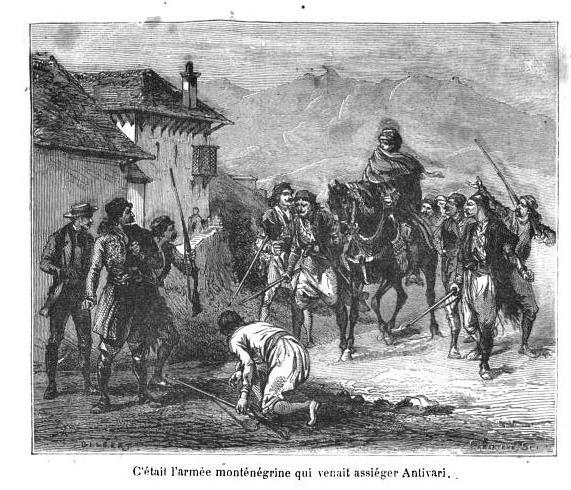

In the Austrian report “Oberalbanien und seine Liga ethnographisch-politisch-historisch geschildert” by Leo Brenner from 1881, we can read that Tivari (Antivari) had roughly 8,000 Albanian inhabitants. After the Montenegrins invaded the city, 7500 Albanians died or fled. Other valuable information in this publication dates from Bolizza (1615), Hahn (1850s), Hecquard & Sax (1858-1864), and 1877. All names given in this article have been restored to their original Albanian forms due to having been slavicized and serbicized over the centuries.
Cited:
“Before the siege:
- 8,000 inhabitants in Antivari and its suburbs.
Afterwards:
- Reduced to about 50, most having died or emigrated.
The whole district is now under Montenegrin rule, except Spica, which belongs to Austria.”
District of Tivari (Antivari) in 1876-1877
Size of the population (According to Sax)
The district covers 380 km².
Coastal region
4,300 Greeks
4,500 Muslims
2,500 Catholic Serbs
Lakeshore region (Krajna):
1,600 Catholics
5,100 Muslim Albanians
2,500 Catholic Serbs
According to Hecquard:
9,000 Muslims
4,500 Greeks
3,000 Catholics
250 Roma
Total: 16,750 inhabitants
Population distribution (According to Sax)
Antivari / Tivari
| Source | Muslims | Catholics | Greeks | Roma |
|---|---|---|---|---|
| Map | 2,500 | 600 | 650 | 200 |
| Book | 2,800 | 850 | 650 | — |
Dobravoda
| Source | Muslims | Catholics | Greeks | Roma |
|---|---|---|---|---|
| Book | 1,200 | — | 600 | — |
| Map | 1,800 | — | — | — |
Albanian regions and villages (Sax)
| Locality (Alb. form) | Muslims | Catholics | Greeks | Roma |
|---|---|---|---|---|
| Mrkoviq (Markaj) (350 families) | 3,100 | — | — | — |
| Tujgjemilë | 1,200 | — | — | — |
| Seoca (Seocë) | — | — | 300 | — |
| Krivice Krivicë | — | — | 100 | — |
| Shestani | — | 400 | 650 | — |
| Muriq | 250 | — | — | — |
| Livari | — | — | 500 | — |
| Zubçi | — | — | 450 | — |
| Šušanj (Shushanj) | — | — | — | — |
Populus according to Hahn (1850s)
City of Antivari (Tivari)
430 houses, 610 families, 3,200 inhabitants
2,350 Muslims
420 Catholics
370 Greeks
60 Roma
Other regions (Hahn)
| Locality (Alb.) | Catholics | Greeks | Muslims | Notes |
|---|---|---|---|---|
| Shestani | 579 | — | 320 | Albanians |
| Livari | 440 | — | ~320 | Albanians |
| Tujgja (Tugjemile) | — | — | 210 | 44 houses |
| Zubç | 83 | — | — | Total 440 Catholics |
| Shushan (Šušanj) | — | — | 420 | — |
| Shpica (Spica, Spizza) | 137 | 105 | 520 | — |
| Mrkoviq | 395 | — | 2,890 | ~20 Catholics |
Depopulation After the Siege (1877)
Before the siege: ~8,000 inhabitants. After the siege: only ~50 remained. The rest either died or fled to Ulqin, Shkodër, or inland Montenegro. The entire district became Montenegrin, except Shpica (Spizza), which remained under Austria.
Bolizza’s List (1614)
| Locality (Alb. form) | Catholics | Muslims | Captain |
|---|---|---|---|
| Tivari | 500 | 500 | — |
| Shpica (Spizza) | 60 | 150 | Gjergj Marku |
| Shushan | 40 | 80 | Dumë Liçi |
| Shušta (Suissa) | 40 | 87 | Pjetër Viti |
| Tubat (Tubaz) | 42 | 37 | Nikollë Peraj |
| Tujgja (Togliemeddi) | 30 | 70 | Vukë Shtrepi |
| Muliq | 25 | 60 | Luka Matushku |
| Dobrivoda | 40 | 100 | Radë Gjuroviqi |
| Mrkoviq | 260 | 1,000 | Dumë Liçi |
| — | — | — | Mark Niko (Nika) |
Other regions (Hahn)
| Locality (Alb.) | Catholics | Muslims | Captain / Leader |
|---|---|---|---|
| Goranë (Gorana) | 20 | 45 | Dumë Luçi |
| Kunja (Cumgni/Kunja) | 20 | 46 | Shukë Gjura |
| Kruta (Crutte/Krüta) | 30 | 75 | Gjuro Çeka (Gjergj Çeka) |
| Salçi | 15 | 40 | Pepa Mealji |
| Gradojeviq (Gradë) | 50 | 130 | Gjergj Marku |
| Podi | 39 | 80 | Pjetër Vuka |
| Raca | 25 | 54 | Gjokë Gjonkoi |
| Gjonkoviqi (Gjonaj) | 30 | 70 | Gjergj Strepja |
| Pagran / Pagrag (Andrea Druni) | 60 | 130 | Pepë Gjuri |
Sources and references
Oberalbanien und seine Liga ethnographisch-politisch-historisch geschildert. Leo Brenner. 1881. p. 254-255.
Bolizza (1615)
Hahn (1850)
Hecquard & Sax (1858-1864) “Histoire et description de la haute Albanie”.
Note: All names given in this article have been restored to their original Albanian forms due to having been slavicized and serbicized over the centuries. Onomastical reconstruction of this type is done by Paul Kretschmer, Jireček, Shaban Demiraj, Eqrem Çabej, Noel Malcolm, Matteo Mandalà and Gustav Weigand.

 Balkan Academia