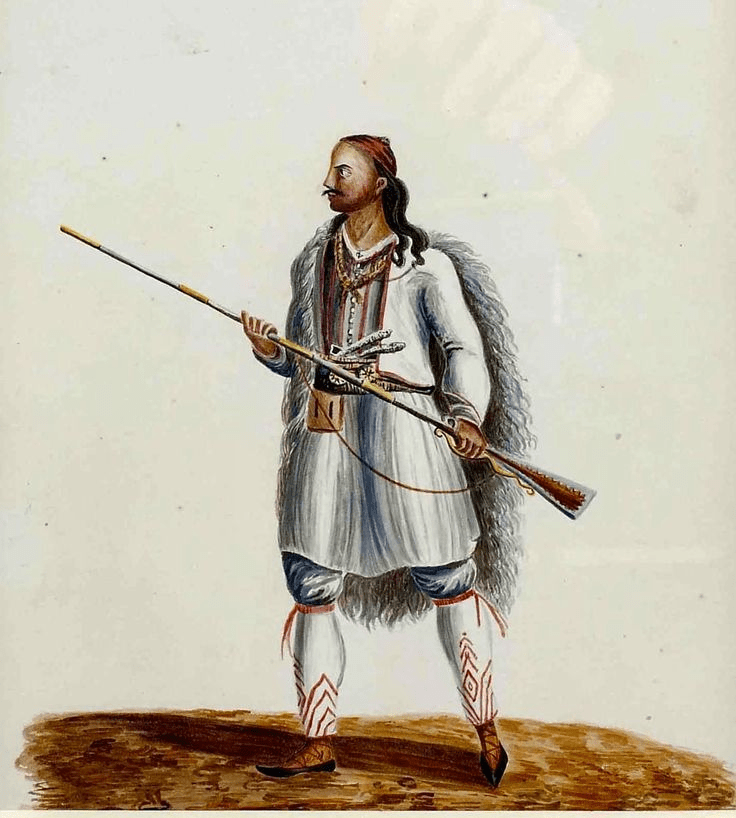

In Albanian highland folklore, especially in the 19th century, there are several anecdotes about shepherds whose rifles misfired – not as an ethnic trait, but as a narrative symbol for precarious life in the mountains, unreliable weaponry, and the thin line between survival and misfortune.
Folk narratives across mountain societies often contain what folklorists call misfortune motifs: recurring narrative patterns in which an object or action fails at a decisive moment, revealing the tension between human agency and an unpredictable world. In the nineteenth-century Albanian highlands, one such motif appears in anecdotes of shepherds whose rifles misfired at precisely the wrong moment.
As seen in accounts surrounding figures such as Avdi Hysa (1862), the failure of the firearm becomes a compressed moral and existential drama. The tool on which personal safety depends betrays its owner, and this betrayal is interpreted as an instance of fate rather than mechanical accident.
Irish motives
This Albanian motif has parallels in several other cultures. In Irish rural folklore, misfortune is commonly embodied in the refusal of everyday tools to function as intended: the horse that stumbles on a flat road or the churn that refuses to yield butter. These stories express a worldview in which the material world retains a trickster-like independence. The idea of “Irish bad luck” belongs to this broad pattern.
Scottish motives
Comparable motifs appear in the Scottish Highlands, where eighteenth- and nineteenth-century hunting tales describe rifles that “forget their aim” or lose reliability when supernatural forces intervene. Here, technical failure serves as a symbolic sign of imbalance or a warning from the unseen world.
Japanese motives
In Japanese folklore, tales of household tools that malfunction or turn against their owner (tsukumogami traditions) similarly emphasize the unpredictable agency of objects, which may act contrary to human intention. A related pattern occurs in Navajo and Apache traditions of “bad medicine days,” when weapons or animals refuse to cooperate, indicating a break in the individual’s harmony with the world.
Epirus
In Epirus and other Greek mountain regions, narratives mention rifles that “go deaf” without warning, often conveying the precariousness of life at the margins of state control.
Albanian “bad luck”
The Albanian misfire motif can therefore be situated within a wide comparative field. It expresses the vulnerability of individuals in rugged environments, the fragility of technology before natural forces, and a subdued fatalism in which misfortune is part of the world’s moral texture rather than a purely accidental occurrence.
Historically, it also reflects the real technical unreliability of black-powder firearms, which misfired frequently due to humidity, poor maintenance, or substandard powder. Folklore converts these material limitations into metaphors of fate.
A possible theoretical formulation would be that the Albanian misfire motif belongs to a pan-Eurasian and trans-Indigenous complex of narratives in which the failure of tools at crucial moments symbolizes the chronic instability of human life under pre-modern conditions.
Similar motifs have been noted in Mediterranean mountain folklore (notably in the works of John K. Campbell), in Irish narrative tradition (Séamus Ó Catháin; Henry Glassie), and in cross-cultural analyses of object agency (Alfred Gell; Arjun Appadurai).
References:
Alfred Gell, Art and Agency (1998).
John K. Campbell, Honour, Family and Patronage (1964).
Henry Glassie, Passing the Time in Ballymenone (1982).
Séamus Ó Catháin, The Festival of Brigit (1995).
Arjun Appadurai (ed.), The Social Life of Things (1986).
Michael Herzfeld, Ours Once More: Folklore, Ideology, and the Making of Modern Greece (1982).
Jun’ichi Konuma, studies on tsukumogami and Japanese material folklore (various articles).

 Balkan Academia