
Abstract
This text highlights the distinctive position of the Albanian language within the proposed Indo-European phylogeny. Unlike the majority of Indo-European branches that descend from Corded Ware populations, Albanian is interpreted as the surviving legacy of an early, direct Yamnaya migration into the Balkans during the Early Bronze Age. In this framework, Albanian represents the oldest Yamnaya-derived linguistic stratum in the region, preceding the later Yamnaya-derived populations that gave rise to the Greco-Armenian clade. This perspective clarifies why Albanian preserves unique structural and historical features and offers a coherent explanation for its divergence from both neighboring Balkan languages and the broader Corded Ware–derived Indo-European world.
Who is Dr. Iosif Lazaridis?
Dr. Iosif Lazaridis is a prominent researcher in ancient DNA and human population genetics, especially known for his work on prehistoric migrations and the genetic history of Europe and West Asia.
Who he is
He is a Senior Staff Scientist in the David Reich Lab at Harvard Medical School’s Department of Genetics, where he conducts research in human evolutionary biology and archaeogenetics.
Education and background
Born in Kavala, Greece in 1976, he completed his undergraduate degree at the National Technical University of Athens and then earned his M.S. (2002) and Ph.D. (2006) in Information and Computer Science from the University of California–Irvine.
Initially trained in computational and data science, he later applied that expertise to the analysis of large-scale genetic data, particularly in ancient DNA studies.
Research contributions
Dr. Lazaridis is widely cited for his contributions to understanding the genetic foundations of ancient human population movements and their connections to modern populations. His work includes:
Ancient DNA studies of European ancestry, showing that present-day Europeans derive ancestry from multiple ancient groups including hunter-gatherers, early farmers, and ancient north Eurasians.
Research on the genetic history of the Southern Arc, bridging Europe and West Asia, which has shed light on migration and admixture patterns through the Neolithic and Bronze Ages.
Collaborative projects on the genetic origins of Bronze Age civilizations, such as the Minoans and Mycenaeans, helping clarify how ancient populations mixed and contributed to later groups.
Contributions to recent high-profile studies on the genetic origins of the Indo-Europeans, combining genetic data with archaeological and linguistic contexts.
Why he matters
Dr. Lazaridis’s work is central to modern archaeogenetics: by analyzing ancient genomes and patterns of genetic ancestry, he has helped reshape how researchers understand prehistoric migrations, cultural interactions, and the deep origins of populations across Eurasia.
Background
The author appears to approach the subject from an interdisciplinary perspective, drawing on recent advances in archaeogenetics, Bronze Age archaeology, and comparative historical linguistics. Their writing reflects familiarity with genome-wide ancient DNA studies, phylogenetic models of language evolution, and the cultural sequences of the Eurasian steppe. The author’s focus on synthesizing multiple lines of evidence suggests a research background or strong scholarly interest in Indo-European origins, population history, and the interaction between linguistic and genetic data.
Albanian and a synthesis of genetic, archaeological, and Linguistic evidence for a revised Indo-European phylogeny
“And 99% of Indo-European speakers stem from Corded Ware ancestors. It is only three small groups: Greeks, Armenians, Albanians who go up to the Yamnaya not via Corded Ware intermediaries. Many others were wiped out linguistically, e.g. Tocharians and most Paleo-Balkan speakers.
Under this theory, Greco-Armenian is a valid linguistic clade while the shared features between Greek and Indo-Iranian (that have caused some to postulate a Greco-Aryan clade) are the result of areal contact on the steppe.
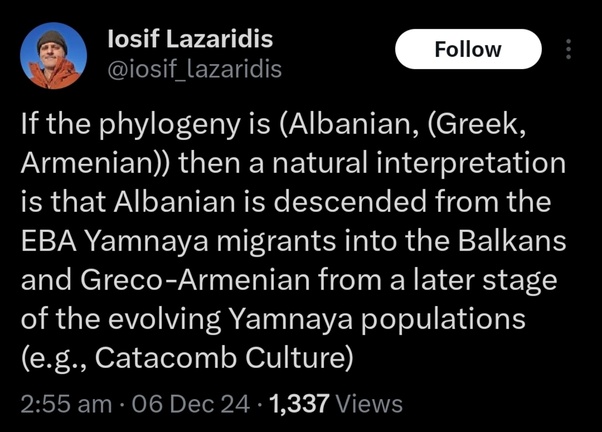
If the phylogeny is (Albanian, Greek, Armenian) then a natural interpretation is that Albanian is descended from the EBA Yamnaya migrants into the Balkans and Greco-Armenian from a later stage of the evolving Yamnaya populations (e.g., Catacomb Culture).”
Commentary
The text offers a sharp and well-reasoned synthesis that unifies genetic data, archaeological migration models, and linguistic relationships into a single explanatory framework. By distinguishing Yamnaya-derived lineages that expanded through the Corded Ware horizon from those that did not, the author clarifies the historical mechanisms behind the present-day Indo-European linguistic landscape.
The proposed model is particularly valuable in accounting for the structural distinctiveness of Greek, Armenian, and Albanian, and in explaining why certain ancient branches—such as Tocharian and the Paleo-Balkan languages—were lost while others persisted. Overall, it is a compelling and integrative contribution to the ongoing debate about Indo-European origins.
Sources
“The genetic origin of the Indo‑Europeans” — I. Lazaridis, N. Patterson, D. Anthony et al. (2025).


 Balkan Academia