
Abstract
This study examines documentary references to Albanians and figures active in Albanian-inhabited regions during the late thirteenth and early fourteenth centuries, with particular emphasis on the coastal and inland areas between Scutari, Ulqin, Antivari, Budva, and the hinterland around Tuzi. Drawing on ecclesiastical, diplomatic, and administrative sources, it identifies priests, nobles, and urban citizens explicitly connected to Albanian territories. The concentration of clerical figures near Tuzi in 1335, alongside evidence of Albanian civic life in Antivari and Ulqin, demonstrates a stable and well-organized Albanian presence. These records collectively attest to the continuity of Albanian settlement, religious structures, and local leadership in the region during the medieval period.
14th century Albanians
By the beginning of the fourteenth century, written sources attest to a dense and continuous Albanian presence in the coastal and inland regions between Scutari, Ulqin, Antivari, Budva, and the hinterland around Tuzi. These attestations appear primarily in ecclesiastical, administrative, and diplomatic records, revealing local communities governed by priests, nobles, and civic officials bearing names that are recognizably Albanian or operating explicitly within Albanian territories.
In the early decades of the century, Antivari and Ulqin emerge as important urban centers inhabited by Albanian citizens. Individuals such as Grube de, recorded between 1319 and 1333 as a citizen of Antivari, demonstrate the existence of an established Albanian urban population with legal and civic status. Earlier figures such as Lazarus, brother of Corpolat and citizen of Ulqin in 1242, provide continuity into the fourteenth century.
The rural hinterland is especially well documented in the year 1335, when numerous parish priests are recorded as serving communities near Tuzi. Lazor, Peter Kuč, Demetrius, George Grataj, Suma Mareus, and Petrus are all explicitly described as pastors operating “prope Tuzi,” indicating a network of Albanian-speaking Catholic parishes in the interior. These clerics attest not only to religious life but also to settled village communities under ecclesiastical administration.
Alongside clerical figures, secular Albanian leadership is also visible. Galuh is described as a lord near Tuzi in 1335, while Golem, recorded as an inhabitant of the village of Kuševo in the same year, bears a name widely recognized as Albanian. Earlier, Golemm, identified in 1253 as an Albanian prince, represents the continuity of native Albanian elites into the later medieval period.
Geographically, the sources situate Albanian life in clearly defined localities. Villages such as Godinje near Scutari, Kruševica near Lake Scutari, Kućeva near Budva, and districts such as Vlastake in Albanian Krajina appear repeatedly. The mountain region of Spizza (Spič) is likewise named as a distinct territorial feature within this Albanian-inhabited zone.
Ecclesiastical continuity further reinforces this picture. Albanian bishops, abbots, and priests are attested from the twelfth century onward, culminating in a well-organized clerical structure in the fourteenth century. The Monastery of Saint Savior of Arbanum, Albanian bishops of Kruja, and priests of Scutari demonstrate the integration of Albanian communities into the broader Latin Christian world.
Taken together, the evidence from the early to mid-fourteenth century reveals a landscape in which Albanians are not marginal or newly arrived, but firmly rooted as villagers, townsmen, clergy, and local lords. The density of references around Tuzi in 1335, combined with sustained urban attestations in Antivari and Ulqin, confirms the presence of stable Albanian communities across both coastal and inland regions during this period.
Albanians mentioned between 1166 and 1335
Slau Zand de; Elericus of Ulqin (1242)
Slau Zand and Eleric of Ulqin, attested in 1242.
SPIZZA (Spič, Capië)
Spizza (Spič, Capië), a mountain belonging to the Ertae, with recorded elevations between 647 and 679 meters.
Julian, bishop of Illyricum (424)
Julianus, Bishop of Illyricum, attested in 424.
Julianus Marinus (Dyrrhachiensis) (1248)
Julianus Marinus of Durrës, attested in 1248.
Lazarus, episcopus Albanensis (Croensis) (1166–1167)
Lazarus, Bishop of Albania (of Kruja), attested in 1166–1167.
Lazarus, diaconus Drivastensis (1251)
Lazarus, deacon of Drivast, attested in 1251.
Lazarus, frater Corpolati, civis Ulciniensis (1242)
Lazarus, brother of Corpolat, citizen of Ulqin, attested in 1242.
Lazor, pastor prope Tuzi (1335)
Lazor, parish priest near Tuzi, attested in 1335.
KRUŠEVICA, village near Truovo, on Lake Scutari
Kruševica, a village near Truovo on Lake Scutari.
Kuč Petrus, pastor prope Tuzi (1335)
Peter Kuč, parish priest near Tuzi, attested in 1335.
KUĆEVA (Cucere, Cocoa), region near Budva
Kućeva (also called Cucere or Cocoa), a region near Budva.
Demetrius (Dimitrius), pastor prope Tuzi (1335)
Demetrius, parish priest near Tuzi, attested in 1335.
Georgie Grataj, pastor prope Tuzi (1335)
George Grataj, parish priest near Tuzi, attested in 1335.
Georgius, abbas monasterii Sancti Salvatoris Arbanensis (1166)
George, abbot of the Monastery of Saint Savior of Arbanum, attested in 1166.
GODINJE, vicus ad locum Scutarensem
Godinje, a village in the region of Scutari.
Golemm (Γουλάριος), princeps Albanensis (1253)
Golemm (Gularios), Albanian prince, attested in 1253.
Golem, incola pagi Kuševo (1335)
Golem, inhabitant of the village of Kuševo, attested in 1335.
Galuh, dominus prope Tuzi (1335)
Galuh, lord near Tuzi, attested in 1335.
Suma Mareus, pastor prope Tuzi (1335)
Suma Mareus, parish priest near Tuzi, attested in 1335.
Petrus, pastor prope Tuzi (1335)
Peter, parish priest near Tuzi, attested in 1335.
Messia (Misie) Petrus, sebastus et baro Albanensis
Peter Messia (or Misie), sebastos and baron of Albania.
Vitus, presbyter Scodrensis (1251)
Vitus, priest of Scutari, attested in 1251.
VLASTAKE, pagus in Krajina Albanensis
Vlastake, a district in Albanian Krajina.
Zan, diaconus Ulciniensis (1242)
Zan, deacon of Ulqin, attested in 1242.
Zore (Care, Cari, Zare), civis Antibarensis
Zore (also Care, Cari, or Zare), citizen of Antivari.
Grube de, civis Antibarensis (1319–1333)
Grube de, citizen of Antivari, attested between 1319 and 1333.
1261, 18 February
Grobina of Dulcigno, elected by the Cathars to consecrate a church, is present.
1273, 18 April
A general council is ordered to be convened in Albania at Lyons.
1273, 30 April
Saracen archers receive arms to be sent to Albania.
Source
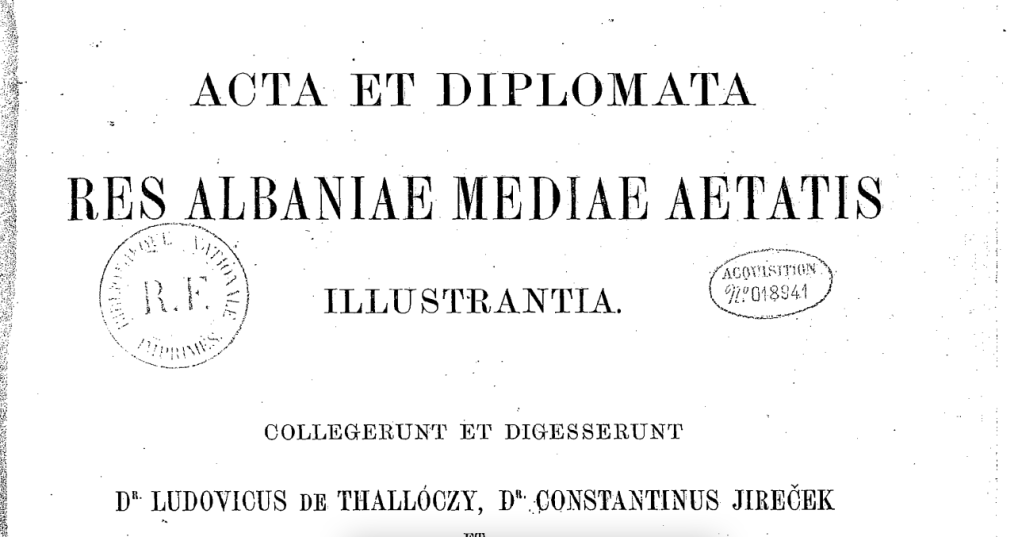
Acta et diplomata res Albaniae mediae aetatis illustrantia. Collegerunt et digesserunt dr Ludovicus de Thalóczy, dr Constantinus Jireček et dr Emilianus de Sufflay. Volume 1. 1913


 Balkan Academia