
by Vasel Gilaj. Translation Petrit Latifi
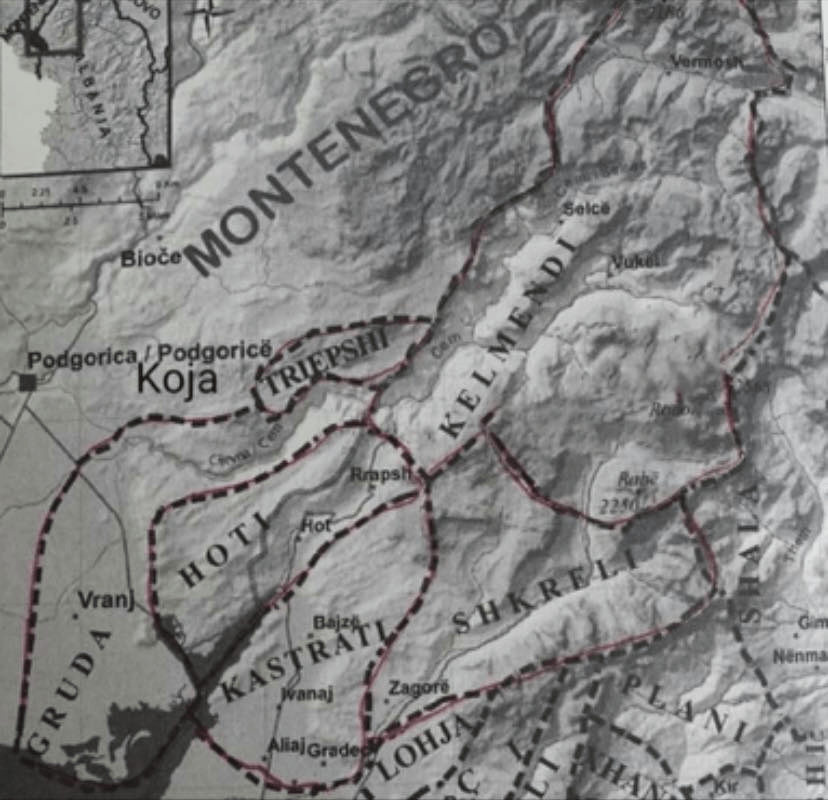
The name Hoti is first mentioned in 1330. In 1446, Hoti had a border conflict with the tribe, which had not been heard from since, as Rovinsky writes, the Mataguzhi tribe, which lived near Tuzi. The Hoti legend begins with the story that Hoti, together with Grude, before the arrival of the Turks, had had fierce battles with the Bosniaks; the most accurate history of the tribe begins with a certain Keci, who lived 13 generations ago, around 1520 in Piperi, in Montenegro.
He had many sons: Lazer, Ban, Kastr, Merkot, Vash and Piper. Lazri is the first of the Hotjans; The other sons belong to the Triepshians, then, as it is said, the tribe of Krasniqi, Vassojević and Piper, while the tribe of Krasniqi in this dialect is called kastravic, which seems a bit contrived and more reminiscent of Kastrati with the suffix vic.
After a murder, all the sons of Keci had to flee from Piper and only the oldest, Keci, and the youngest son. Piper, were given permission to stay on their old land. Lazer Keci and Ban Keci went to Triepsh, but when their herds increased so much that they could not be fed in Triepsh, the two brothers divided their wealth and Lazri went further south.
According to a decision, in the future the border between the two brothers would be clear. Lazri, climbing the southern slope of the lem, noticed that he had mistakenly taken a kopje of Ban, but, so that he would not return to Triepsh, he called his brother from afar to give up the designated border and, in exchange for the kopje, he gave his brother the northern slope of Bukovik, which descends to the Cemi Stream.
Thus, the new border between Hoti and Triepsh became Bukovik. Lazri’s descendants did not want to recognize the new border and therefore even today the northern slope of Bukovik is the bone of contention between Hoti and Triepsh.
From Lazri’s only son, Gega, other Hotjan chieftains descend and even Pjeter Gega founded, as Hahn calls it, Trabonje; the other sons Gjoni, Laj and Jumi are the chieftains of the Rapsha tribe. The descendants of John live in Brigje (Bridza). It is said that Kusha was separated from Trabonja 12 generations ago; about the Vuksan – Lekaj faction I have been able to learn something positive so far, that it is derived from the Hoti tribe and that the first of this faction, Vuksa, the son of a Leka clan, lived 5 generations ago, that is, approximately in 1788.
The village of Vuksan – Lekaj, or rather its colonization by the Hotja people, is of a relatively recent date. Then I also learned that the entire land of Hoti and Gruda, before the settlement of these tribes, had been inhabited by Bosniaks. The last wars with the Bosniaks, which Gojedhena mentions, took place, according to her, in Qafe e Kishit during the time of Djeloš Leka and Vuksan Leka, that is, at the time when a part of the Hotja people invaded, starting from Traboja, the land inhabited by Vuksan Lekaj. The remnants of the first inhabitants still live today in Bozhaj, Izhm and Staja.
Ujk Luci
The Hotjans were valued during the time of the Turks as the first banner of Malsia se Madhe and had at that time the privilege of taking their place on the left wing of the Turkish army in every battle. They owed this to the heroism of Ujk Luci, since he, with the help of people from the center, had played a major role seven generations ago, when Ulcinj was conquered by the Turks; then Ujk Luci gained the privilege of not paying market taxes, as was customary, whenever he tied his horse to the entrance to the Shkodra market.
Ujk Luci later converted to Islam and is the ancestor of the Muslim families that are found today in Hot. Unfortunately, the name Ujk Luci is missing from our fragment in the genealogical tableau. The fact that he lived 7 generations ago takes us to 1687 and therefore it is interesting that the Turks actually won a battle in Ulcinj in 1696.
This is also another proof of the accuracy of our method, which we have used in the reconstruction of the history of the Albanian tribes. Although he became a Muslim, the custom continued for every descendant of the Bajraktar to celebrate Saint John on August 29, to hear mass and then to host a feast. Population about 4000, houses 500.
Reference
Taken from the book; “The Tribes of the Highlands of Northern Albania and Their Customary Law”. “Eneas” Publications. Translator Dr. Jur. Mihallaq Zallari. Editor for publication; Acad. assoc. Marenglen Verli & Dr. Edmond Malaj.


 Balkan Academia