
Abstract
This article examines the life of Count Niklas von Markovich (born 1751) and his actions around the Adriatic, a region shaped by Albanian, Dalmatian, Venetian, Hungarian, and Ottoman powers. Focusing on Markovich, this article traces the decline and adaptation of the House of Spizza following Ottoman invasions. It discusses Markovich’s military career, travels, and political ambitions, as well as his inherited prestige among Albanian communities. Special attention is given to linguistic and cultural transformations, including the possible Albanian origins of the family name and its later Slavic form.
Markaj family
The history of the Markovich (Markaj) family belongs to the Adriatic borderlands where Albanian, Dalmatian, Venetian, Hungarian, and Ottoman spheres met. Rather than attempting a full reconstruction of the family’s genealogy across several centuries, this text focuses on Count Niklas von Markovich, born in 1751, whose life illustrates both the persistence and the transformation of an old frontier noble lineage. His career unfolded in a period marked by Ottoman expansion, imperial rivalry, and the gradual decline of traditional aristocratic power.
Family tradition places the original power base of the Markovich lineage in Albania, with the castle of Spizza as its principal seat. Spizza lay between Scutari and Antivari and controlled a fertile and strategically important coastal territory. From this position the family exercised military authority and maritime influence.
According to preserved charters and later accounts, the family received imperial recognition for its service against piracy and Ottoman expansion, most notably in a charter issued by Emperor Charles V in 1541. Earlier traditions trace the family’s noble status back to the twelfth century, reflecting a long-standing self-image of imperial legitimacy typical of Adriatic frontier elites.
Change of name
The Ottoman conquest of Albania and Greece marked a decisive decline in the family’s fortunes. As Ottoman rule expanded through both military force and the fragmentation of Christian political authority, the Markovich family lost much of its land and influence. One branch remained under Ottoman control, where survival required accommodation and, in some cases, changes to the family name.
Other branches dispersed. One returned to Hungary, where its descendants gradually lost clear noble distinction. Another withdrew to Venetian Dalmatia, settling in Budva, a city near the Albanian border within the territory of the Republic of Venice. From this line descended Count Niklas von Markovich.
Budva belonged administratively to the district of Antivari, a Catholic center with strong Venetian connections. The Markovich family held the status of patricians in Budva and nobles of Antivari, placing them within Venetian civic and military structures while keeping close ties to the Albanian and Montenegrin hinterlands. This position reflects the character of Adriatic border nobility, which was shaped less by fixed ethnic identity than by religion, service, and regional influence.
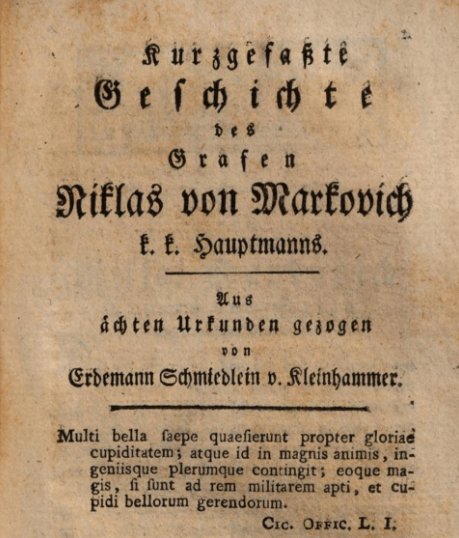
Count Niklas von Markovich (b. 1751)
Count Niklas von Markovich was born on 5 December 1751. His father, Raphael Markovich, Count of Spizza and patrician of Budva, was described as a man of advanced age but undiminished martial spirit, formed by decades of frontier warfare against the Ottomans. Niklas was sent to Padua for education, where he showed ability in the sciences. Nevertheless, his temperament inclined strongly toward military life rather than clerical or administrative careers. He sought experience in border regions where conflict and movement offered what he regarded as a more suitable form of education.
While still young, he joined maritime expeditions along the African coast and participated in raids with Montenegrin forces against Ottoman borderlands. During the Russo-Turkish War of 1768–1774, he entered Russian service and took part in naval operations. Contemporary accounts emphasize his extraordinary mobility.
He traveled extensively through Albania, Dalmatia, Italy, the Greek mainland and islands, the Adriatic coast, and North Africa. These journeys were not merely adventurous but observational. He paid close attention to geography, natural resources, political institutions, and local customs, gathering information in an informal but systematic way.
Albanians respected him for his family name
Several sources stress his particular standing among Albanians, noting that he was respected not only for his personal qualities but because of his family name. This suggests inherited authority rooted in long-standing regional ties. The form of the surname Markovich may reflect a Slavic rendering of an earlier Albanian clan name, such as Markaj, a common phenomenon in the multilingual administrative environments of Venetian and Habsburg borderlands. Catholic Albanian families in particular often adopted different name forms depending on political and linguistic context.
Markovich also enjoyed influence among Herzegovinians and Montenegrins and maintained close relations with bishops and church leaders. He pursued political projects aimed at strengthening cooperation among these neighboring peoples and at drawing the Montenegrins closer to the Latin Church. Ultimately, he envisioned their reintegration under the Hungarian crown.
He also planned on using his influence to encourage an Albanian uprising against Ottoman rule. These plans, however, were judged as impractical by his fellow colleagues. Observers understood that Albanians valued religious autonomy and local freedom above external political promises and would tolerate the Ottomans as long as their faith and customs remained undisturbed.
Source
Merkur von Ungarn oder Litterarzeitung für das Königreich Ungarn und dessen Kronländer (1786–1787). Herausgegeben von einer Gesellschaft patriotischer Liebhaber der Litteratur; geordnet und besorgt von Martin Georg Kovachich.

 Balkan Academia