
Abstract
This report describes violent border conflicts between Montenegrin forces and Ottoman-controlled regions in northern Albania during July, focusing on the massacre at Kolashini following Montenegrin military defeats along the Morača River. It argues that the attack was not an isolated act but part of a deliberate Montenegrin strategy to provoke border disputes, expand territory toward the Tara and Lim river basins, and influence decisions of the international border commission. The text also examines diplomatic tensions within the commission, the contested role of Montenegrin deputies, and alleged French political and financial support for Prince Danilo of Montenegro.
Cited:
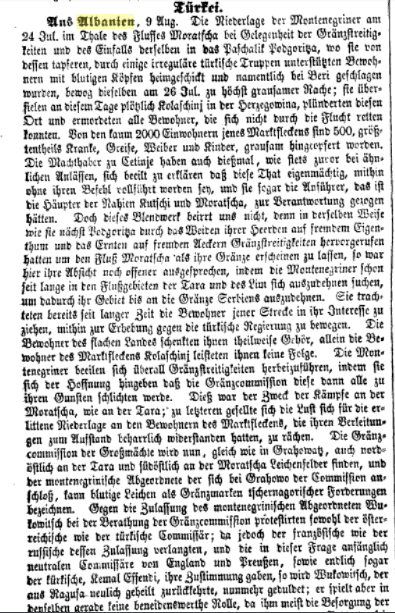
“Turkey. Albania, August 9. The defeat of the Montenegrins on July 24 in the valley of the Moratfcha (Moraça) River during border disputes and their invasion of Podgoriva Paschalik (Pashalik of Podgorica) where they were sent home with bloody heads by its brave inhabitants, supported by some errant irregular Turkish troops, and particularly defeated at Beri, prompted them to a most cruel act on July 26.
On that day, they suddenly attacked Kolashini, plundered the town, and murdered all the inhabitants who could not escape by fleeing. Of the barely 2,000 inhabitants of that market town, 500, mostly the sick, the elderly, women, and children, were cruelly sacrificed. The authorities in Cetinje, as on similar occasions before, have again claimed that this act was carried out unilaterally, without their command, and that they even held the leaders, namely the heads of the Nahien Kutschi (Nahia of Kuci) and Moratscha, accountable.
However, this deception does not mislead us, for just as they had provoked border disputes near Vorgoriza (Podgorica) by grazing their flocks on foreign land and harvesting crops on foreign fields, in order to make the Moratscha River appear as their border, their intention here was even more openly expressed, since the Montenegrins had long sought to expand into the river basins of the Tara and the Lium (Lim), thereby extending their territory to the border of Serbia.
They had long sought to win over the inhabitants of that region to their cause, and thus to incite them to revolt against the Turkish government. The inhabitants of the lowlands partially listened to them, but the residents of the market town of Kolaschini did not follow them. The Montenegrins are quick to provoke border disputes everywhere, clinging to the hope that the border commission will then settle them all in their favor.
This was the purpose of the fighting at the Moracha, as well as at the Tara; in addition to this slander, there was the desire to avenge the defeat suffered against the inhabitants of Marktsleden, who had persistently resisted their calls to revolt. The border commission of the great powers will now, just as in Grabowaty (Grabovac) also be deployed northwards.
Montenegrin deputies, speaking to the commission at Grabowo Castle, can identify bloody corpses as boundary markers of Chernagorian claims. Against the admission of the Montenegrin deputy Vukovich to the deliberations of the border commission, both the Austrian and the Turkish commissioners protested; however, since both the French and the Russian commissioners demanded his admission, and the commissioners of England and Prussia, initially neutral in this question, as well as finally even the Turkish one, Stemal Effenti, gave their consent, Vukovich, who recently returned from Ragusa healed, is now tolerated.
However, he plays a fine and enviable role, since he is usually responsible for procuring the necessary pack animals, and in case of lapses, he is treated rather harshly by the protector of his present homeland, Consul Hecquard, Captain Jovanovich of Austria, and Captain Stein of Prussia is directing the technical work, namely the surveying of the border. We have just been informed that the remnants of those Turkish troops who were betrayed at Grahowak (Grahovac) were embarked on a warship at Gravosa on the 7th of this month to return to Constantinople.
Furthermore, Montenegrins assure us that Danilo received a letter from the highest authority in France, in which he was thanked for the friendly reception he had received from Admiral Iurien de la Gravière, as well as satisfied with his cooperation with France’s intentions, and personally promised an annual salary of 50,000 florins. Desterr Stg.”
Reference
Johann Friedrich “von” Cotta. Allgemeine Zeitung Munchen. 1858. p. 3744. Nr. 182. Link.

 Balkan Academia