
Abstract:
This study examines an 1858 report published in the Allgemeine Zeitung München concerning conflicts along the Albanian–Montenegrin frontier in the late 1850s. The article describes the Montenegrin military occupation of the regions of Bjelopavlic, Kuçi, and Pepaj in 1857 under the leadership of Mirko, followed by the exile of local tribal chieftains and the confiscation of their lands. Drawing on contemporary diplomatic and journalistic accounts, the report highlights widespread discontent among the local Albanian population, accusations of illegal annexation, and severe economic exploitation through taxation and extortion. It further situates these events within the broader geopolitical context of Ottoman authority, European diplomatic intervention, and rising Montenegrin territorial ambitions after the Battle of Grahova. The source provides valuable insight into local resistance, inter-tribal relations, and the fragile balance of power in the western Balkans during the mid-nineteenth century.
Summary:
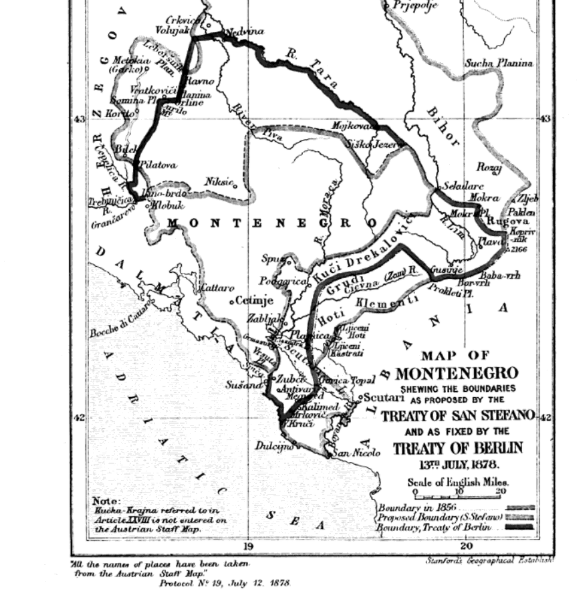
In 1858 the Allgemeine Zeitung Munchen published an article about an the Albanian-Montenegrin situation. It is stated that in 1857, Montenegrin forces, led by Mirko, invaded the regions of Bjelopavlic (Alb. Palabardhë, denoted as Bielopawlevich), the Kuçi (Kuchi) and Pepaj (denoted as Piperi). The chieftains of these tribes (suggesting they were thus Albanians) had to flee into exile. Later, these tribal leaders turned to the Port and the Pasha of Shkodër for help. These illegally acquired territories were thus criticised. Allegedly, only the Vasojevic (denoted as Vasoevich) were happy with this arrangement, though they also revolted against the Montenegrin lord, according to other articles published at the time. We can also read that the Montenegrins of Brda extorted the Albanians of the regions.

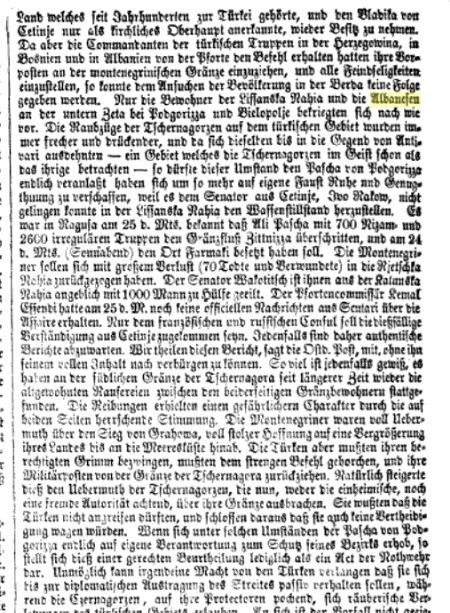
Cited and translated from the article (Some of these toponyms are distorted and have thus been restored to their modern equivalent).
“Montenegro: Regarding the latest conflict between Turks and Montenegrins, we take the following report from the East Post: From Dalmatia, July 25th. It was already known three weeks ago that the dull discontent of the population in the Berda against the Montenegrin rulers was increasing daily. The Naiya Bielopawlevich (Bjelopavlic), Piperi (Pepaj) and Kuchi (Kuçi) were, as is well known, militarily occupied by the Montenegrins in 1857 under the personal leadership of Senate President Mirko and conquered after a hard fight.
Only the Naiya Vasoevich (Vasojevic) was satisfied with the new turn of events. The most respected chieftains of these mountain districts had to flee into exile; their estates were confiscated and later given as fiefs to the supporters of Prince Danilo. Since then, only native Chernagorts (Crnagors) have served as district governors and heads of the Berda (Brda).
The former voivodes turned to the Porte. With the help of the Pasha of Scutari, Prince Danilo was indeed called upon to evacuate the illegally occupied districts. However, since the Montenegrin Senate had committed itself to collecting the tax in the Nahia districts, but after deducting administrative costs, to remit it as tribute to the Pasha in Scutari, the already initiated Turkish execution against the Nahia Vasoyevich was averted, all the more so because the consuls of France and England had intervened with their good offices to secure this settlement.
Meanwhile, the economic situation of the Montenegrins in the four Nahia districts of the Berda has become increasingly unbearable for the population. Under the pretext that the tribute for the Sultan had been increased in 1858, the most extreme forms of extortion were employed, and the Montenegrin Berjanits (Brda) collected the arrears with truly inhuman severity.
At the Battle of Grahowacz, the rather densely populated mountain districts were not represented by a single man. Had the Turks won then, the Bielo Pavlevitscher (Bjelopavlic) and Kutschier (Kuci) would have immediately taken up arms to drive the hated Chernagoras out of the country. Upon hearing the news that these Nahien were to be incorporated into the territory of the Chernagora Definition, discontent reached its peak.
The part of the population that had previously been friendly towards the Montenegrins united with the exiled chieftains upon hearing of the general amnesty and was likely to turn its weapons against the usurper. The Turkish commander of Scutari and Spulch (Spuz) was formally summoned by the community elders to reclaim land that had belonged to Turkey for centuries and recognized the Vladika of Cetinje only as its ecclesiastical head.
However, since the commanders of the Turkish troops in Herzegovina, Bosnia, and Albania had received orders from the Porte to withdraw their outposts on the Montenegrin border and cease all hostilities, the request of the population in the Berda (Brda) could not be granted. Only the inhabitants of the Lissanska Nahia and the Albanians on the lower Zeta near Podgorizza (Podgorica) and Bielopolje continued to fight each other.
The incursions of the Chernagorts into Turkish territory became increasingly brazen and oppressive, and since they extended as far as the area of Antivari—a territory the Chernagorts already considered their own—this circumstance likely prompted the Pasha of Podgorizza to finally take matters into his own hands to secure peace and satisfaction, because it was the Senator from Cetinje, Ivo, who was concerned.
Nakov was unable to establish a ceasefire in the Lissanska Nahia. It was known in Ragusa on the 25th of this month that Ali Pasha, with 700 Nizam troops and 2600 irregular troops, had crossed the border river Zitnitsa and allegedly occupied the town of Farmaki on Saturday, the 24th of this month. The Montenegrins are said to have retreated to the Niechka Nahia with heavy losses of 70 dead and wounded.
Senator Vakotich allegedly rushed to their aid from the Katunska Nahia with 1000 men. The Porte Commissioner, Kemal Effendi, had not yet received any official news from Scutari about the affair on the 25th of this month. Only the French and Russian consuls are said to have received the confidential information from Cetinje. In any case, authentic reports are awaited. “We are sharing this report,” says the Eastern Post, “without being able to vouch for its full content.”
That much is certain. Certainly, the usual skirmishes between the border inhabitants of Chernagora had been taking place again for some time along the usual border. The friction took on a more dangerous character due to the prevailing mood on both sides. The Montenegrins were full of elation after their victory at Grahova, brimming with proud hope of expanding their territory all the way to the sea coast.
The Turks, however, had to suppress their justified anger, obey the strict order, and withdraw their military posts from the Chernagora border. Naturally, this increased the elation of the Chernagorians, who now, disregarding both local and foreign authority, broke out across their borders.
They knew that the Turks were not allowed to attack and concluded that they would not dare to defend themselves. When, under such circumstances, the Pasha of Bobgorizza (Podgorica) finally rose up on his own initiative to defend his district, this can only be judged as an act of self-defense. It is impossible for any power to demand that the Turks behave appropriately towards a diplomatic settlement of the dispute while the Chernobyls, insisting on their protectors, allow themselves predatory violations of Turkish territory.
The incident is not suitable to be treated as a major issue, but it should prompt a swift and impartial resolution of the Montenegrin question.”
Source
1858 the Allgemeine Zeitung Munchen. “Montenegro”. Link.

 Balkan Academia