
Abstract
This chapter offers an early modern reconstruction of the origins, genealogy, and territorial distribution of the Illyrian peoples, drawing on biblical genealogy, classical mythology, and ancient historical and geographical sources. The Illyrians are traced back to Dodanim, descendant of Japheth, and connected to Epirus and Dodona. Through figures such as Illyrus, Achaeus, and Encheleus (Achilleus), the text establishes a genealogical framework explaining the emergence of major Illyrian tribes, including the Taulantii, Dardani, Autariatae, Partheni, Dassaretae, and others. Classical authors such as Appian, Strabo, Pliny, Pomponius Mela, Stephanus of Byzantium, and Scylax are extensively cited to support claims about tribal origins, migrations, and settlements across Illyria, Epirus, Macedonia, Moesia, and the Adriatic coast. The chapter aims to reconcile sacred scripture with classical tradition to present a coherent account of the earliest Illyrian peoples and their historical geography.
This section continues the reconstruction of Illyrian genealogy and settlement by focusing on the Scordisci, Triballi, and related peoples, drawing primarily on Appian, Strabo, Pliny, Bonfini, and later humanist commentators. It traces the Scordisci’s migrations from Thrace into Pannonia and the central Danube region, identifying their principal settlements between the Sava, Drava, and Morava rivers. The chapter further links the Triballi and Agrians to Illyrian descent and clarifies debates over the origins of certain cities. It concludes with a broader ethnographic synthesis, describing how successive migrations and cultural amalgamations shaped the Illyrian confederation, eventually distinguishing Liburnians, Japods, Illyrians proper, and Scordisci, while emphasizing their political independence, social organization, and enduring cultural identity before Roman domination.
CHAPTER III: On the First Illyrian Peoples
I.
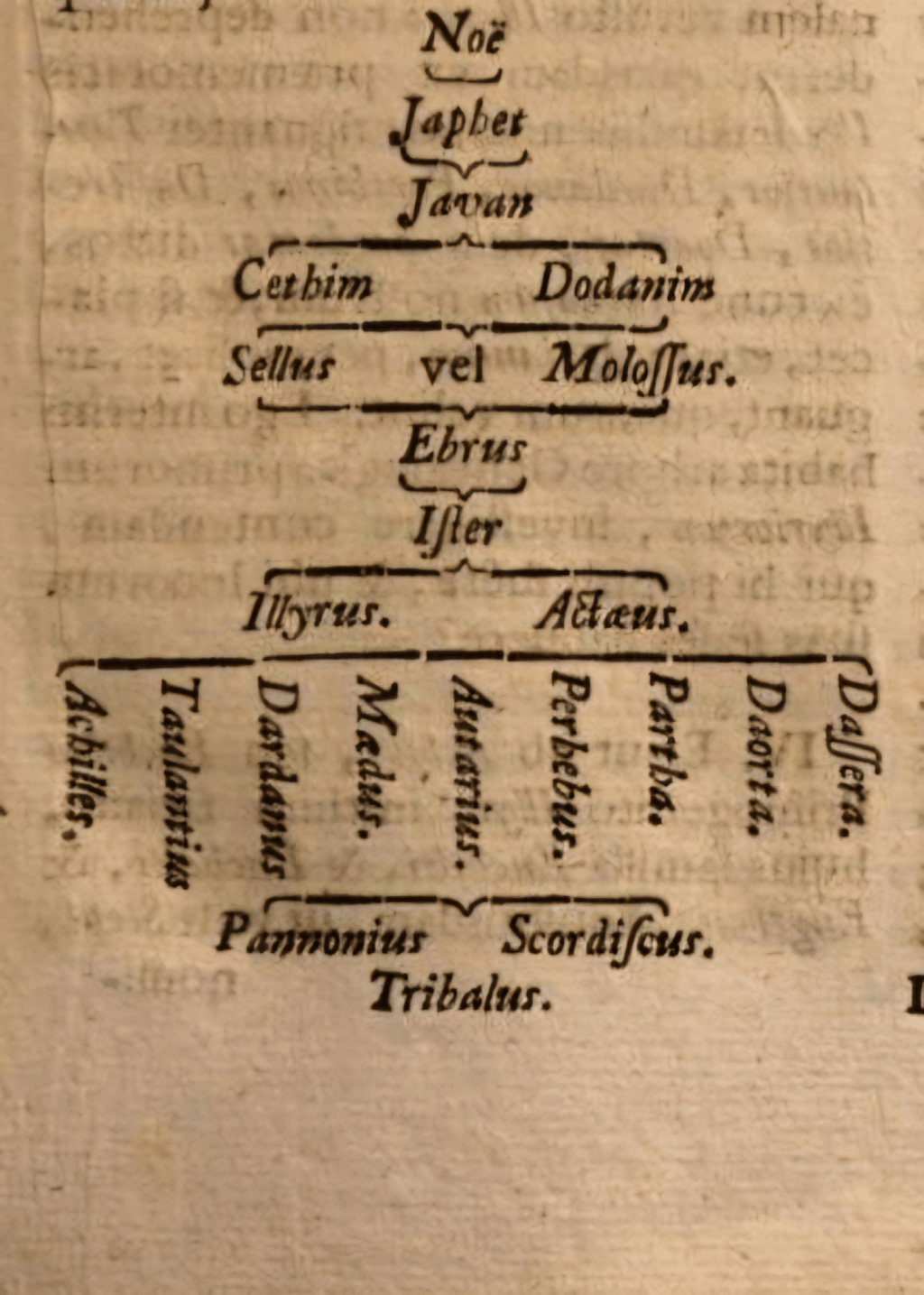
From what has been explained above on the origin and nomenclature of the Illyrians, for the facilitation of the matters that follow and for a clearer understanding of ancient history, I thought of presenting in advance an accurate summary of the first genealogy of the Illyrians, collected by the earliest historical writers, and elaborating it as follows.
Noah
|
Japheth
|
Javan
|
Cetim — Dodanim
|
Sellus or Molossus
|
Ebrus
|
Illyrian
|
Illyrus — Achaeus
|
Taulantii — Dardani — Maeones — Autariatae — Perrebii — Partheni — Dassaretae
Pannonii — Scordisci — Triballi
II.
I do not believe that there will be anyone in the future who will reproach me for having presented here the genealogical tree up to the Dodanim, or for having acted against the sacred codices, because Genesis, chapter X, expressly describes the first genealogy after the universal flood of families:
Noah begat Japheth, Japheth begat Javan, Javan begat Kittim and Dodanim; these were brothers. See on this Huguccion, Sacra Pagina dictionary, corresponding entry.
As for the Dodanim, whether Seti, Molossi, or Ebrus, who are placed in the genealogical tree as descendants, I do not dare to affirm with complete certainty; nevertheless, according to a prudent conjecture, it is permissible to give them a place. And I hope that no one will contradict me, not even some severe critic who values this century, for if someone were to present another more reliable genealogy for the first ancestors of our Illyrians, I would immediately admit that I am convinced.
I am in the meantime publicly presenting what seems to me to be the nearest to the truth according to conjecture; and that this conjecture may not seem incredible, I will add below the relevant evidence that Dodanim is the father of the Illyrians, which I try to prove in the same way in Chap. I, No. 2; but this evidence I make stronger by the following passages.
For Dodanim, having come to Asia with his father Javan, from Greece, and separated from him, settled near his neighboring brother Kittim (who began to dwell in Macedonia), in Epirus, which is now called Albania, according to Gesner and Münster; and was settled there mainly, because there was the city of Dodona and near it the nearby Nemus, in which was the temple of Jupiter Dodonas, as is shown in Stephanus Calepinus and Gesner, under the name Dodona.
That Dodona has always been from the Aetolians, writes Brietius, year 4385. From the Aetolians. The inhabitants of Dodona, according to Stephanus, were also called Sellae, and Molossae, perhaps from Sella and Molossia; the sons of the Dodanim, who lived in the cities of Epirus, Sellae and Molossi, were called Dodona, because they took their name from Dodanim.
Going further, it is neither right to affirm nor deny that Ebrus is descended from Sella or Molossi; but nevertheless, from the Aventine, Chap. I, no. 2, it appears that Ebrus was the parent of the Illyrians, which is there explained.
Finally, Istria, according to the Mappamundi Orbis, gave birth to Illyrin and Achaeus, whom Illyrus, according to Bonfin, decade I, book I, (as I have shown erroneously before in Chap. I, no. 2), either wrote wrongly, or named differently; whose name, Illyri, was changed into Illyrus and regenerated (although he does not mention the name of the king), he does not deny. Thus Illyri and Achaeus, according to Philostratus, who follows the opinion of Homer, were distinguished and famous men.
From Achaeus in Epirus was founded the kingdom of the Epirotes, and from him the city and cape Actium were named, where Augustus, after defeating Antoninus in a naval battle and Cleopatra, founded the city and called it Nicopolis, as Plutarch writes; and from him Sebastus, Minferus; but since Achaeus was received by Illyri, we return to the Illyrians.
III. Illyrus according to Appian
Illyrus, according to Appian, while fighting in Illyria, begot six sons:
Achilleus [Achilles], whom many historians call Encheleus; then Taulant, Dardan, Med, Autarieu and Perchebi; and six daughters: Partha, Dassa and Dassaea. Of all these, although they had different blood relations, nevertheless a common name was preserved: Illyrian, it seems, – as Appian himself writes, quoted in these words:
“These things seem to me worthy of being remembered among many others.
From the Taulants, Perchebi, Achilles, Autariates, Dardans, Medes, Parthenes, Dassaretes and Dassas, descend the Autariates, the Pannones themselves, or rather the Scordisci, the sons of the Paeonians; from the Paeonians come the Triballi, from whom the names of the nations are afterwards translated.”
There are many others who, – not so much Apian as Georgius Rascaius, – once in the service of kings, inhabitants of Croatia and Slavonia, try to overturn the former memory; but they never showed that the Illyrians begat descendants, much less that from these all the ancient Illyrian families were formed.
But let them see what the opponents of Ortelius say, in Geographia, Table 112, where the ancient provinces of Greece, peoples, cities, towns, rivers, mountains, etc.; and if in addition, among the western or northern coasts, they do not understand Illyria, but some of the previously mentioned families of the Illyrians noted, such as the Taulantes, Dardanes, Parthenes, Dassaretes, Doarites, and the so-called Sardias, from whom our Rascia comes, and if they like, even Appian himself, as far as is permitted, let them judge as they please.
I will meanwhile endeavor to investigate the first genealogical tree of the Illyrians, who these peoples were and where they had their dwellings.
IV.
And to begin with Achilleus, or Encheleus, the firstborn of Illyrus, the beginning of this family is made by the Enchelians and Enchelae, from whom, as Stephanus wishes, the name was so called, and also was called according to the ancient Latin custom; and that Aristotle mentions that this province of Illyria has been inhabited since ancient times, is attested by Pomponius Mela in the book De situ orbis, book II, chapter 3, which Bocharti also writes in Phaleg, part II, book I, and in Geographia Sacra, book I, chapter 23.
Likewise also on the river Rhizon, where the city of the same name was located, according to Stephanus Rhizon, and also on the city Butua, now Budva, and Ptolemy once mentions it as a famous city (as Bombardius writes, Topographia Regni Hungariae, sec. 3, no. 3); and on the noble coast of Illyria an emporium near Epidamnus is mentioned by Scylax Caryandensis, which Lucas Holstenius has translated from the Greek into Latin; there he also notes a city built, which was called Enlheleia, so called from Encheleus, near Cadmus; and the poets have fabled that with his wife Harmonia, they were changed into serpents; and he died, as mentioned in Chap. I, no. 1, at a very great age. Of these Lucan speaks, book III.
“Even under the sad name of Encheleia the old tombs of Cadmus were erected.”
The district, which the tribe of the Encheleas inhabited, is mentioned by Scylax in Joannes Lucius, book I, chapter 3. This district was a part of Illyria, which lay between the rivers Narona and Drinus.
Neither in the Geographical Table, nor in the history is Achilleus mentioned, but it is mentioned by Lucius that Encheleas and Achilleus were the same person; therefore it must be admitted that Achilleus and Encheleus are one and the same, just as Lucius himself, book I, chapter 3, speaking of the Illyrian people, admits it from Stephanus, confessing that the tales of Cadmus are set in the Illyrian Kingdom.
Therefore P. Alexius Pigafetta attributed the Encheleas to the Illyrians rather than to the Phoenicians, relying on the origin of the word Akelim, as does Vet. & Nov. Illyrici Praelim., chap. 2, § 2; and it is not to be believed that Cadmus was ever an Illyrian, as is written in the place cited, § 13.
V.
After the Encheleas, in the second place must be mentioned the Taulantes, who, according to Stephanus, were so called; and also ancient inhabitants of the province of Illyria. Pomponius Mela speaks of them, and it is said that among them the drink of wine was prepared from honey. These were the first peoples of modern Liburnia, as Pliny writes, book III, chap. 22; some of whom also dwelt near Epidamnus, of whom Scylax in Lucius, book I, chapter 2, says:
“The Taulantes are an Illyrian tribe, in which is situated the city Epidamnus, which the river calls Palamnos.”
Hence Lucan, book VI:
“Quenque vocat collem Taulantius incola petræ,
Insedit castris.”
VI.
In the third place must be mentioned the Dardanians, or Dardanians, whom Pliny, book III, chapter 26, places in Upper Moesia; while the Dardanians, or Mysians, who dwelt in Phrygia, are mentioned from book IV, chapter 30.
These, according to Dardanus, son of Jove, brother of Ior, founder of Ortis, while the others from Dardanus, son of Illyrus, were necessarily not only different, but also entirely different nations, as is to be believed.
And that these Dardanians were also named after Dardanus as their father, Stephanus testifies from Virgil:
His ortus in agris Dardanus Idaeas Phrygiae penetravit ad urbes Threiciamque Samon, quae nunc Samothracia fertur.
So also our Dardanians, from Dardanus, the son of Illyrus, filled Moesia, which was called Dardania, whom Pliny, book IV, chapter 1, calls a very warlike people; and the Macedonians, book IV, chapter 10, call very ancient.
But today Lower Moesia, as P. Timon and P. Franc. Grossi write, in Geographia Globi Terraquei, is called Bulgaria. While Upper Moesia, which our Dardanians inhabited, borders on Tomemen, according to S. Sabae, and Ritter in Stemmatographia, and also on Rasha, or Serbia, formerly called Dardania, from which Dacia Ripensis afterwards sprang.
VII.
In the fourth order are included the Medes, who had the city of Media near Macedonia, near Odonum, as Dionysius wishes in Bassarica; these were built there. From them Median Thrace, neighboring Pannonia, took its name.
These are called Medes, according to Stephanus, with e or æ as a diphthong, to distinguish them from the Medes of Asia, a people of the same name. Some of them migrated to Macedonia and were called Medobithi, according to s Aristotle in Mirabilia.
Also Animali, book IX, mentions some of these Medes who migrated to Transylvania, which does not seem an incredible conjecture, since there also existed a Median colony, so called by the Romans; about this Bombardius writes, Transylvania, section 3, number 3, and adds that even today, in the Hungarian language, they are called Medgyes.
VIII.
In fifth place are the Autariates, descendants of Illyrians, who lived near the Thesprotic tribe, near the Caones in Epirus, around Ambracia, which Pliny, in Prooemium, book IV, says was inhabited by the Ateri, skilled sailors. Lucan also mentions them, book III, under the name Thesprota:
Thesproti, Dryopësque ruunt.
Strabo writes that these were the largest and most powerful tribe of the Illyrians, who, together with the Triballi, subdued many other Illyrian peoples, and even expelled some Thracians.
IX.
In the sixth order come the Perrebi, an Illyrian nation, but in Epirus, with the city of Perrebe, or with the Perrebian tribe, founded there, which, after being broken by the power of the Lapiths, moved to the mountainous regions near the Thessalian Pindus. This is attested by Stephanus, who adds that the Greeks called Mount Pindus after the inhabitants Perrebi. Propertius sings of this, book I:
Aut cur Perrebi tremuere cacumina Pindi.
X.
In the seventh order stand the Parthians, or Partheni, who, as a distinct people, dwelt around Hyrcanum by the sea, according to Pomponius Mela; formerly they dwelt in Macedonia, but were expelled thence, according to Pliny, and were called Dasaretae and Canavi, and dwelt from Dyrrhachium about 79 miles, marking the boundary between Illyria and Macedonia.
Afterwards, as Stephanus writes, they migrated to Illyria and built the city of Parthum in the province of Oeni Humani in Peneasia, as Pomponius Mela testifies, book II, chapter 22. This is confirmed by Fregotus in his Geographia Dalmatiae, title Ragusium. Formerly they possessed the province around Ragusa, like ancient Parthia, which, in the time of Augustus, Pollio conquered.
XI.
After them come the Daorites, whom Ptolemy, book III, chapter 9, also mentions as Dortica; they dwelt with the Dardanians in Upper Moesia, where they also built a city of their own name, near the river Danube, as Ptolemy testifies.
These Stephanus, according to Pomponius Mela, numbers among the Illyrian peoples.
XII.
In the ninth and last place are the Dasaretes. They lived in Macedonia, according to Pomponius Mela, and opposite them lived the Parthians; Pliny calls them an Illyrian nation. Stephanus says that they were neighbors of the Autariates, as Pomponius writes.
These were such that they could have succeeded immediately after the Illyrians; from them, as is clear, many descendants came, therefore there is no doubt that the Pannones and Scordisci are descended from the Autariates, as Appian writes.
But Scylax Caryandensis mentions more names: Manios, Bulinos, Oricos, Amantinos, and doubly Illyrians called in a special way.
Before we pass to the Pannones and Scordisci, we have still to explain the settlements of these peoples.
XIII.
Therefore Scylax, quoted by Joannes Lucius, book I, chapter 2, about the Illyrian peoples mentioned, describes them thus:
“Beyond Nestor, towards the river Naron, it is not very wide, but with triremes and sea-going ships, capable of trade; and Istad is located far from the sea. These, according to their genus, are called Illyrians by the name of Mani.
Lacus is located opposite, near that very large emporium, and belongs to the Illyrian tribe of the Autariates. About the Bulini it is said thus:
The Bulini are very ancient barbarians, who lived on the coast directed by the Pennine; the Bulini are an Illyrian tribe. The kingdom of the Bulini extended from Nestus to the Istra.
Further, as far as Oricum and Amantia, he says: The Orici and Amanti inhabit this region. The Amanti are Illyrians and belong to the Bulini and Bucesi.
This is located near the Ionian Island. Finally, about the Illyrians proper, of whom it is said that they are twofold: one, named after Illyrus himself, the founder; it is described thus: behind the Liburni is the tribe of the Illyrians, who inhabit the coast, as far as Caon, and opposite Corcyra and the Island of Alcinous.
In this province there is a Greek city called Heraclea, and there are also ports; and here dwell barbarians, called Lotophagi. These are noted by Skylaxus for a part of the Illyrian tribe; for the rest he says: The Taulants are an Illyrian tribe, in which is the city Epidamnus, which Aousius otherwise calls Palamnus.
From Epidamnus to Apollonia is 50 stadia; from Apollonia to Istadius is 330 stadia. Apollonia is a Greek city; the Aousius flows from Mount Pindus, passes by Apollonia, and flows towards Oricum into the Ionian Sea.
From Amantia to Istadius is 60 stadia at sea; all these tribes dwell in the middle of the continent: the Amantes, above Oricum, and Chaonius, as far as Eidonia; in the province of Chaonia there is a small island called Erythra.
Here come the Gerones and the Periboeans; the small cattle are numerous; around these places are the Keraune mountains in Epirus, where is the small island called Sason [Sazan], situated opposite the third part of a day’s sail from Oricumi.
These are those which Scylax mentions of the Illyrian peoples which Appian has not named; and these, being added here, lead to the Amantes, sons of the Pannones, and under the rule of the Scordisci, which would be superfluous, for we have spoken above of the Pannones; therefore we will now only depart from the Scordisci.
XIV.
The Scordisci, with their descendants, first united with the Hebra, who dwelt in Adrianople, and are now called Maritsa. Then they invaded Macedonia and Thrace by force and destruction; and about the year of the world 3944, as Brietus records, they settled between the rivers Sava, Drava and Morava, as Bonfini, decade I, book I, testifies.
Although the Scordisci lived beyond the Sava, as Schönleben estimates (Appar. Carniol., chap. 5, § 7, no. 7), saying: and from here their settlement must be sought, a little below Karlstadt, and Retechan, between Gritzowitz and Szeredica, which is called Scordisca, with a slightly altered name.
This is reinforced by Pliny, book III, chapter 25, under the emperor Claudius, writing: “From these (the mountains of Claudius) opposite the Scordisci, and behind the Taurisci; although Idipium may be placed between the Drava and the Morava, where both rivers still have villages, once more famous cities, one Nensi, the other Szeredica, which in modern Styria is otherwise called Mürz.”
Strabo, book VII, says that the Scordisci also had the cities of Heorta and Capedunum. The province of Heorta (which Schönleben, Appar. Carniol., chap. 5, § 3, no. 1, calls Heorte) is also mentioned by Pliny, book IV, chapter 10, in Pannonia; therefore he who would look for Heorta in Lower Pannonia, that is, in modern Croatia and Slavonia, will not be mistaken, says Schönleben, in the place cited.
Idipium and Capedunum are also mentioned by Schönleben, chap. 5, § 2, no. 2, who in Jordanes, De rebus Geticis, chap. 58, explains it as Heorta, Hernum, or, as Grammarius puts it, Herbam, near the banks of the Danube; but this is not correct. Capedunum, if called according to the former presentation, is the same Szeredisco mentioned above.
XV.
Pannon, as shown in the genealogical tree and as shown in the previous chapter, no. 3, gave birth to the Triballi, who settled between the Dardanians and the Mysians, as Pliny writes, book III, chapter 26; also book IV, chapters 1 and 10. Stephanus also accepts these as an Illyrian tribe.
Strabo shows that the Agriones, extending as far as the Ister, occupied a distance of fifteen days’ journey. The Agriones, or Agrians, who lived beyond the Triballi, and the Metanastes, that is, the exiles, founded the city of Agrian, which is now an episcopal see in Upper Hungary, built opposite the Danube in the plain of Partisgam, not far from the river Tibicus; therefore, because they were Agrians, they called the city Agrian. This is written by Bonfini, decade I, book I.
That these Agrians were an Illyrian people is also proven by Saintivanus Dissertatio, Paralypomena Rerum Memorabilium Regni Hungariae, catalog 8. However, that Agrian was more accurately built by Agron, king of the Illyrians, and was called Agrian after his name, has long been refuted by the humanists in Pannonia.
So far Appian’s explanation of the genealogy of the Illyrians, based on the opinions of several authors; is sufficient for the kind reader, and invites him to read further the rest.
XVI.
While the Illyrian tribes mentioned above, and the Illyrian region so called, had been living for a long time without interruption, it happened that various peoples from Asia and Europe poured upon them, such as the Argonauts, the Colchians, the Paphlagonian Henates, and the Celts-Gallics, who, choosing settlements among the Illyrian lands, united with them in a single body and were called with them, the Illyrian nation, until the name of the most well-known Illyrian peoples was divided into the Liburnians, the Japodians, the Illyrians, and the Scordians.
The Illyrians, the most ancient and noble of all, lived between the rivers Arsia and Drinus, as Pomponius Mela, book II, chapter 3, and Pliny, book III, chapter 21, write, and they united as a confederacy.
The Liburnians, according to Pomponius Mela, in the place cited, and Pliny, book III, chapter 22, dwelt on the right of the Tedan, as far as the river Titius, and on the Adriatic sea, as far as Mount Albius.
The tribe of the Japods was separated from the Liburnians by the Tedan river, and dwelt between the Albean mountains, as Pliny, book III, chapter 19, and Ptolemy, book II, chapter 17, writes.
The Illyrians, or Illyrians, had their permanent residence in the peninsula, as Ortelius shows, from the inner end where Tergesta is located, along its coast, as far as the Tedan river. As for the Scordisci, where they lived, it was shown above, in the previous chapter, no. 14.
As for these Illyrian peoples, although confined by narrow borders, before they submitted to Roman rule, they had their own kings, independent of any other power; and at all times they produced men distinguished for literary knowledge, for ability in government, and for bravery in war, – as Appian attests.
Hence Schimnus Chius, in Joannes Lucius, book I, chapter 2, describing the coast, seafaring and Nicomedes, king of Bithynia, distinguishes thus:
“From here on Illyria, which includes many tribes; for foreign hordes were often added who took the name Illyrian. A part of them dwells far from the sea, the rest keeps the inner side of the Adriatic. Some are under royal power, some live according to the laws, some are independent. The latter are savage, predatory and murderous; while the more civilized citizens are very hospitable, faithful in faith and diligent in agriculture.”
From these, the kind reader may observe that the customs of the Illyrians were still like those of tribal nations; for Schimnus Chius describes them here as Gentiles, themselves Gentiles before the birth of Christ about the year 150. This is noted by Franciscus Orosius on the origin of the Hungarians and clearly describes it while he was alive.
Source
Title: Natale solum magni Ecclesiae doctoris Sancti Hieronymi in ruderibus Stridonis occultatum: probatorum nihilominus historicorum et geographicorum opinionibus, ad brevis Illyricanae chronologie adjumento erutum
Author: Josephus Bedckovich
Publisher: ex Typographeo Mülleriano, 1752

 Balkan Academia