

by Joseph Dedvukaj.
Based on Z. Duckett Ferriman, Home Life in Hellas (Modern Day Greece)(London, 1910)
In the early twentieth century, British writer and traveler Z. Duckett Ferriman lived extensively in Greece and produced one of the most detailed ethnographic accounts of its society, customs, language, and population. His book, Home Life in Hellas, published in London in 1910, is not a political manifesto, but a sober observational study grounded in firsthand experience and contemporary scholarship.
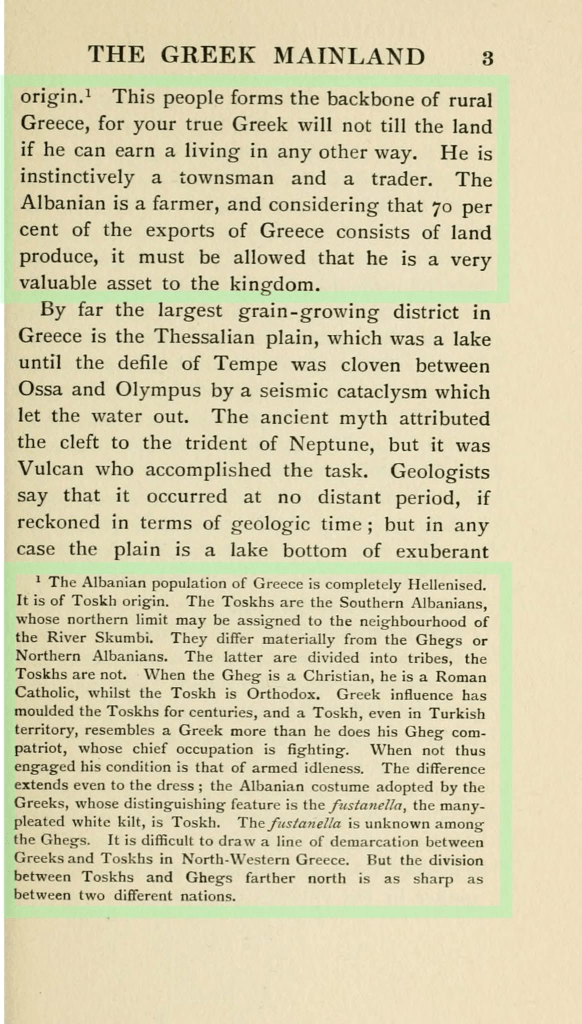
Yet this work has never been translated into Greek, a fact that becomes understandable when one examines its contents.
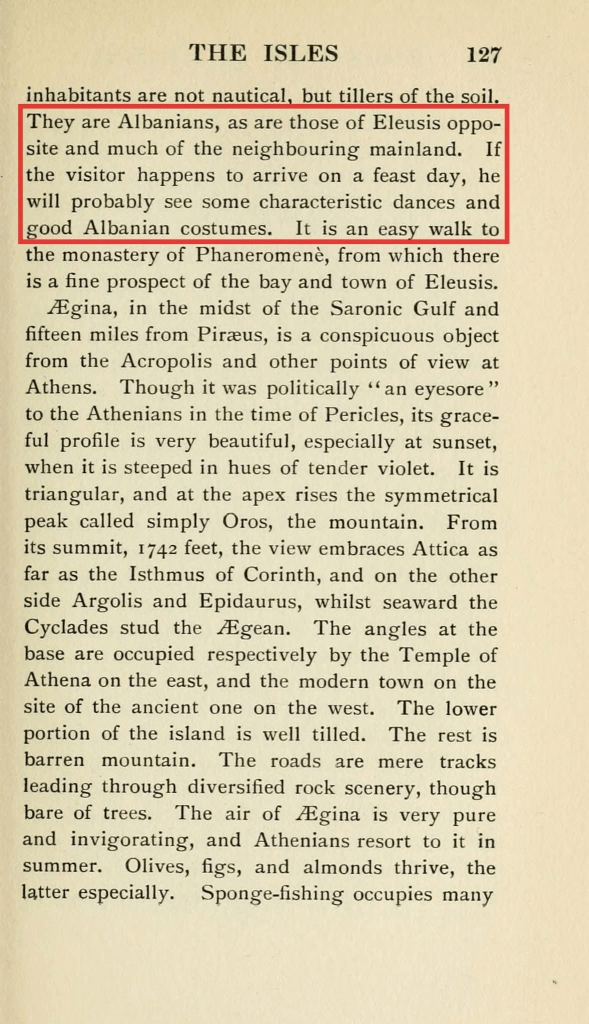
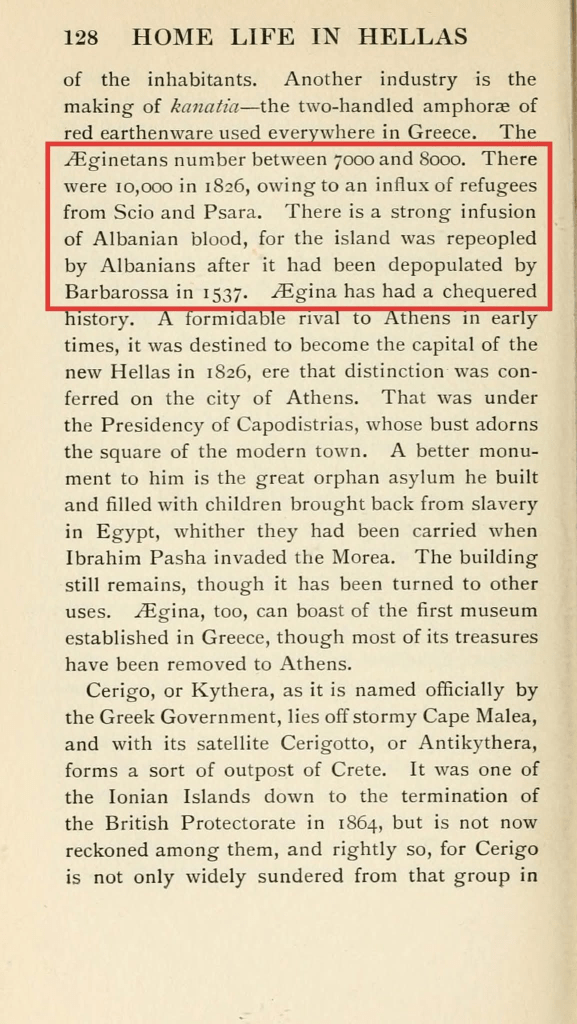
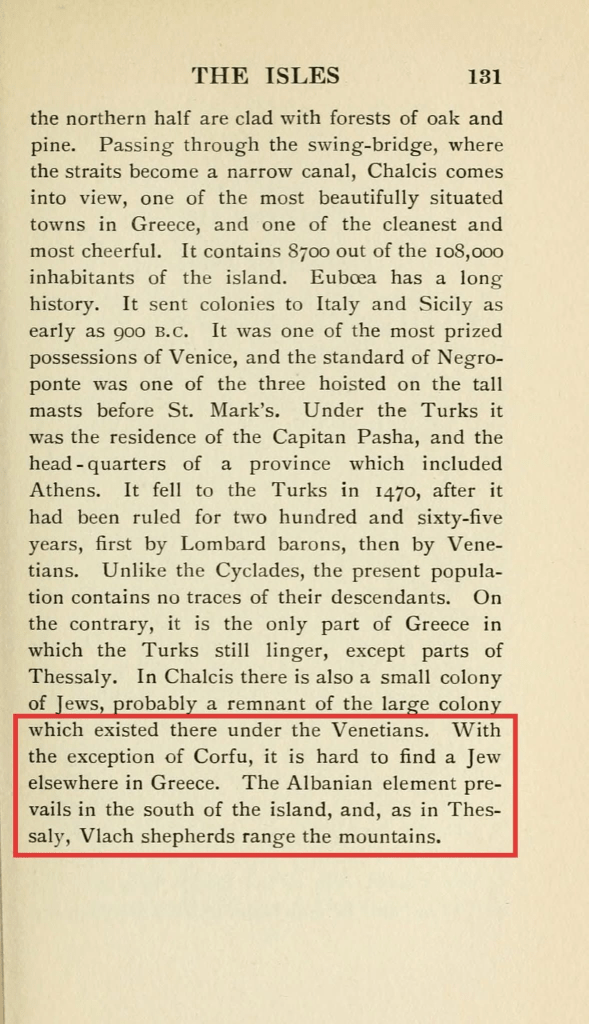
Ferriman documents, repeatedly and unambiguously, that Albanians (Arvanites) were not a marginal or recent presence in Greece, but a deep-rooted, indigenous population occupying large portions of Hellas, including Attica, Boeotia, Achaia, the Peloponnese, Euboea, and the environs of Athens itself.
1. Albanians as the People of Historic Hellas
Ferriman states plainly that many of the most celebrated locations of classical Greek history—
Corinth, Marathon, Plataea, Mantinea, Leuctra, Eleusis, and Salamis—were, in historical reality, “peopled, not by Greeks, but by Albanians.”
This is not a claim about temporary migration. It is a statement about population continuity: the living communities inhabiting these regions at the dawn of the modern Greek state were Albanian-speaking and Albanian-descended.
He further notes that Athens itself, despite its symbolic role as the heart of Hellenism, was surrounded by countryside “peopled by Albanians,” making the capital the best place in Greece to observe traditional costume precisely because of this Albanian hinterland.

2. Language as Proof of Indigenous Presence
Ferriman records that Skypetar (Albanian) was spoken by a significant portion of the population—around eleven percent nationally, and far more locally—particularly within walking distance of Athens, where women and children often spoke little or no Greek.
Crucially, he emphasizes that these were not isolated enclaves:
“To this day, in the Albanian districts of Greece, even in the vicinity of Athens, the language is Albanian.”
This persistence of language, especially among women and children, is a classic anthropological marker of long-established, native populations, not transient settlers.

3. Albanian Culture as the Core of Greek National Symbols
Ferriman identifies some of the most iconic symbols of Greek national identity as Albanian in origin:
• The fustanella, worn exclusively by the elite evzonoi, is described as
“the national Greek—or rather Albanian—dress.”
• Albanian embroidery, costume, and folk traditions are repeatedly noted as dominant in Attica and central Greece.
• The Greek royal guard itself was recruited almost entirely from Albanian-speaking mountain populations.
These are not peripheral influences; they are central to the visual and military identity of the Greek state.
4. Autochthony Without Separatism
Ferriman makes an important distinction: Albanians in Greece were autochthonous, yet politically loyal.
“Both Albanian and Vlach are loyal Hellenes.”
They did not need to be foreigners to be absorbed; rather, they were native populations incorporated into a modern nation-state, often at the cost of their language through compulsory schooling and military service—processes Ferriman openly describes as causing the decline of Albanian speech in Greece.
5. A Reality at Odds with National Myth
Ferriman ultimately acknowledges what many earlier scholars observed: that modern Greece is a composite society, not a racially or ethnically uniform continuation of antiquity.
He states bluntly:
“There are few agricultural districts in Greece where the population is purely Greek.”
This is not an attack on Greece. It is a recognition that Albanian autochthony in Hellas is part of historical reality, not an anomaly.
Why This Book Matters
Home Life in Hellas is not forbidden by law—but it is excluded by silence. Its absence from Greek translation is telling, because it challenges a simplified narrative of uninterrupted ethnic homogeneity.
Ferriman’s work shows that Albanians were not newcomers to Hellas. They were:
• Indigenous to large regions,
• Custodians of land, agriculture, and military service,
• Bearers of traditions later rebranded as “Greek national.”
This book does not erase Greek history—it restores Albanian presence to it.
Bibliographic Reference
Z. Duckett Ferriman, Home Life in Hellas: Greece and the Greeks,
London: Mills & Boon, 1910.
Available via Internet Archive: https://archive.org/details/homelifeinhellas00ferruof

 Balkan Academia