
by Fadil Kajtazi and Valon Qorri. Translated by Petrit Latifi
Despite the fact that the Serbian historian Vladimir Qorović (1885-1941) tries to overshadow the Illyrian-Dardan presence before the Slavs invaded Illyricum, he is forced to refer to toponyms, starting with Illyria, Dardania, and Rizonium(1). What is important in all this neglect and omission is the fact that this historian is forced to accept the statement of the Serbian ethnographer Jovan Erdelanović (1874-1944), who says:
“The natives, who many centuries before the arrival of the Serbs lived in this land and adapted it to their needs, had such a cultural heritage that the Serbs had to accept, because they were among the most suitable for the existence of the new life, or they marked notions and objects that the Serbs had not known before” (2).
Among these natives, in the same place, this author mentions “the old Vlachs and the Arbanasi”. Although Cvijici tries to leave this issue open, with a small guess, saying, “but mostly it is very difficult to prove”, however, from his statement, we understand that his subconscious as a scientist forces him to conclude that: “there is no doubt that the Serbs took from the old inhabitants a form and way of livestock life (the name of the village), then something from domestic life and costumes” (3).
However, the difficulties of proof are facilitated by the situation on the ground: The fact that the Slavs came to the Illyrian-Dardan areas, where they found them there and that they “had such a cultural heritage, which the Serbs had to accept”, and “…took from the old inhabitants…”, can be explained and proven by ethnography, among other things, through the name of the wind musical instrument fife. Strabo, when describing the Dardanians, says: “…nevertheless, they do not leave music aside, but, on the contrary, they always use flutes and stringed instruments (harks, F. K.)”(4).
Before Strabo wrote about the musical spirit of the Dardanians, archaeological excavations show that the tradition of music was cultivated in the Illyrian-Dardan territory since the Neolithic era. During archaeological excavations at the Runik site, in central Dardania (Kosovo), an exhibit was found that, upon examination, turned out to be a wind musical instrument, made of clay (photo 1), which belongs to the early Neolithic period – the 7th – 6th millennium BC(5)1 and, compared with the new studies of Paul Heggarty (Max Planck Institute)(6), this instrument corresponds to the time when the Albanian language separated as a branch from the Indo-European language group, about 6000 years ago.
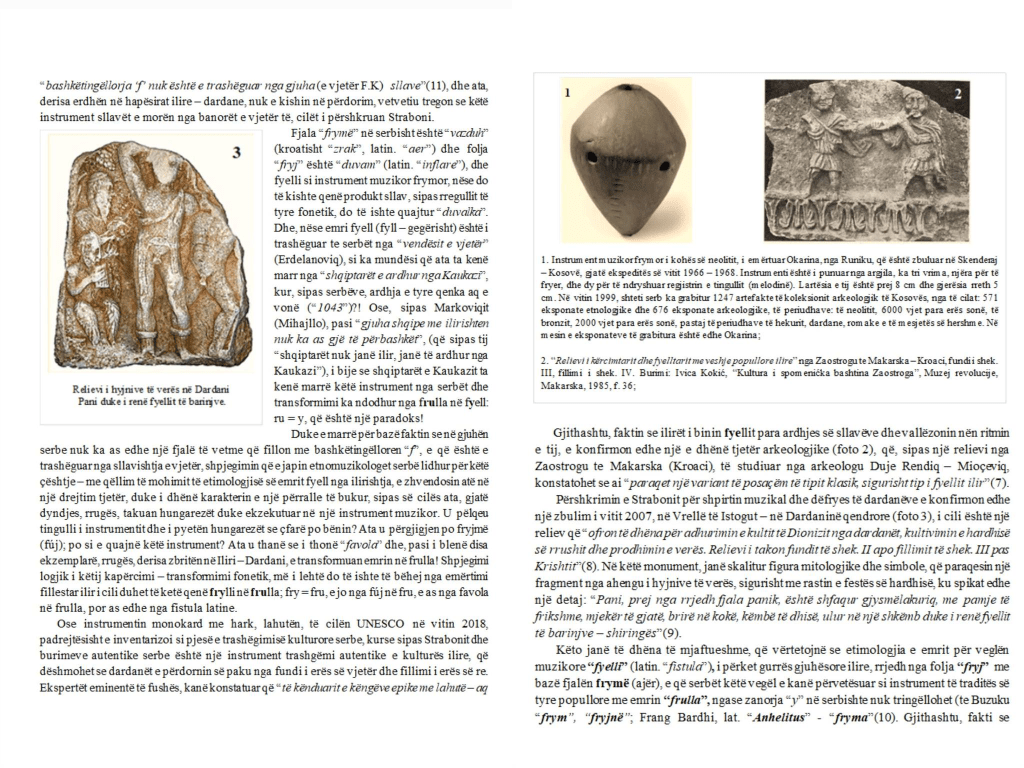
Also, the fact that the Illyrians played the flute before the arrival of the Slavs and danced to its rhythm is confirmed by another archaeological data (photo 2), which, according to a relief from Zaostrog in Makarska (Croatia), studied by archaeologist Duje Rendic – Miočević, states that it “represents a special variant of the classical type, certainly the type of the Illyrian flute”(7).
Strabo’s description of the musical and fun-loving spirit of the Dardanians is also confirmed by a discovery in 2007, in Vrellë of Istog – in central Dardania (photo 3), which is a relief that “provides data on the worship of the cult of Dionysus by the Dardanians, the cultivation of grape vines and the production of wine. The relief dates back to the end of the 2nd century or the beginning of the 3rd century AD”.
On this monument, mythological figures and symbols are carved, representing a fragment of the feast of the wine deities, certainly on the occasion of the festival of the vine, where another detail stands out: “Pani, from which the word panic derives, appeared half-naked, with a frightening appearance, a long beard, horns on his head, goat’s legs, sitting on a rock playing the shepherd’s flute – the syringa” (9).
These are sufficient data to prove that the etymology of the name for The musical instrument “fiddle” (Latin “fistula”), belonging to the Illyrian language family, derives from the verb “fryj” based on the word “air”, and the Serbs have adopted this instrument as an instrument of their folk tradition under the name “frulla”, because the vowel “y” in Serbian is not trilled (in Buzuku “frym”, “fryjnė”; Frang Bardhi, Latin “Anhelitus” – “breath” (10).
Also, the fact that “the consonant ‘f’ is not inherited from the (old F.K) Slavic language” (11), and they, until they came to the Illyrian-Dardan areas, did not have it in use, in itself shows that the Slavs took this instrument from the old inhabitants of, whom Strabo describes.
The word “breath” in Serbian is “vazduh” (Croatian “zrak”, Latin “aer”) and the verb “fryj” is “duvam” (Latin. “inflare”), and the flute as a wind musical instrument, if it had been a Slavic product, according to their phonetic rule, would have been called “duvalka”.
And, if the name flute (fyll – Ghegish) is inherited by the Serbs from the “old natives” (Erdelanović), how is it possible that they got it from “Albanians who came from the Caucasus”, when, according to the Serbs, their arrival is so late (“1043”)? Or, according to Marković (Mihajllo), since “the Albanian language has nothing in common with Illyrian”, (which according to him “Albanians are not Illyrian, they came from the Caucasus”), it follows that the Caucasian Albanians got this instrument from the Serbs and the transformation took place from the flute to the fiddle: ru = y, which is a paradox.
Taking into account the fact that in the Serbian language there is not a single word that begins with the consonant “f”, which is inherited from the Old Slavonic, the explanation that Serbian ethnomusicologists give regarding this issue – with the aim of denying the etymology of the name fyle from Illyrian, shifts it in another direction, giving it the character of a beautiful fairy tale, according to which they, during On the way, they met Hungarians playing a musical instrument.
They liked the sound of the instrument and asked the Hungarians what they were doing? They answered that we were blowing (fúj); but what do they call this instrument? They told them that they call it “favola” and, after buying several specimens, on the way, until they landed in Illyria – Dardania, they transformed the name into frulla.
The logical explanation of this overcoming – phonetic transformation, would be easier to do from the initial Illyrian name which must have been frylli to frulla; fry = fru, and not from fúj to fru, nor from favola to frulla, but not even from the Latin fistula. Or the monochord bowed instrument, the lute, which UNESCO in 2018, unjustly inventoried as part of the Serbian cultural heritage, while according to Strabo and authentic Serbian sources it is an authentic heritage instrument of the Illyrian culture, which is proven that the Dardanians they used it at least from the end of the old era and the beginning of the new era.
Eminent experts in the field have concluded that “the singing of epic songs with the lute – so characteristic of the present-day peoples of the Balkans – also has its deep roots in the singing of Illyrian rhapsodes about the heroic deeds of their ancestors” (12). For the continuity of singing with this instrument by the Albanians, we have the testimony of a Serbian officer, Dimitrije Mita Petrovic, who participated in the ethnic cleansing of Albanians in the region of Toplica (northern Dardania) during the years 1877-1878.
He, without reading Strabo, writes in his diary: “In almost every house we found lutes and their bows, which the fled Albanians had left. It is also a tradition among them that, after finishing work, the lute player sings, while the others around listen. With the lute, the desire for revenge and glory arose” (13).
Literatures
Dimitrije Mita Petrovic, “The Battles in Toplica 1877 – 1878”, Erik Has, 2017, p. 134.
Excerpted from “File: Serbian Ideology of Genocide – Serbian and International Sources
“Horreum Margi (Çuperlia), was the largest city in the depths of Moesia, before the border of Dardania”, or “Dardania, the northernmost province of Macedonia, the so-called Macedonia salutaris, and a part of Pannonia”, Vladimir Ćorović, “Istorija srpskog naroda” p. 31.
Vladimir Ćorović, “Istorija srpskog naroda”, p. 36.
Jovan Cvijić, “Balkan Peninsula and South Slavic Countries”, p. 87.
Strabo “Geographica”, L. VII, 7, “Illyrians and Illyria in Ancient Authors”, p. 155.
Group of authors (Adem Bunguri), “Archaeological Map of Kosovo I”, p. 28.
https://akad.gov.al/tryeza-shkencore-nderkombetare…/. Updated 04.04.2025
Aleksandër Stipçević, “Illyrians – history – life – culture – symbols of the cult”, p. 268.
Haxhi Mehmetaj, “Archaeological heritage of the municipality of Istog”, Prishtina, 2016, p. 60.
Ibid., p. 61, fig. 54.
Frang Bardhi, “Latin – Albanian Dictionary 1635”, p. 87.
Citation: F. Croatian Encyclopedia, online edition. Miroslav Krleža Lexicon Institute, 2021. Accessed 15. 7. 2021;
http://www.enciklopedija.hr/Natuknica.aspx?ID=18787
Aleksandër Stipçević, “Illyrians – history – life – culture – symbols of the cult”, p. 268..


 Balkan Academia