
by Lulzim Osmanaj. Translation Petrit Latifi
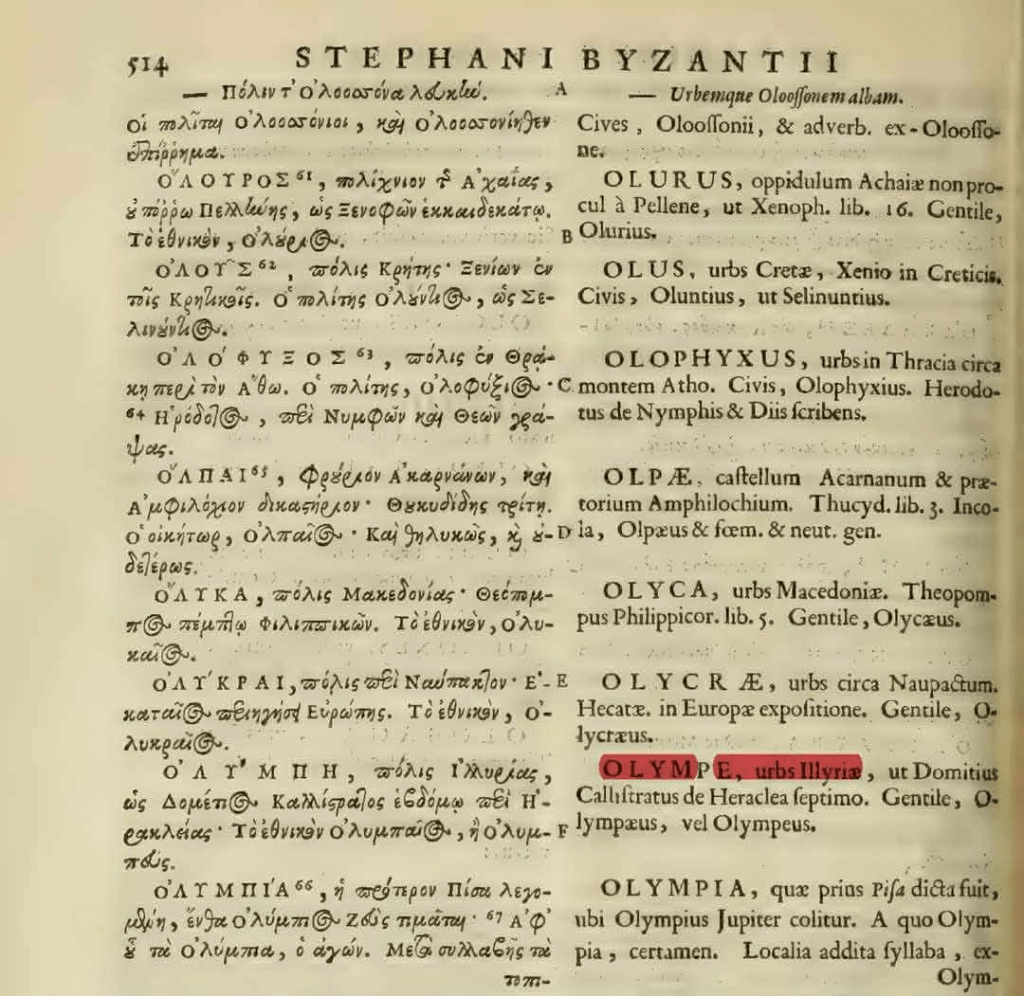
According to Stephani Byzantii, in his work Ethnika, Olympe (Ολύμπη) is mentioned as a city of Illyria: “OLYMPI, a city of Illyria.” As in Homer’s verses, where names live beyond time, here too history speaks clearly: not every Olympian was Greek, and not every story begins in Elis.
[Hellenic or Greek as these people are called today had nothing to do with ethnicity but with religion and culture] On the Illyrian coast, the name Olympe carried the weight of antiquity, of gods and autochthonous peoples.
Illyria was not only a land of warriors, but also a space of sacred names, which ancient authors preserved in books – not in modern myths.
OLYMPUS, a city of Illyricum, as Domitius Callifratus says of Heraclea in the seventh. Gentile, O. Flympæus, or Olympeus.
Evangelis Zappas
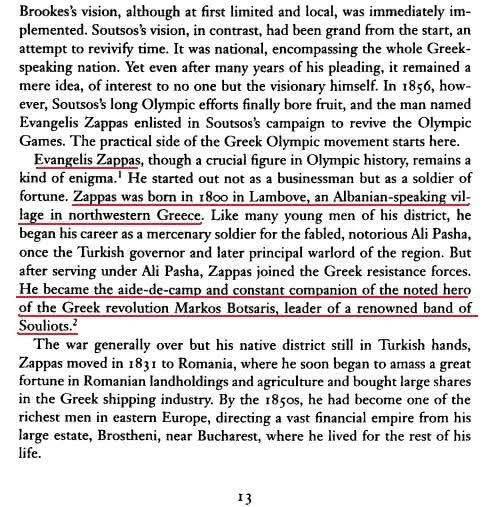
“Brookes’s vision, although at first limited and local, was immediately im-plemented. Soutsos’s vision, in contrast, had been grand from the start, an attempt to revivify time. It was national, encompassing the whole Greek-speaking nation. Yet even after many years of his pleading, it remained a mere idea, of interest to no one but the visionary himself. In 1856, how-ever, Soutsos’s long Olympic efforts finally bore fruit, and the man named Evangelis Zappas enlisted in Soutsos’s campaign to revive the Olympic Games. The practical side of the Greek Olympic movement starts here.
Evangelis Zappas, though a crucial figure in Olympic history, remains a kind of enigma. He started out not as a businessman but as a soldier of fortune. Zappas was born in 1800 in Lambove, an Albanian-speaking vil-lage in northwestern Greece. Like many young men of his district, he began his career as a mercenary soldier for the fabled, notorious Ali Pasha, once the Turkish governor and later principal warlord of the region. But after serving under Ali Pasha, Zappas joined the Greek resistance forces. He became the aide-de-camp and constant companion of the noted hero of the Greek revolution Markos Botsaris, leader of a renowned band of Souliots.
The war generally over but his native district still in Turkish hands, Zappas moved in 1831 to Romania, where he soon began to amass a great fortune in Romanian landholdings and agriculture and bought large shares in the Greek shipping industry. By the 1850s, he had become one of the richest men in eastern Europe, directing a vast financial empire from his large estate, Brostheni, near Bucharest, where he lived for the rest of his life.”
Source
THE MODERN OLYMPICS A Struggle for Revival. DAVID C. YOUNG

 Balkan Academia