
by Lulzim Osmanaj. Translation Petrit Latifi
Abstract
This paper examines how Albania and the Albanians were introduced and understood in Japan, based on the research of Nakazawa Takuya. By analyzing world history books, chronologies, and historical studies published from the late nineteenth to the early twentieth century, the paper highlights Japanese references to Albanian historical figures such as Mehmed, Ali Pasha, and Skanderbeg. These figures appeared mainly in discussions of Ottoman history and the Greek War of Independence. The study demonstrates that early Japanese knowledge of Albania developed indirectly through European historiography and contributed to the formation of a distinct image of Albanians as brave and resistant to imperial rule.

“Mehmed became Grand Vizier in 1656, he went on to explain that “Mehmed was from Albania and had passed the age at which people rarely live so long since ancient times [i.e. seventy] when he became Vizier.”
A book on the Greek War of Independence, written in 1896, described “Ali Pasha [arīpashiyaアリー、パシヤ], viceroy of the capital of the Albanian province, Ioannina [jiyanina ジャニナ]” as the catalyst for the Greek uprising against the Empire.
The book gave a detailed biography of Ali Pasha, including the fact that he was from Tepelena (teperenテペレン) and that he had been a bandit in his youth. Thus, the history of Albania and the Albanians was introduced to Japan along with the names of its figures main.
Knowledge of Skanderbeg was brought to Japan. In a history book in 1890, “Skanderbeg [sukanderubebgu]” was mentioned as a “brave Albanian general”.
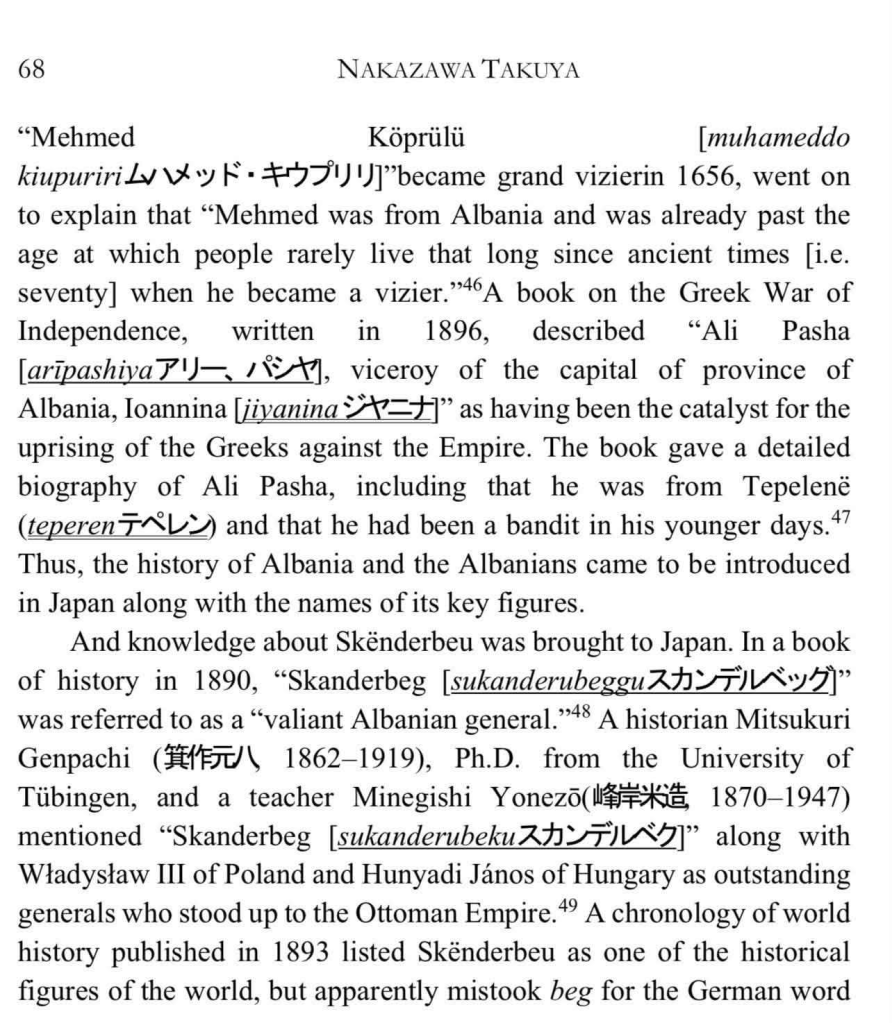
A historian, Mitsukuri Genpachi (1862–1919), a doctor of science from the University of Tübingen, and a teacher, Minegishi Yonezō (1870–1947), mentioned “Skanderbeg [sukanderubeku]” along with Władysław III of Poland and Hunyadi János of Hungary as outstanding generals who resisted the Ottoman Empire.
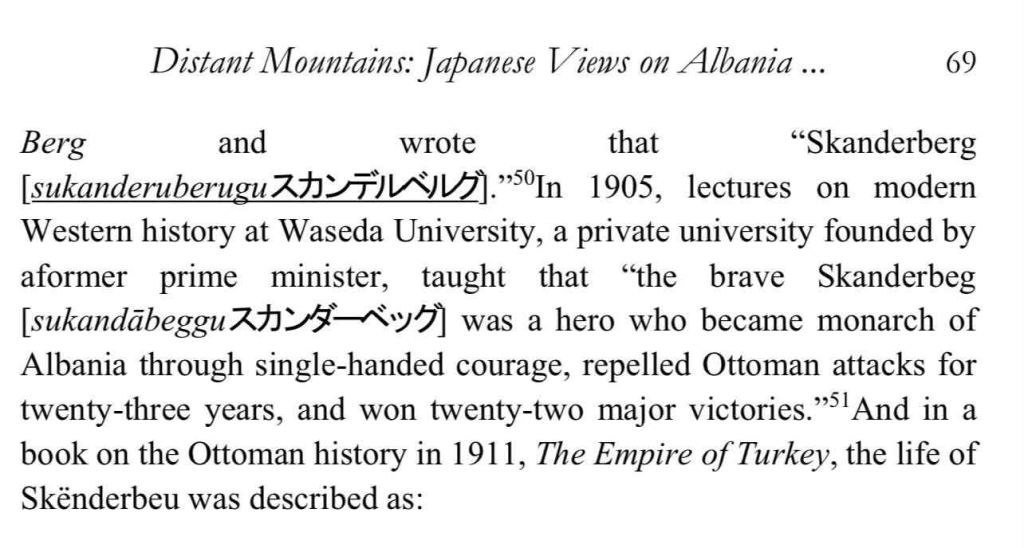
A chronology of world history published in 1893 listed Skanderbeg as one of the world’s historical figures, but apparently confused the word beg with the German word.
[…] Furthermore, the Albanians [arubanījin アルバニー人] who inhabited the region, who were more fearless than any other nation, and although they had been quasi-independent for some time and did not wholeheartedly follow Turkish rule, they were completely opposed when they heard that the land where their graves were located would belong to another country. […]

In Japanese
日本語アブストラクト
本稿は、中澤拓也の研究に基づき、日本においてアルバニアおよびアルバニア人がどのように紹介され、理解されてきたかを歴史的文献を通じて考察するものである。19世紀後半から20世紀初頭にかけて刊行された世界史書、年表、歴史研究書を分析し、メフメト、アリ・パシャ、スカンデルベグといったアルバニア出身の歴史的人物が、日本の知的世界にどのように受容されたかを明らかにする。これらの記述は、オスマン帝国史やギリシャ独立戦争の文脈を通じて、日本におけるアルバニア像の形成に寄与したことを示している。
中澤拓也の研究による日本におけるアルバニアとアルバニア人の歴史
以下は日本語訳です:
「メフメトは1656年に大宰相となったが、その際に『メフメトはアルバニア出身であり、古代以来まれにしか人がそこまで長生きしない年齢、すなわち七十歳に達してから宰相となった』と説明している。
1896年に書かれたギリシャ独立戦争に関する書物では、「アルバニア州の首府ヨアニナ[jiyanina ジャニナ]の総督であったアリ・パシャ[arīpashiya アリー、パシヤ]」が、帝国に対するギリシャ蜂起のきっかけとして描写されている。
同書はアリ・パシャの詳細な伝記を与えており、彼がテペレナ(teperen テペレン)出身であったこと、また若年期には山賊であったことなどが含まれている。47 こうして、アルバニアおよびアルバニア人の歴史は、その主要人物の名とともに日本に紹介されたのである。
スカンデルベグに関する知識も日本にもたらされた。1890年の歴史書では、「スカンデルベグ[sukanderubebgu]」が「勇敢なアルバニアの将軍」として言及されている。
テュービンゲン大学出身の理学博士で歴史家の箕作元八(1862–1919)と、教師の峰岸米蔵(1870–1947)は、オスマン帝国に抵抗した傑出した将軍として、ポーランド王ヴワディスワフ3世およびハンガリーのフニャディ・ヤーノシュと並んで、「スカンデルベグ[sukanderubeku]」の名を挙げている。
1893年に刊行された世界史年表では、スカンデルベグは世界の歴史的人物の一人として掲載されているが、どうやら「ベグ」という語をドイツ語の単語と混同しているようである。
[…]さらに、その地域に居住していたアルバニア人[arubanījin アルバニー人]は、他のいかなる民族よりも勇敢であり、長らく半ば独立した状態にあってトルコの支配に心から従っていたわけではなかったが、自らの祖先の墓がある土地が他国のものになると聞いたとき、彼らは完全に反対したのである。[…]

 Balkan Academia