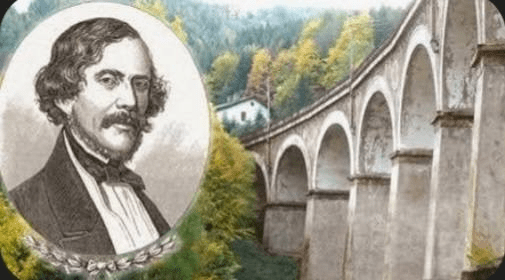

In the history of European engineering, few names carry the weight of courage, vision and creative mind as that of Carlo Ghega. He was not just a talented engineer; he was the man who dared to challenge nature where others saw only insurmountable obstacles. With his monumental work in the Alps, Gega definitively changed the way humanity thought about rail transport and the very limits of what was possible.
Origin and formation
Karl Gega was born on January 10, 1802 in Venice, into a family of Albanian origin. This cultural heritage, linked to the tradition of resilience and perseverance, seems to have left deep traces in his character. From a very young age, Gega displayed extraordinary mathematical abilities. He graduated in engineering at an age when most were still students, becoming one of the most promising minds of the Austrian Empire.
His training was not only academic; it was also practical, fueled by study trips to Europe and the United States, where he studied the most advanced technologies of the time, especially in the field of railways. This mixture of theory and practice would transform Gega into a visionary engineer.
Success in engineering
In an era when railways were considered suitable only for flat terrain, Karl Gega rejected the technical dogmas of the time. He believed that engineering should not be subject to fear, but to logic, calculation and imagination. In this spirit, he designed bridges, tunnels and tilt systems that had until then been considered impossible for steam trains.
Gega quickly became a key figure in the engineering administration of the Austrian Empire, earning the trust of both politics and science. But the pinnacle of his success would come with a project that would forever place his name in world history.
Major Project: Semmering Railway
Karl Gega’s greatest work is undoubtedly the Semmering Railway (Semmeringbahn), the world’s first mountain railway, built between 1848 and 1854. This ambitious project crossed the Austrian Alps, in a harsh terrain, with steep slopes, deep valleys and extreme climatic conditions.
The railway included: over 16 magnificent viaducts,v15 tunnels carved into the rock, curves and inclines that challenged the locomotive technology of the time.
Many experts predicted failure, even disaster. But Gega proved that science and courage can conquer nature without destroying it. The project was successfully completed and became a symbol of the European industrial revolution. Today, the Semmeringbahn is part of the UNESCO World Heritage, a lasting testament to his vision.
Legacy
Karl Gega did not leave behind only bridges and rails; he left behind a model of thought. He showed that technical limits are often mental limits and that progress comes from those who dare to challenge the impossible. For Albanians, his figure remains a source of pride, a testament to the Albanian mind having contributed to the foundations of modern European civilization. Karl Gega did not only challenge the Alps, he challenged the fear, routine and skepticism of his time, building a road that continues to inspire today.

 Balkan Academia