
The photos and the information is extracted from Fadil Kajtazi’s book “THE SERBIAN IDEOLOGY OF GENOCIDE (Analysis from Serbian and international sources) ENGLISH EDITION” published in 2025. Parts of the book has been translated and edited by publicist Petrit Latifi.
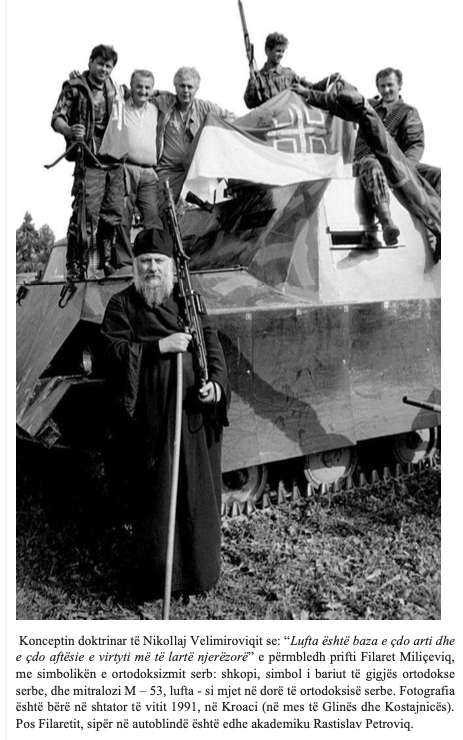
The doctrinal concept of Nikolaj Velimirović that: “War is the basis of every art and every ability and the highest human virtue” is summarized by the priest Filaret Milicević, with the symbolism of Serbian Orthodoxy: the staff, the symbol of the shepherd of the Serbian Orthodox Church, and the M-53 machine gun, war – as a tool in the hands of Serbian Orthodoxy. The photo was taken in September 1991, in Croatia (between Glina and Kostajnica). In addition to Filaret, on top in the armored car is also academician Rastislav Petrović.

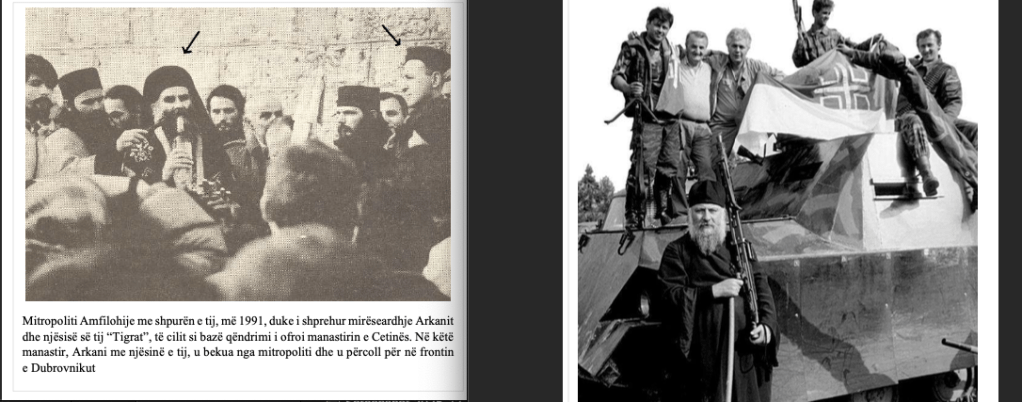
Metropolitan Amfilohije with his entourage, in 1991, welcoming Arkan and his “Tigers” unit, to whom he offered the Cetinje monastery as a base. In this monastery, Arkan and his unit were blessed by the metropolitan and escorted to the Dubrovnik front.
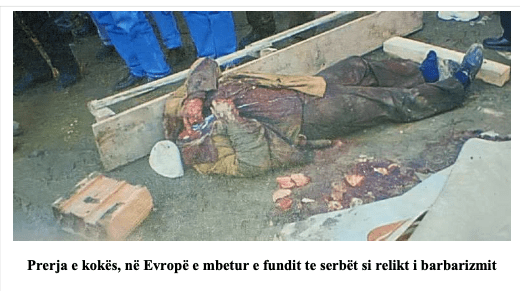
Beheading became a ritual of the Serbian echelons of genocide and was used massively against Albanians during the Balkan wars. Also, this method of massacre by the Chetniks was used during World War II, mainly against Bosniaks and partisans. This ritual of massacre, Serbian military units, police and volunteers, also used during the process of the dissolution of Yugoslavia 1991-1999, mainly against Bosniaks and Albanians.
In the photograph, the corpse of Banush Azem Kamberi, born in 1936, executed by beheading by the Serbian police in Reçak on January 15, 1999. That the murder was carried out according to the old ritual and with the passion of a sadistic outburst – with orders for genocide, can be seen from the way the corpse was arranged. The Serbian police, after cutting off the victim’s head, placed their index finger on the spot of the head and the plis, which is a traditional Albanian hat, on top.
This symbolism of the arrangement of the crime scheme was done with the aim of leaving a message of genocide: “This is how we will exterminate all Albanians”.
Photo by: Sanije Aliaj, “Consequences of the War in Kosovo – February 28, 1998 – June 10, 1999”, Democratic League of Kosovo – Sector for Immigration and Refugees, Prishtina, 2002, p. 362. The Recak massacre is the term for the event in the village of Recak, which took place on 15 January 1999. There, 40 Kosovars were found killed, 25 of whom were found in a hole on top of a hill. The oldest was 74 years old, while the youngest was a 12-year-old child. Most of the dead were between 18 and 65 years old, and among the dead was a woman.” Source: Kjell Arild Nilsen, “Milošević u ratu i u Haagu – Dokumentacija”, p. 416.
Source
Fadil Kajtazi. IDEOLOGJIA SERBE E GJENOCIDIT ( Analizë nga burimet serbe dhe ndërkombëtare ) BOTIMI I NË GJUHËN ANGLEZE. 2025.
ISBN 978-9951-980-02-9. Katalogimi në botim – (CIP). Biblioteka Kombëtare e Kosovës “Pjetër Bogdani”.


 Balkan Academia