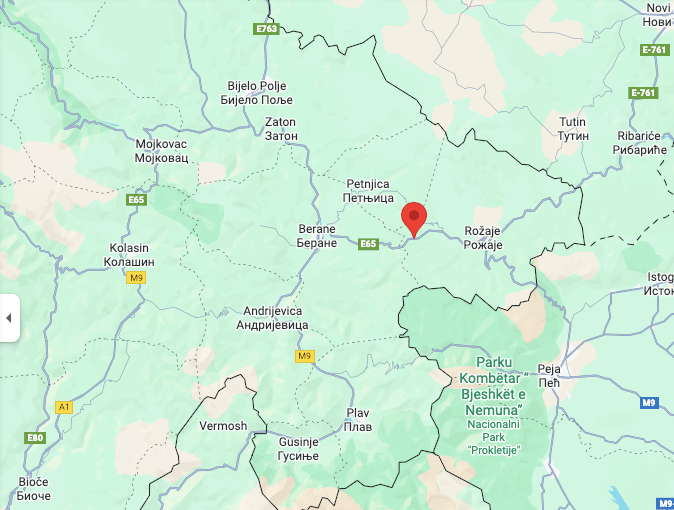

The Battles of Kacuberri, Çakorr, Smilevicë, Livadhi i Gjakut, Rozhajë, Senicë, Dugopolanë, Pazar të Ri, Shekullar, Kolashin and Ribaric were part a series of battles fought between the Albanian highlanders of Rugova, Plav and Gucia and the Serbian Chetnik paramilitary forces. These battles are mentioned in Albanian folklore.1
During World War II, on July 1, 1941, the Albanian government major Kolë Bibë Mirakaj, who was a military and administrative representative, appointed Zekë Berdyna as the civil leader and military commander of the Dukagjini bajraqs from Vermica to the Mokne mountain range. Zekë Berdynaj, as a leader of volunteer fighters, participated in many battles against the Chetniks fought in: Çakorr, Smilevicë, Kacuberr, Livadhi i Gjakut, Rozhajë, Senicë, Dugopolanë, Pazar të Ri, Shekullar, Kolashin, Ribaric, etc.2
The volunteers from Lugu i Leshan led by Hajdin Sahiti (1889-1952)
His call for the organization of a volunteer force to defend the Fatherland was answered by many men from Lug i Leshan to Peja. In all the villages of this area, as well as in other Albanian regions, volunteer units were formed which, although they stayed in their homes, were ready to go to the defense of the ethnic borders at the call of their leaders.
This was also the case with the volunteers from Lug i Leshan led by Hajdin Sahiti. They went to the aid of the fearless defenders of the endangered areas from Gryka e Rugova, Plava e Gucia, Bihori, Pazar i Ri, Tutin, Kacuberri, Rozaja, etc., these forces that were led by brave war leaders, such as Bik Dresheviqi, Qamil Dukagjinci, Sak Fazlia and others.
Hajdin Sahiti and his volunteers interacted with well-known leaders of the volunteer forces of Plavë and Gucië, Rugova, Sanxhak, Rozhaja, Podgur, Anadrina, Lugu i Baranit, Drenica, Shala and Bajgora, Llapi, Prizren and its surroundings, Has and Llapusha, such as Zhuk Haxhia, Sak Fazlia, Rizë Zymeri, Demë Ali Pozhari, Mulla Zekë Berdyna, Metë Bajraktari, Ramë Binaku, Lan Selimi, Ahmet Sali Shatri, Mehmet Gradica, Shaban Polluzha, Bislim Bajgora, Qazim Bajraktari and many other brave men.
Hajdin Sahiti and his brave men fought in Çakorr, in Pazar i Ri, in Tutin, in Mokna, in Smilovicë, in Kacuberr, in Rožaja and wherever the ethnic border was threatened. But Hajdin Sahiti and his men carried out joint actions and stood on the front lines with the legend of Rugova bravery Sak Fazlinë and his fearless warriors in Mokna, Çakorr, Smilovicë and many other places and battlefields.
He coordinated tactical combat actions with the brave man, the warrior and commander of the Llapushë volunteers, Alush Smajli. Hajdin Sahiti, with his fighting skills and the indomitable courage he had, but also of his men, remained indelible in the memory of the participants in the joint war. He remained a highly valued figure for the bravery and fighting skills demonstrated in these battles, which aimed to protect, liberate and unite the Albanian lands.3
Sources and references
- SHTIGJEVE TË RINISË. Poezi. Ali Daci 2012. https://www.google.se/books/edition/SHTIGJEVE_T%C3%8B_RINIS%C3%8B_Poezi/1fWuAwAAQBAJ?hl=sv&gbpv=1&dq=Lufta+e+Kacuberrit&pg=PA45&printsec=frontcover ↩︎
- Drini, 2023. “Hisori nga jeta e Mulla Zekë Berdynajt, luftëtarit të madh të lirisë shqiptare”. https://www.drini.us/hisori-nga-jeta-e-mulla-zeke-berdynajt-luftetarit-te-madh-te-lirise-shqiptare/ ↩︎
- “HAJDIN SAHITI LUFTËTAR E UDHËHEQËS I FORCAVE VULLNETARE PËR SHQIPËRINË ETNIKE (1889-1952)” 2009. https://www.albaniapress.com/indeksi?p=lexo_lajmin&id=8599 ↩︎

 Balkan Academia