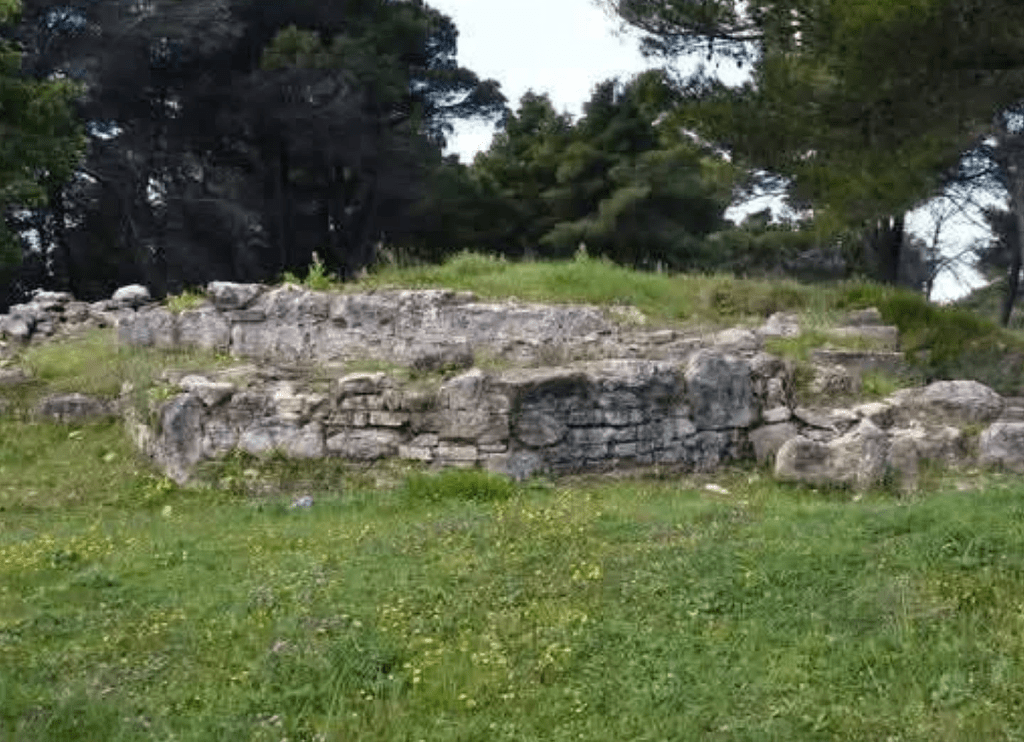

The Illyrian settlement of Gurëzeza e Cakranit represents one of the most important testimonies of early Illyrian habitation in this area of Upper Myzeqe. Positioned in a strategic terrain, with natural control over the valleys and old communication routes, this site testifies to social organization, protection and sustainable life in the Illyrian period. However, for years it has been left in total oblivion.
No systematic archaeological excavations have been carried out, no conservation or restoration interventions, there is no access road, nor information boards to identify and explain the site to the public. The lack of institutional attention has turned this asset into an invisible place, unprotected and endangered by natural degradation and human interventions.
Gurëzeza e Cakranit is not simply a hill of stones, but a page of Illyrian history that is being hidden in silence. Institutional silence today risks that tomorrow this evidence will be lost forever. Heritage is not protected with declarations, but with action, scientific research, and concrete care.
Euronews writes:
In today’s destination we will go back in time to Illyrian stories, to learn more about the power of our ancestors.
We will go to Cakran, where the 508-meter hill of Gurëzezë rises above it, where an entire glorious era has remained underground and many epics are buried.
Before going to Cakran, we visit the historical museum of Fier, where we will get acquainted with the history of epics and the treasures of Gurëzezë.
The historical museum has four sectors and eight pavilions such as history, archeology, iconography and ethnography. This museum preserves 1,500 original objects from the Stone Age to modern times.
“In the area of Cakran, where Gurëzeza is located, a multitude of tools, weapons of war, ceramic vessels, horn and bone tools and underground dwellings have been found from the Neolithic period. What makes this place even more interesting is the fact that the “toponymy of the knife” continues to be preserved there, because flint knives constantly surface from the works, which not only gave the name to the settlement, but also have an originality as museum objects,” says Ilirjan Gjika, director of the Fier Historical Museum.
The Illyrian community of the Bylins extended during the ancient period in the present-day province of Mallakastra. During the 4th-3rd centuries BC, the Bylins created and developed the form of their state called the “Byline League”. It was nothing more than the union of several tribes that in history is known by the political term ‘koinon’.
Their ruins are located in Belishovo and Gurëzezë in Cakran. Professor Bashkim Vrekaj tells us the details about the important Illyrian tribe.
“The Bylins are one of the most well-known, most developed Illyrian tribes that reached a high level of organization with the creation of the “Koinonin of the Bylins”. They had the advantage of being only 40 kilometers away from Apollonia and had contacts with this city. This influenced their civilization and it was one of the most civilized areas in antiquity,” says Professor Bashkim Vrekaj.
To get to Cakran, you can use the highway that connects Fier with Mallakastra or the old road that goes to Vlora.
The forest crown of Gurëzezë is also called the “Amazon” of Fier and if you want to go hiking, you can use the Gjorgozë, Kreshpan-Gurëzezë tourist trail which offers stunning views.
The ruins of the Illyrian settlement are found only in two ancient stone piles. Most of it lies underground and according to archaeologists, it is said to have extended over 23 hectares of land.
Gurëzeza is thought to be the third most important city within the “Bylin Koinon”. The city had a quadrangular plan and was surrounded by walls 2100 m long. Gurëzeza had the function of controlling the Apolloni-Bylis road, the present-day Cakran plain and the Gjanica valley.
The city in Gurëzeza had a developed artisan-trade economy. This is evident from the remains of many pottery workshops and the discovery in 1978 of a treasure of 2500 ancient coins belonging to: Apolloni, Dyrrachium and Orik.
Artur Skënderaj, whose lands lie at the foot of the Illyrian city of Gurëzeza, is quite passionate about the history of his ancestors, and he has even found a special ring-signet, which according to him belongs to King Monun.
“In the city I have found several historical artifacts before our era. I have found a ring that shows the divine man, who saw a face with a shield in his strategic position that protected the sacred divine light. On the ring is the sun made of gold and the silver field. The silver shows the land we come from, while the gold shows the precious light that emanates from us,” says artist Artur Skënderaj.
Gurëzeza gives you peace and love and we suggest you put this place on your list of destinations, where you can take a walk along the tourist trail and then relax in the pine forest, where the ancient Illyrian civilization lies.
Sources
https://euronews.al/destinacion-eksploron-gurezezen-e-qyteterimit-te-lashte-ilir/
LIST OF MONUMENTS: FIERI DISTRICT (PDF). Institute of Cultural Monuments – Ministry of Culture. Retrieved 23 December 2025.


 Balkan Academia