
Authored by George Michas. Translation Petrit Latifi
Abstract
This paper examines the largely silenced Holocaust of Psara (1824), focusing on the final resistance and self-sacrifice of the Arvanite Liapi tribe. Drawing primarily on the eyewitness diary of naval commander Georgios Sachtouris, it highlights how the Liapids chose to remain and fight in the Old Fortress of Paliokastro while others fled. Surrounded by overwhelming Ottoman forces, they ultimately set fire to the fortress, killing themselves along with their families and thousands of attackers. The study also explores how political and ideological biases in Greek historiography contributed to the marginalization of this event and the erasure of Arvanite contributions from national memory.
Also known as “The Holocaust of Psara”, D. Solomos, in his epigram on the destruction of the island of Psara by the Turks, which occurred in 1824, tells us that:
“On the black back of Psara,
walking only in glory
studies the brilliant boys
and on their heads wears a crown
made of some plants
that had remained in the deserted land…”
But how many of us modern Greeks know that these “brilliant boys” were Arvanites, and in fact from the Liapi tribe, who, when everyone else boarded ships to escape and save themselves, they, as Arvanites always do, stayed to the end in the war forts and finally, together with their wives and children, set themselves on fire in Paliokastro on the island, taking with them to their deaths approximately 4 thousand Turks?
But about these events, based on the information of the naval officer Sachtouris, the Athens Lawyer Mr. Panagiotis Ginosatis has written an excellent text, which was first published in the magazine “Besa”:
“Of course, there are many pages of our history that have remained dark.
There are many sacrifices of the people, which did not deserve to take their place in official history, because some conveniences did not allow it.
Few, of course, will know about the holocaust of the Old Fortress of Psarra. And this is because this event – like many others mentioned among the Arvanites – has been carefully kept hidden by the spiritual leaders of our country.
For about two hundred years now, the logic and historical memory of the people have been under pressure to accept that the pillars of the nation are the Phanariots, the Kocabazes and the high clergy.
The feasibility of this position, of course, is the other reasoning, which comes almost automatically, namely that the descendants of the Phanariotes and the Kocabas, as well as the descendants of the bishops, are the natural leaders of Hellenism.
Therefore, basing their practice on the idea that, in order to create history (which requires courage), it is better to write history (which requires only paper and ink), they managed to monopolize writing and, consequently, the teaching of history by leaving aside, distorting and interpreting the facts in their own way.
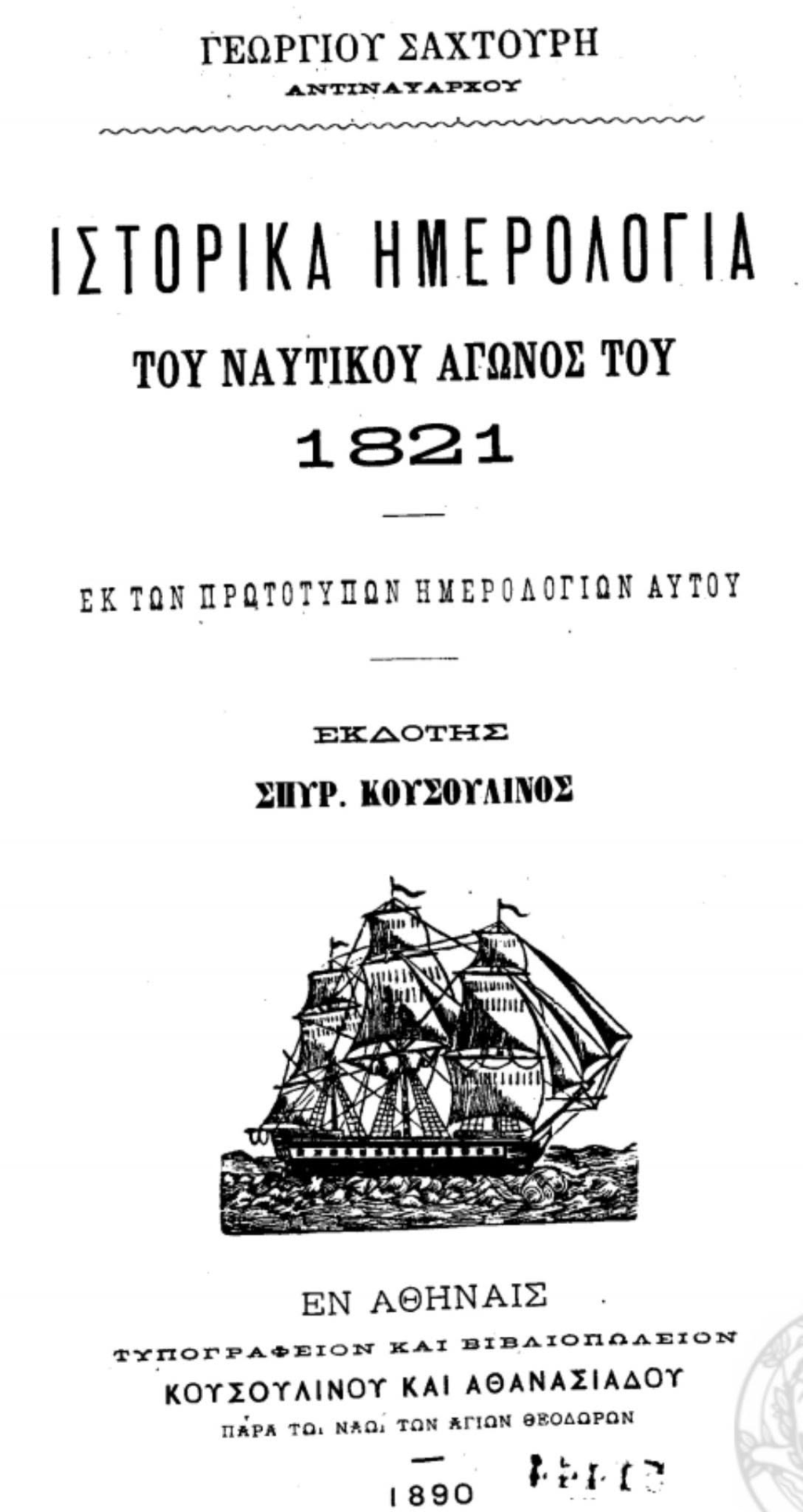
Something similar happened with the Psarras Holocaust, which occurred in 1824 and is described in the diary of the warship “Athena” by the ship’s captain, Georgios Sachtouris.
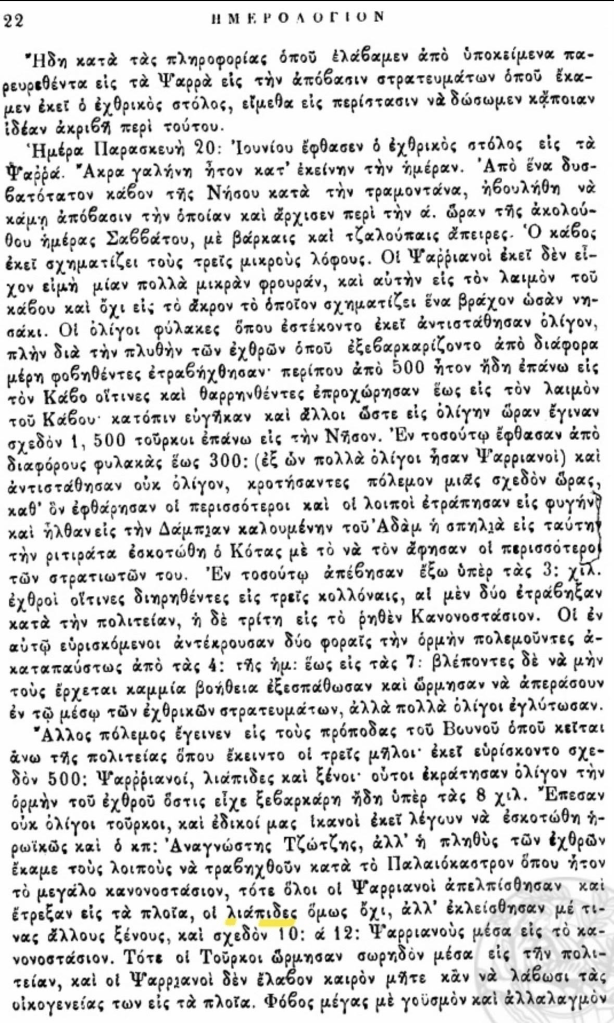
We quote excerpts from the diary, preserving, as much as possible, the spelling of the original text:
“July 15, Tuesday… According to the information we received from subjects who were present at Psarras at the landing of troops that the enemy fleet made there, we are able to give an accurate idea of this.
On Friday, June 20, the enemy fleet arrived at Psarras….”. The description of the landing of the Turks from a very inaccessible cape on the island and the surprise of the Psarraians follows, so that the great naval commander can continue.
“Another battle took place at the foot of the mountain that lies above the city where the three mills were located. There were almost 500 Psarrians, Liapids and foreigners, who briefly held back the attack of the enemy, who had already landed over 8 thousand.
Many Turks fell, and some of our skilled men there say that even the captain was heroically killed: Reader George, but the crowd of the enemy made the rest retreat towards Paleokastra where the large garrison was, then all the Psarrians despaired and ran towards the ships, but the Liapids did not, but closed themselves with some other foreigners and about 10-12 Psarrians inside the garrison…”.
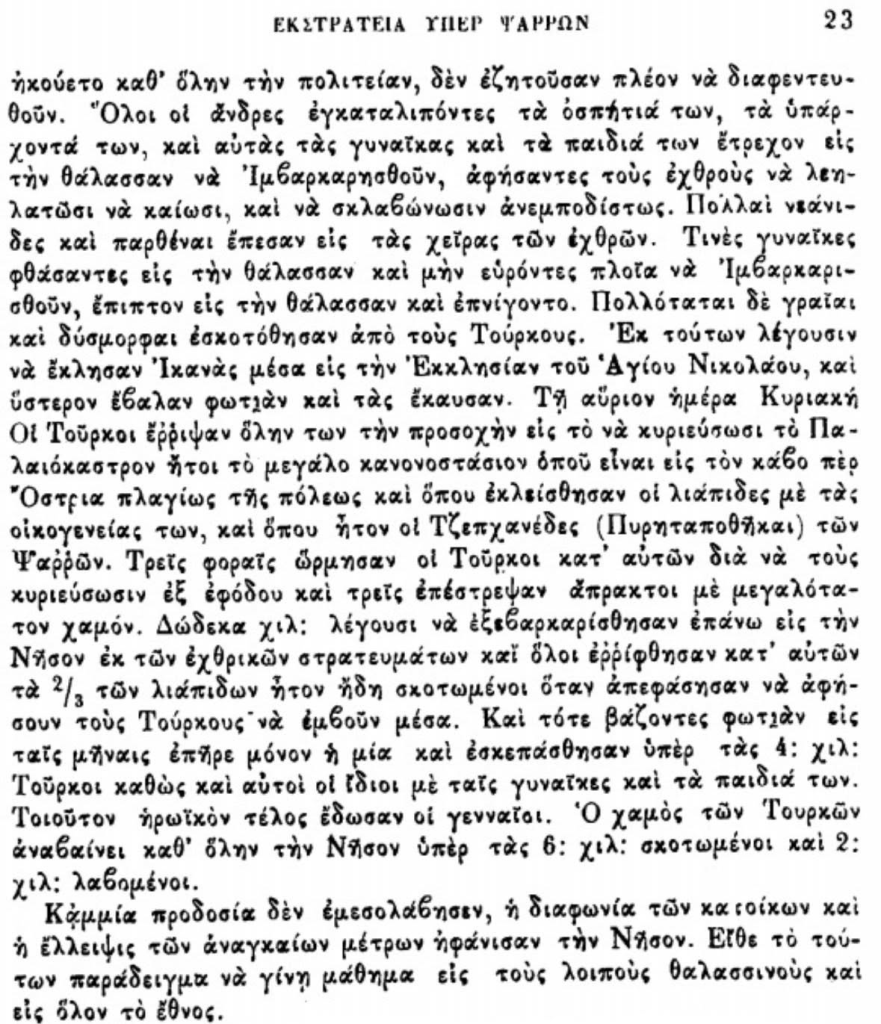
Then Sachtouris describes the massacre, plunder and enslavement within the state and continues. “The next day, Sunday, the Turks concentrated all their attention on the occupation of Paleokastra, that is, the large garrison located on the cape near Ostria, near the city, where the Liapids were confined with their families, and where the firemen (fireworks) of Psarras were located.
Three times the Turks attacked them to conquer them by assault, and all three times they returned empty-handed with heavy losses.
It is said that twelve thousand men landed on the island from the enemy troops and all fell upon them.
2/3 of the Liapids had already been killed when they decided to let the Turks enter. And then, setting fire to the moons, only a crowd of people were captured and over 4 thousand Turks were covered, as well as themselves with their wives and children.
“This is the heroic end that the brave experienced.” It is one of the events that is silenced because it is impossible to misrepresent. Sachtouris is absolute. He even clearly names the tribe to which these brave Arvanites belong. They are the Liaps (Labs).
Their blood is useful for the liberation of Greece, but their memory is unsuitable for future generations. This was judged by our historians, whose writings, more than their scientific point of view, echoed the ideologies and goals of non-Greeks (with which they “killed” them once again).
From the publication:


 Balkan Academia