
Abstract
This paper examines the Serbian exploitation of Kosovo’s mineral resources, with a particular focus on the Trepça mining complex in Mitrovica. Following the annexation of Kosovo by Serbia and later its incorporation into Yugoslavia, Trepça became one of the federation’s most significant economic assets, producing vast quantities of lead, zinc, silver, and gold. Despite its immense output and financial importance, generating billions of dollars in turnover, the benefits of Trepça were largely centralized in Belgrade, while local Albanian workers received low wages and limited economic development. Drawing on historical records, production data, and contemporary reports, the paper argues that Trepça functioned as a case of colonial-style economic exploitation, encapsulated in the proverb “Trepça works, Belgrade builds.”
Trepça works, Beograd is building
Ever since Serbia invaded and annexed Albanian territories, particularly the city of Mitrovica, there has been a process of exploitation with a flow of riches and ores being transported to Belgrad. This enabled the city to grow and enrich itself while Albanian miners recieved low wages. Hence the old proverb “Trepça punon, Beogradi ndërton” meaning “Trepça works, Beograd is building”.
Colonialism
The Serbian exploitation of Albanian mines is similar to the exploitation of colonial Africa, where European empires extracted gold, diamonds, and rubber while local populations received minimal benefits. In Latin America, silver and gold from mines such as Potosí made Spain rich, while indigenous laborers were subjected to harsh conditions. In South Asia, British control over raw materials like cotton and tea fueled industrial growth in Britain but limited the natives industrialization. Similar patterns appeared in the Congo under Belgian rule and in the Middle East through unequal oil concessions. These cases reveal a recurring global system where resource extraction served imperial centers at the expense of local societies. The Serbian colonial exploitation thus belongs to the same category as other European ones.
Trepça the treasure of Yugoslavia
Trepça was considered the treasury of Yugoslavia, and in this capacity Trepça was considered one of the largest financial sources of this federation. The former Finance Director of the giant Trepça indicates that during one fiscal year the combine had a turnover of up to four and a half billion dollars.
How much gold does Trepca produce?
Cited from a 2016 article of VOAL:
“What I reported 20 years ago, on October 9, 1996, and 19 years ago, on September 16, 1997, about gold, Trepça and the coal of Kosovo’s underground resources and their colonial exploitation. Kosovo press, front page headline today: “Trepça” reaches a dead end:
PRISTINA, October 15, 2016/ Within 45 years, from 1945 to 1990, a total of 10,710 kg of high-purity gold were produced in Trepça. The average was 238 kg of gold per year, according to data from experts, connoisseurs of Kosovo’s economic giant. Even 113 tons of pure silver within a year is one of the production records in Trepça at that time.”
The history of Trepca
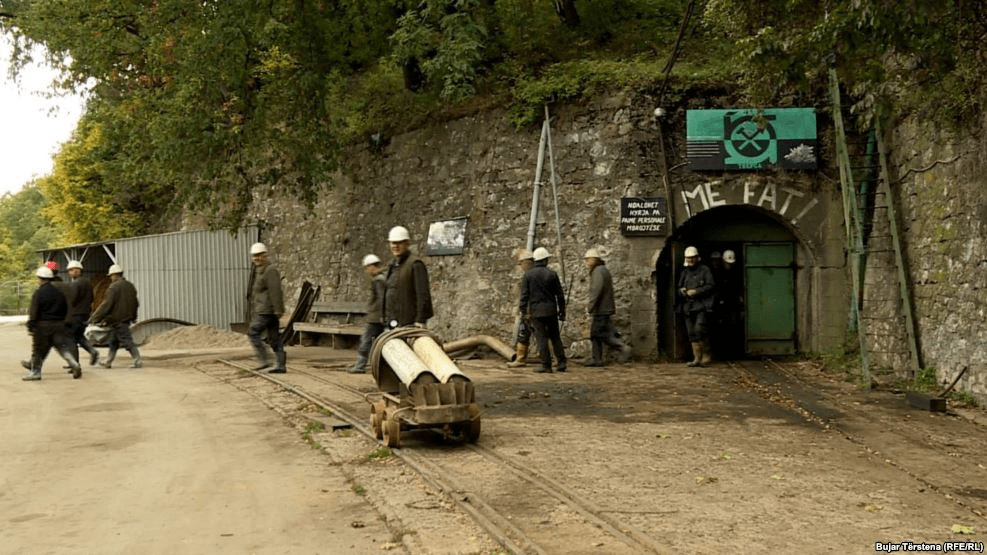
The Trepça Mine in Stantërg belongs to the city of Mitrovica. Mitrovica is undoubtedly one of the most important cities not only in Kosovo but also in the entire Balkan Peninsula and beyond, in terms of mineral resources. It lies in the alluvial plain of the rivers: Ibër, Sitnica and Lushtë, as well as on the slopes of the surrounding hills.
Mitrovica is located at an altitude of 508 – 510 m above sea level and has a good geographical position. Our country is rich in natural resources, especially known for its Pb – Zn – Ag mineralizations, which have been known since ancient times.
Since then, the resources of Kosovo were exploited by our Illyrian ancestors, then by the Byzantines, the Sassanids, the Turks and finally by the Serbian occupier. Since ancient times, it has been known about polymetallic sulfide deposits of Pb, Zn, Ag, Au, in Kosovo.
This has been confirmed by the discoveries of many old mining works: galleries, wells, tools that were used at different times during the exploitation of mineralizations of this type, as well as the residues from their smelting.
Some of the sulfur deposits (Trepça in Stantërg, Belo Brdo, Cërnac, Përroi i nënurur – Artanë), even today after the last war in Kosovo (1998/99), are still in use. Meanwhile, deposits such as: Hajvalia, Badovci and Kishnica are submerged in water and have remained without any supervision, although before the war (period 1988/99), they were important producers of Pb, Zn and Ag ores, etc.
For the first time in literature, the name Trepca is mentioned in 1303, in documents preserved in the archives of Dubrovnik (Republic of Croatia), as well as in Ottoman archives, especially for the Artana region.
The development of mining in the territory where the Trepca mines are located is known since the Illyrian and Roman times, and continued until the Middle Ages. Meanwhile, later, mining reaches its most rapid development in the 13th century.
The first geological research began in 1924, when English geologists began geological research for polymetallic sulfide mineralizations of Pb – Zn, within the Trepca ore field in Stantërg. Later, precisely in 1926, a joint-stock company known as Trepca Mines Limited was formed in London, which received a concession to exploit this resource for 50 years.
In 1930, the experimental production of Pb – Zn sulfide mineralizations in this source began. During the Second World War, the Germans kept the Trepça mine in Stantërg in working condition, but with a reduced level of production. While from 1945 onwards, until 1990, the mine worked continuously, with an average production capacity of about 600,000 tons per year.
During this period, the following mines were in use: Stantërg, Cërnac, Belo Brdë, Koporić and Zhuta Perlla – Albanik (formerly Leposaviq); Kishnica, Hajvalia, Badovci and Përroi i Ngjyrosur – Artanë. Based on production statistics, the Trepça mine in Stantërg, from 1930 to 2000, had this production performance.
Meanwhile, after the war, during the period 2000 – 2004, the mine did not produce, but was in the process of maintenance, research and preparation of workshops for production. Thus, in 2005, the mine began producing Pb and Zn ore with minimal capacity.
The greatest success of the Trepça combine was achieved in 1983, when Trepça exported goods worth 103 million dollars, ranking 5th among exporters in the former Yugoslavia. For 58 years of production work, the Trepça combine has produced 33 million tons of ore with an average content of 9% (Pb and Zn), or about 3 million tons of metal (Pb and Zn).
In addition, in the Trepça metallurgy and enrichment plant, at different times, the following quantities of precious metals were produced:
silver (Ag)
gold (Au)
bismuth (Bi)
cadmium (Cd)
In the ten-year period: 1975 – 1985, the average annual production at the plant was:
refined lead
electrolytic zinc
pure silver
gold
bismuth
cadmium
pyrite and pyrrhotite
sulfuric acid
The polymetallic deposit of Pb, Zn, Ag and Au in Stantërg is among the most well-known polymetallic deposits in Europe, in terms of size and the most attractive of the variety of minerals and crystalline beauties that this deposit has. Based on the amazing beauties of the crystals, the idea of founding myth of the crystal museum in Stantërg.
Thus, in 1964, the Trepça Crystal Museum in Stantërg was founded. At that time, the first collections of minerals had begun and then, their placement in the museum. Initially, the number of crystals extracted was small, but over time this number increased until today. The number of crystals extracted from the Trepça source is large and it is difficult to know their exact number. However, in the Trepça Crystal Museum fund, there are currently 1560 exhibits on display.
TWO REPORTS, 20 AND 19 YEARS AGO
Two reports that I made for the Albanian State-Official News Agency (ATA), one 20 years ago, on October 9, 1996, and the other 19 years ago, on September 16, 1997, about the gold, Trepça and coal of Kosovo’s underground assets and their colonial exploitation:
[16] KOSOVA WANTS ITS GOLD FROM FORMER YUGOSLAV RESOURCES
PRISTINA, OCT 9 (ATA)- By B.Jashari, Kosova is asking its own gold from the former Yugoslav resources, in the context of its right to inherit assets of the federation, where it had an equal status with six other federal units.
Last week President of the Republic of Kosovo, Dr. Ibrahim Rugova, asked Switzerland to block in its own banks the gold reserves of former Yugoslavia, until Kosovo’s right to inheritance is accepted.
The gold reserves of former Yugoslavia continue to be a state secret, but Albanian experts say that approximately it can be estimated as Kosovo’s share. Figures what Trepce’s output can be or has been in a year are very well known.
According to a scientific analysis on Kosovo’s resources, academician Minir Dushi has jumped to the conclusion that some 686 kg of gold and 204 tons of silver can be turned out in one year by “Trepce”.
Former director of “Trepce”, Aziz Abrashi, has admitted that in cases of “low productivity”, Trepce’s annual output was 270 kg of gold and 113 tons of silver, of great purity.
According to experts and witnesses the whole gold extracted from the Kosova mines whose quantity has always been kept secret during the entire existence of former Yugoslavia, has been taken and sent to Belgrade, to the state’s treasury, under a tight surveillance.
The return of gold, which is an unalienable asset of Kosovo, is an important segment of former Yugoslavia’s inheritance. But without Kosovo there can be no inheritance, and for this correct approach, the state and political leadership of Kosovo demands and expects international backing as well as support from the former Yugoslav republics.
[05] BELGRADE AIMS TO INTENSIFY EXPLOITATION OF KOSOVO RESOURCES
PRISTINA, SEPT 16 (ATA)-Discovery and intensive exploitation of coal resources of Kosova is at the center of a study undertaken by the Mineral-Metallurgical Faculty of Belgrade, for the supply of the whole energy system in rump Yugoslavia.
The project envisages the construction of nine heat-power stations, with a 2,800 Megawatt capacity, which will be added to the seven heat-power-station block set up earlier, with a 1,500 Megawatt capacity.
According to the above project there are 20 billion tons of coal reserves, which would be enough for a 1,500 year period. B.J. P.Ta/pas/lm/sh/
A KOSOVA PRESS ARTICLE TODAY, HEADLINE AND FACING ARTICLE:
“Trepça” enters a dead end/The three essential units of “Trepça” – the flotation mines in Stan Tërg, the flotation mines in Kizhnica and Artana and the flotation mines in Leposavić – risk going into liquidation from November 2, if by then the Constitutional Court does not issue a verdict regarding the dispute raised by the deputies of the Serbian List or does not decide on an extraordinary measure.
This is because the law by which those units were transformed into joint-stock companies cannot enter into force without the Constitutional Court giving its final verdict, Koha Ditore writes today.
The law was approved at the end of last week and makes the Government the owner of 80 percent of the shares in these mines and flotations.
But, a day earlier, it was made a subject of the Constitutional Court by the deputies of the Serbian List, who opposed the law both for its content and for the procedure through which it was approved.
The reason for this is that the law will not enter into force within the regular constitutional deadline.
Sources
SPECIAL – Gazeta DIELLI by the correspondent in Kosovo Behlul JASHARI.
http://www.hri.org/news/balkans/ata/1997/97-09-16.ata.html
http://www.hri.org/news/balkans/ata/1996/96-10-09.ata.html
Albanian Telegraphic Agency


 Balkan Academia