
by Fahri Xharra. Translation Petrit Latifi
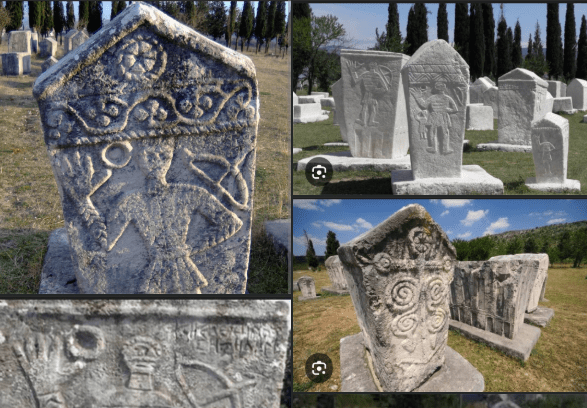
Stećaks – monumental medieval tombstones widespread in Bosnia and Herzegovina, Croatia, Montenegro and western Serbia – constitute one of the most enigmatic complexes of the material culture of the medieval Balkans. The dominant Serbian narrative of the 19th–20th centuries presents these monuments as part of the Serbian cultural heritage. This study aims to show that this claim is not based on archaeological, iconographic, epigraphic or historical data, and that stećaks should be understood as an expression of an autochthonous Thracian–Illyrian and Arberian heritage, crystallized in the context of the late Balkan Middle Ages.
Geographical extent and chronology
According to the UNESCO inventory (2016), over 70,000 stećaks are known, of which about 60,000 are located in Bosnia and Herzegovina, while the rest are in Croatia, Montenegro and Serbia[1]. Their dating mainly belongs to the period. 12th–15th centuries, i.e. an era in which:
Serbian state structures did not have a stable extension in most of these territories; the jurisdiction of the Serbian Orthodox Church was limited and clearly documented only in specific areas[2]. This fact constitutes a fundamental problem for any attempt to interpret stećaks as “Serbian” monuments.
Lack of features of Serbian identity
3.1. Ecclesiastical iconography
Studies by Marian Wenzel have shown that stećaks almost completely lack canonical Orthodox symbols, such as: the Byzantine-Serbian cross, iconography of saints, liturgical motifs[3].
In contrast, medieval Serbian cemeteries are closely associated with monasteries, churches, and standardized epigraphic formulas[4].
3.2. Epigraphy
The inscriptions on stećaks: are few, use simple funerary formulas, do not mention Saint Sava, the Serbian Orthodox Church, or Slavic church titles[5]. If these stones were a product of medieval Serbian culture, the absence of these elements would be inexplicable.
The argument of autochthonous continuity (Thracian–Illyrian and Arbër)
4.1. The building population
A significant part of contemporary historiography accepts that the stećaks are associated with indigenous local populations, who:
were not fully Slavized, preserved pre-Christian tribal structures and traditions[6].
These populations correspond geographically and historically to the areas where medieval sources attest to Arbëro and Arbëro-Vlach presence (Hum, Zahumlje, western Bosnia, inner Dalmatia)[7].
4.2. Pre-Christian iconography
The frequent motifs on stećaks – sun, moon, rosettes, round dance, knights – are well-known elements of the Illyrian-Thracian heritage and do not form part of the medieval Serbian artistic repertoire[8].
Dualism (Bogomils and Cathars) and the role of the Arbëro
The Serbian narrative often identifies the stećaks with Bogomilism as a “Slavic heresy”. This approach is reductive. Balkan dualism:
has earlier roots, linked to Eastern and Anatolian traditions,
spread among the autochthonous populations, including the Arbans and Vlachs[9].
The stećaks clearly reflect this worldview:
lack of church hierarchy, rejection of official iconography,
emphasis on spirituality and eternity, not on the institution[10].
Modern Serbian appropriation: an ideological construct
The fact that stećaks are not mentioned in medieval Serbian sources and enter the “Serbian” discourse only in the 19th century clearly indicates that we are dealing with a late ideological appropriation, similar to other processes of Balkan nationalism[^11]. This process is not critical historiography, but retrospective colonization of cultural heritage.
Conclusion
The analysis of archaeological, iconographic, epigraphic and historical data shows that stećaks: are not Serbian monuments,
do not belong to the Slavic Orthodox tradition, represent an autochthonous Thracian-Illyrian and Arbër heritage of the medieval Balkans. The Serbian narrative on stećaks should be seen as a product of modern identity politics, not as a result of scientific research.
Footnote / References
[1]: UNESCO, Stećci – Medieval Tombstone Graveyards, Paris, 2016.
[2]: J. V. A. Fine, The Late Medieval Balkans, Ann Arbor, 1987.
[3]: Marian Wenzel, Bosnian and Herzegovinian Tombstones, London, 1965.
[4]: Dimitrije Bogdanović, Istorija stare srpske književnosti, Belgrade, 1980.
[5]: Ćiro Truhelka, “Srednjovjekovni nadgrobni spomenici Bosne”, Sarajevo, 1941.
[6]: Noel Malcolm, Bosnia: A Short History, London, 1994.
[7]: Milan Šufflay, Srbi i Arbanasi, Zagreb, 1925.
[8]: Aleksandar Solovjev, Srednjovekovna simbolika Balkana, Belgrade, 1958.
[9]: Malcolm Lambert, Medieval Heresy, Oxford, 1992.
[10]: John V. A. Fine, ibid.
[11]: Ivo Banac, The National Question in Yugoslavia, Ithaca, 1984.


 Balkan Academia