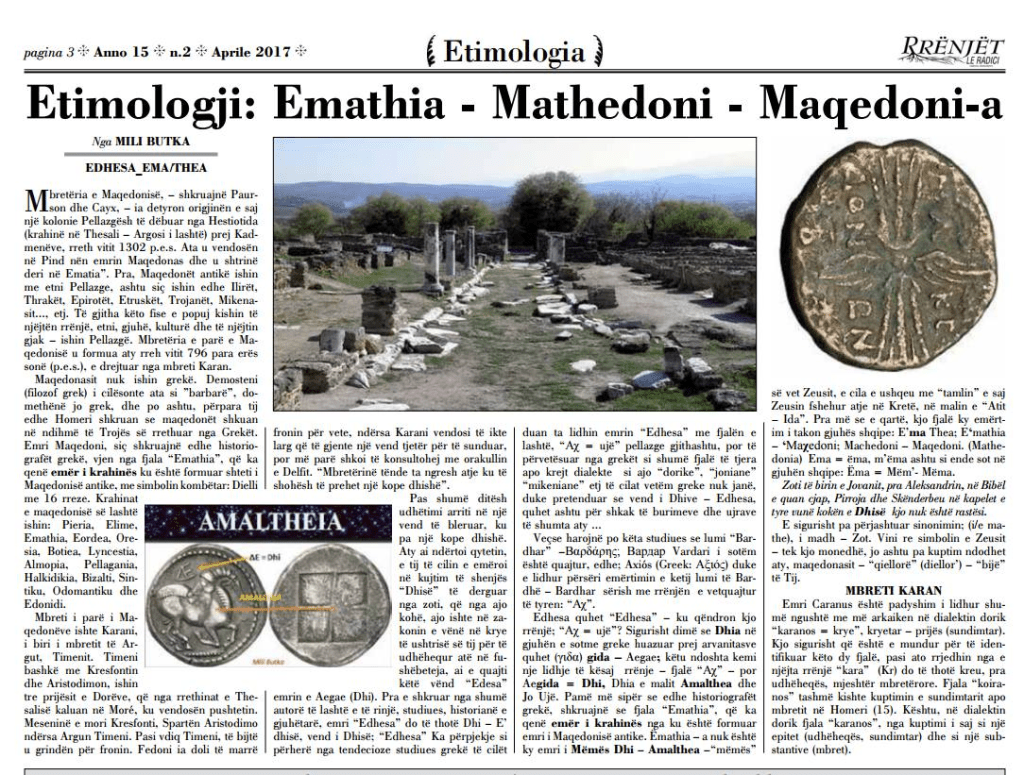

by Aleksander Hasanas (Mili Butka). Translation Petrit Latifi
This article discusses the etymology and early historical background of the name Macedonia, focusing on the terms Emathia, Mathedoni, and Maqedonia. It argues that the name and identity of ancient Macedonia predate classical Greek usage and are connected to older pre-Hellenic linguistic layers in the Balkans.
The Kingdom of Macedonia, writes Pausanias and the Cayx, traces its origin to a Pelasgian colony and the Pelasgian descent of Hestioda (region of Thessaly – Argos or region) from Cadmeans, around the year 1302 BCE. They settled in Pindus under the name Macedonians and expanded as far as Emathia.
Thus, ancient Macedonians were also Pelasgians, like the Illyrians, Thracians, Epirotes, Etruscans, Trojans, Mycenaeans, etc. All these tribes and peoples shared the same roots, ethnicity, language, culture, and the same blood, that is, Pelasgian.
The first Macedonian kingdom was formed around the year 796 BCE, led by King Caranus. Macedonians were not Greek. Demosthenes, the Greek philosopher, referred to them as “barbarians,” meaning not Greek, and likewise before him Homer wrote that Macedonians marched on Troy alongside Greeks.
The name Macedonia, write Greek historians, comes from the word “Emathia,” which was the name of the region where ancient Macedonia was formed. The symbol of ancient Macedonia was the Sun with sixteen rays. The regions of Macedonia were Pieria, Elimeia, Emathia, Eordaea, Orestis, Bottiaea, Lynkestis, Almopia, Pelagonia, Chalkidiki, Bisaltia, Sintike, Odomantike, and Edonis.
The first king of Macedonia was Caranus, son of King Argus, Timenus. Timenus, together with Cresphontes and Aristodemus, were the sons of Dorus, who from the regions of Thessaly passed into Morea, where they established power. Messenia was taken by Cresphontes, Sparta by Aristodemus, while Argos by Timenus. After the death of Timenus, a conflict arose over the throne. Pheidon took power.
Seeking a place to rule, Caranus decided to leave Argos and search for another land to settle, but first he went to consult the oracle at Delphi. “Your kingdom will be found where you see much rain.” After many days of travel, the journey arrived at the chosen place, where rain fell without stopping. There he built a city and named it in memory and as a sign “Dhisë,” meaning god, because from that time it was the sign at the head of his army to guide the journey, and he called this place “Edhesa.”
Many ancient and modern authors, scholars, historians, and linguists write that the name “Edhesa” means rain, place of rain. “Edhesa” is derived from the root “Dhi – E – dhishë,” place of rain. Surely the word Dhi in today’s Greek is borrowed from earlier languages (ydor), meaning water. Perhaps Aegean is connected to this same root word “Ax,” but Aegean = Dhi, Dhia of Mount Amalthea and not water.
We see above that Greek historiographers write the word “Emathia,” which was the name of the region from which the name of ancient Macedonia was formed. Emathia is not the name of Mother Earth – Amalthea – “mother.”
It is very clear that this word belongs to the Albanian language: Ema Thea; Emathia; Maqedoni; Macedoni (Mathedonia). Ema = ëma, mother, as it still exists in Albanian language. Ema = Mëmë, Mama. God was called father. Alexander, in the Bible, is called son. The daughter of Skanderbeg in the chapels is also called the daughter of Dhisë. This is not accidental.
Certainly, without excluding synonyms (mëmë), great mother – god. The Sun is the symbol of Zeus and this symbol is also found on Macedonian coins, meaning “heavenly” (sun) – son of Him.
King Caranus’ name is undoubtedly connected closely with the archaic root in the Doric dialect “karanos” = head, leader, expedition (commander). This surely can be identified as a Greek word, after the root “kara” (Kr) meaning head, thus leader, military commander. The word “kora” perhaps had the meaning of expedition or leader in Homer. Thus, in the Doric dialect, the word “karanos” has the meaning of leader or commander and is a substantive (king).
Source
Etymology: Emathia – Mathedoni – Maqedoni-a. Mili Butka. Originally published in Rrënjët, April 2017.


 Balkan Academia