
Abstract
This study examines the Turkish War of Independence (1919–1923) through the lens of Greek military invasion of western Anatolia. Beginning with the Allied-approved Greek landing at İzmir in May 1919, the conflict evolved through successive Greek advances aimed at securing new territories and suppressing emerging Turkish resistance. The analysis traces major campaigns, including the inland occupations, the battles of İnönü, the advance toward Ankara, and the Battle of Sakarya, which marked the end of Greek offensive momentum. The failure of these operations contributed to the consolidation of Turkish military organization and ultimately shaped the military and diplomatic outcome of the war.
Leaders, military developments, outcomes, and the Greek intervention. This conflict marked the dissolution of the Ottoman imperial order and the emergence of a new state in Anatolia. It unfolded across several fronts, involved multiple military and political leaders, and was shaped by a limited number of decisive campaigns. The following overview includes the background to the Greek landing in İzmir and traces the war’s main phases.
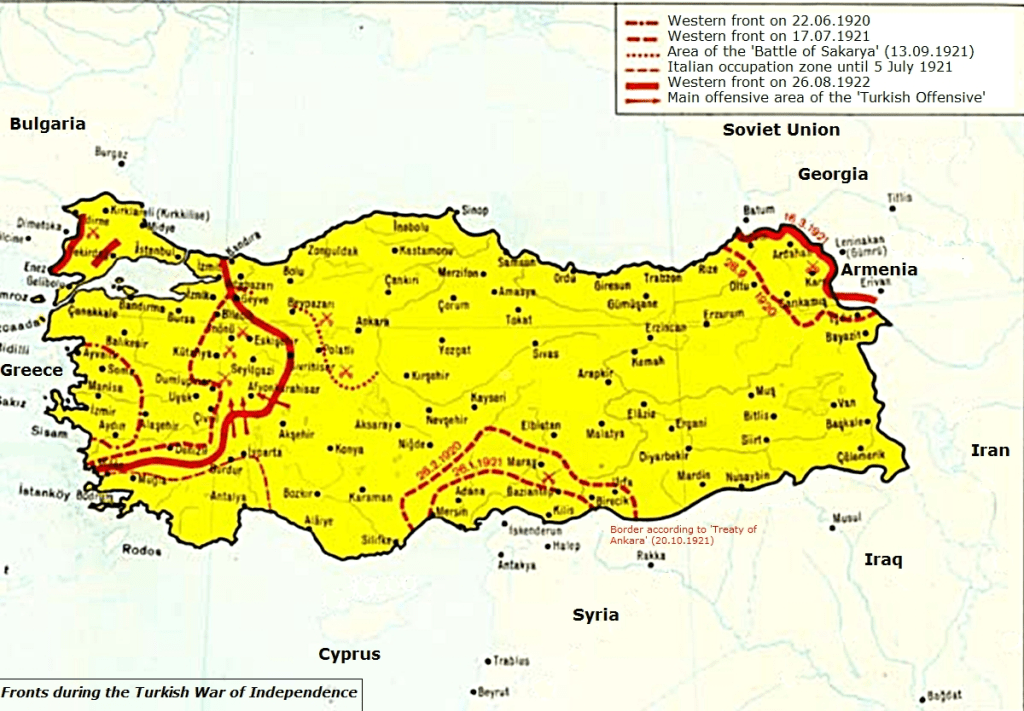
The Turkish War of Independence was shaped to a large extent by a series of Greek military operations in western Anatolia between 1919 and 1922. These campaigns aimed to secure territorial control following the First World War but ultimately contributed to the consolidation of organized resistance in Anatolia.
Background — The Greek landing in İzmir (1919)
On 15 May 1919, Greek forces landed in İzmir with Allied approval. The operation was intended to establish control over western Anatolia while postwar negotiations were ongoing. Greek troops rapidly expanded their zone of occupation beyond the city, encountering local resistance almost immediately.
Early clashes between Greek forces and irregular Turkish units occurred throughout the Aegean hinterland, marking the beginning of sustained armed conflict.
Early Greek advances (1919–1920)
Following the İzmir landing, Greek forces conducted a series of advances inland, occupying towns and transport corridors in western Anatolia. These operations were designed to:
- secure communication lines
- suppress local resistance
- demonstrate effective control over the region
At this stage, Turkish resistance consisted largely of irregular militias, which lacked centralized command but engaged Greek units through ambushes and localized fighting.
Expansion of the Greek campaign (1920–1921)
In 1920 and early 1921, Greece expanded its military objectives. Greek forces launched coordinated offensives aimed at destroying emerging Turkish regular units and undermining the authority of the Ankara-based leadership.
Major advances targeted strategic railway lines and key urban centers. These operations resulted in the occupation of large areas of western Anatolia and placed significant pressure on Turkish defensive positions.
Battles of İnönü — Greek offensives halted (1921)
Greek attacks in January and March–April 1921 sought to break Turkish forces near İnönü and reopen the route toward central Anatolia. While Greek units achieved some tactical successes, they failed to secure a decisive breakthrough.
The inability to defeat Turkish forces in these engagements marked a shift in the conflict, as Turkish resistance became increasingly organized and centralized.
The advance toward Ankara (summer 1921)
In the summer of 1921, Greek forces launched their deepest offensive into Anatolia, advancing eastward toward the Ankara region. This campaign represented the peak of Greek military reach.
Greek troops extended supply lines across difficult terrain while engaging Turkish forces in continuous defensive actions. The campaign culminated in the Battle of Sakarya.
Battle of Sakarya — End of the Greek offensive momentum
The Battle of Sakarya (August–September 1921) followed weeks of sustained Greek attacks against fortified Turkish positions. Despite repeated assaults, Greek forces were unable to achieve a decisive victory.
After heavy casualties and logistical strain, Greek units withdrew westward. This withdrawal effectively ended Greece’s capacity to conduct large-scale offensive operations in Anatolia.
Final Greek defeat (1922)
Although Greek forces retained defensive positions for several months, they were no longer able to regain the initiative. In August 1922, Turkish forces launched a major counteroffensive that broke through Greek lines.
The defeat at Dumlupınar led to a rapid collapse of Greek positions and a general retreat toward the Aegean coast. İzmir was re-entered by Turkish forces on 9 September 1922, ending Greek military operations in Anatolia.
Consequences of the Greek campaign
The Greek offensives had several long-term effects: they contributed to the militarization and unification of Turkish resistance, they overstretched Greek logistical and political capacity and they played a central role in shaping the final military outcome of the war The failure of the Greek campaign influenced subsequent diplomatic negotiations and the eventual recognition of a sovereign Turkish state.
Sources
Zürcher, Erik J. Turkey: A Modern History. I.B. Tauris.
Llewellyn Smith, Michael. Ionian Vision: Greece in Asia Minor, 1919–1922. Hurst.
Ahmad, Feroz. The Making of Modern Turkey. Routledge.
Shaw, Stanford J., and Ezel Kural Shaw. History of the Ottoman Empire and Modern Turkey, Volume II. Cambridge University Press.
Erickson, Edward J. Ordered to Die: A History of the Ottoman Army in the First World War. Greenwood Press.

 Balkan Academia