
written by Noah Jasmin.
The discovery of stone with pictograms in Dzhuxha expands the origin and geography of the prehistoric Pelasgian civilization in the territory of Mirdita, in Xibër, Blinisht, Orosh, and in Rubik, in 2015, in cave settlements, objects of the Stone Age, Copper Age and in the formation of the Illyrian-Piruste ethnoculture
I often travel to Albanian countries to be, not only an experiencer of their interesting mosaic, but also an in-depth explorer of the beautiful, useful, with the variety of underground, geographical, ethnocultural, spiritual and historical assets in the most idyllic and possible way. the past of our heritage.
On both sides of the “Rugga e Kombit”, which crosses the valley of Fan and the course of the river of the same name, lies the territory of Mirdita, in a relief with an evocative vision of beauty, as an amazing natural amphitheater, which in addition to being excellent for HEC , pocket constructions, resorts and dilapidated mining factories, historical sites; the ancient ruins, the holy Catholic buildings, the epic towers very interesting from the architectural style, with historical cultural values not only as family residences, but also as defense posts from the invaders, today most of them ruined and replaced by modern houses, and the cities of Rubik, Rrëshen, Kurbnesh and Repsi, which mourn among the bright colors of greenery.
Further on, Gëziqi, where quite a few cult objects were once erected, the most important being the Benedictine Abbey of St. Paul, the episcopal seat of the Diocese of Pulti and a place of assemblies. Among the ruins of the Ndrefana Church, the Coat of Arms of Arbër has been discovered, which is kept as the symbol of the door of the Dukagjin family.
Where is Blinishti? In the medieval period it was an important settlement, where according to the Croatian albanologist Milan Suflai: it was the political center of one of the most important arborist families of the century. XIII.
Mirdita’s nature speaks to you in the language of art. She, like an oracle, tells us the events, symbols and mysteries even from long ago, that resist her in the underground and surprisingly one day find a way out, to remind us that they are hidden lights that keep the glow on. of ancient times.
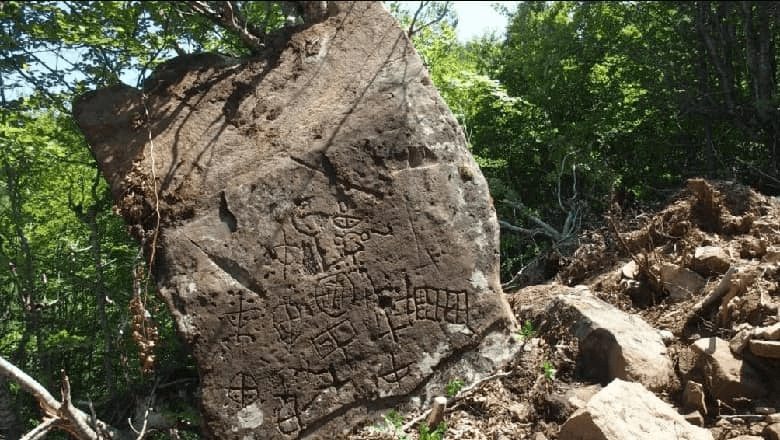
Turned into an object of curiosity not only for researchers and historians, but also for fans, the stone with prehistoric pictograms discovered by chance by a simple person not after the archeology works in Dzhuxha of Mirdita constitutes an interesting historical event, which proves the existence of a civilization ancient.
The finding of this stone in Djuxhë, which brings divine messages from the depths of a distant past, should not be called a coincidence, because it has similarities with prehistoric rock art symbols discovered in other areas of Albania, such as in Lepenicë in 2005, in Malice of Prespa in 2012, in Boville in 2013, of Reçi’s drawing, etc. They are known as the beginnings of writing in all of human science and date back extremely far into antiquity, thousands of years before the birth of Jesus Christ, perhaps around 5 BC, and more.
The discovery of stone with pictograms in Dzhuxha expands the origin and geography of the prehistoric civilization of the Pelasgians in the territory of Mirdita, the same in Xibër, Blinisht, Orosh, and in Rubik, in 2015, in cave settlements, objects of the Stone Age, Copper until the formation of the Illyrian-Pirust ethnoculture, who spoke their language, respected their deities, buried the dead in their ancient and traditional way, preserved the clothing and names of children, respected their customs and customs.
In Merkurth of Oroshi, traces of rock art have been discovered in a cave, as well as an ax from the Neolithic period. While digging for the opening of the “Nation Road”, a cave was destroyed in Konaj (today there are no traces left), that on its side walls there were rock art writings and weapons, hunting tools, bronze swords, knives, Illyrian helmets, women’s jewelry, a priceless treasure, whose whereabouts are unknown.
With Frrok Bardhin towards the Dwarf
We travel to Djuxha together with Frrok Bardhi. With the still undiminished feeling for his birthplace, which he does not forget, and which he carries with him everywhere, the discovery of the stone with pictograms and the ancient history of the land, has made him more proud.
– The more years go by, – says Frroku, – the more we yearn for the place where we were born, where we spent our childhood, where our clothes are torn, where our soles are worn and where our ancestors rest. Footprints are here and sometimes we find them and sometimes we lose them, but we are aware that we have planted a piece of our soul here. Therefore, loving the homeland and feeling yourself with its pulse, and trying to contribute, is a value. Without knowing who you are and where you come from, there is no pride and nationalism.
The conversation flows pleasantly and the day brightens up, but his words are echoes of historical values, which show that beautiful souls speak with the chords of sensitivity about our heritage, for which time is confused, some from ourselves, some from others, and some from fate , has left them far. Frroku is a special person with a world of his own, which proves citizenship, humanity, intellect, dignity, kindness, independence in thoughts and actions, as an added value of the mirditori. Our society needs such people, because they always stand out where the “antagonistic contradictions” that aspire to national ideals are squared off. He tells you bits from the epic, the tragic at times, the side whispers of legends, oral histories (ballads, tales told by the locals), finds and artifacts, toponyms and mythology of these places, and we don’t make any comments about them. let me describe in a short exposition, the historical aspects of Mirdita, the ancient settlements, the towns, the testimonies of the centuries-old wars and efforts of the men, who preserved these lands intact.
After passing the silent Reps, drowned in the ruins of mining buildings, it doesn’t take long to reach Djuxha (the name is not even known to the remaining inhabitants from where it got it), through a zigzag-shaped uphill road, but which has the beauty of alpine landscapes amidst sun-kissed forests, weaving tree branches to form tunnels of greenery, with the sweet whistling of the symphony of the morning breeze. It appeared, unexpectedly, with all its majesty, Guri i Nuses, the stone of legend, wrapped for hundreds and hundreds of years in the mystery of the name, to amaze us with its gray and very steep slope at a relative height of 1700 m. Walk and the Great Road comes to mind: Shkodër-Prizren, which crossed the lands of Mirdita with the Oroshin station in the palaces of Markagjonaj, where it was the spiritual and political center of Mirdita (from the XNUMXth century). In front of us stood the majestic Munella and under its feet Domgjoni with the unique Gurra, built in the XNUMXth century AD. On the slopes narrowed by the rocks between the ridges, the eyes look for the prison of Spaçi, considered as the Albanian Gulagu, a heavy “crippling” hell for hundreds of prisoners, from the curse of time and the follies of the communist fools.
Djuxha lies under Mount Zepa, with neighborhoods scattered here and there; Birzhëza, Lasha, Melthi, Kroji i Madh, where mothers only give birth to sons, so that they sound so beautiful in the soul. The slopes of Mount Zepa are a green wonder, with endless meadows; aromatic and medicinal flowers, amazing karst pits and caverns like boulders and glacial layers over 10 m thick, fields, fresh air, fresh waters, which shine as they meander through the greenery, tall and dense trees and rocky slopes, which appear more majestic from the purity of the sky and the rays of the sun, and offer unlimited freedom to experience a sense of peace in the soul. They have meaning even without researching the treasures of antiquity, where kindness, hospitality and respect are limitless. If you climb higher, close to the peaks, which rise like a pyramid, from where an amazing landscape opens, Sofra e Leka, Kodra e Kuvendi, Shpella e Manec, Kepi i Kyteza, Rirti i Kyteza, and above, where the telephone antennas rise television repertoires, to get so close to the fortress of Bato, this fortress where the warrior Bato fought the Romans, to see the ruins of the churches with the mysticism that surrounds them, that they were built on places where the pagans prayed to the gods.
Due to the difficult conditions, an almost biblical abandonment of the Dwarfs is witnessed, towards the surrounding areas and cities for a better life. Now all that is left is the forest with its fragrance, the stillness and the chirping of birds, along with the chorus of chirping warblers, but also the occasional jingle of cattle bells.
Dwarf breathes antiquity
On a whole stone hillside surrounded by a heavenly landscape, a magical thrill grabs you, and does not let you go for a long time, with all the sensory energies of the mind and soul, when you are facing the stone, 2.40 cm high, 1.70 cm wide and 28 cm thick, and weighing 2.5 tons, discovered by the erosive works of extracting the plates in Dzhuxha of Mirdita.
archaeologists, this stone with pictograms has been identified as a sign of an ancient culture, which was practiced by the Illyrian peoples of Dardania to ancient Thrace and Asia Minor. Researchers think that these symbols predate the Vinca culture, as mystical inscriptions. Therefore, these pictograms are very early and the dating of this prehistoric work must be postponed quite a bit in time. The settlements of that period are very widespread in the Albanian territory, reflected and analyzed by archaeologists Frano Prendi and Adem Bunguri in the book, “Studies on the prehistory of Albania”. Eight thousand years ago, a homogeneous population lived in today’s territory of Albania pre-Illyrian, which in the bronze period about four thousand years ago took on the clear features of the Illyrian nation. These features were expressed through fortifications, pottery, female ornaments, weapons, as well as cult elements. Together with these, myths were also created, which we often encounter in mythologies: Bees, Fairies, Shtojzavalle, Heavenly Deities, Fire, legends, ballads, various rites and superstitions and famous epics, which according to some finds in the Korça basin, thought to begin with the famous creation of the wall.
The pictograph stone may perhaps be more than a temple of a prehistoric cultural stratification of Pelasgian times, requiring the decipherment and explanation of many codes perhaps still unspoken and not properly understood, of the symbols of faith of pagan Orpheism the same as those prehistoric Copper Age (Eneolithic). Orpheus was a creator of c. 3-2 BC to 1-2 AD, (The Hymns of Orpheus). So they are pre-Homeric, although they are not mentioned in either Homer or Hesiod – two important authors of Hellenic and European culture. Scholars believe that Orpheus predates Homer and Hesiod. So they are Pelasgians, which may have been part of a Pelasgian pilgrimage center of the ancient “Myrmidonas” tribe, which is a phoneme of the name Mirdita. The Myrmidonas are mentioned by Homer in the Trojan War as its defenders and are also found in the Map of Hondius.
In the background of the stone, the bow and arrow stand out, which represent the earliest hunting and fighting tools, which clearly show the warrior and intelligent character from which the current Albanian race came to life. The bow and arrow are the weapons used in a battle, and the places surrounded by a cross in the middle are those of the fighting, while the sectioned rectangle on the right, at the end of the stone, are the burial places of the fallen in that war. It has been said in all studies that the Illyrians were a warrior people, a characteristic that was inherited from the Arbers. The part on the right where a rectangle is shown, divided into several parts, represents the burial place of the fallen of that battle, but nothing can be said for sure without being examined by researchers.
The most special symbol on this stone has to do with the prehistoric cult of the sun, perhaps the most ancient cult of mankind and the Moon, the two shining stars responsible for the birth, resurrection and resurrection of plant and animal creatures on and around the earth. It is known that at that time the Sun was considered the God of the Pellazian world. These occurrences required keeping records through writing.
There or in the museum
For days, the dilemma of the inhabitants of Djuxha, journalists, well-wishers and researchers, whether this symbol of ancient times will remain where it was found to tell the history and lifestyle of the first ones, or whether it will be possible to move it to the museum , to be better preserved. In general, they are not moved from the place where they are discovered, but in every country of the world it happens that, with exceptions, for certain reasons and circumstances, movable archaeological materials are taken to specialized centers, where they are studied and analyzed.
The inhabitants of Djuxha sacredly nationalized and “notarized” this work of the ancient history of these three before it was separated from there, even with the consent of the local government of Mirdita, accompanied by strong security measures, by a police team, which it also left a bad taste for the way it was transported, without proper means, to the National Museum. In the absence of our state to preserve it, this was the only way to save it from damage or loss, as has happened with many Albanian archaeological treasures, to be sold, wasted, “forgiven”. Let’s hope it’s in the right place and safe. As and where he was there was no complete security. The ill-wishers of Albanian history could destroy it in an “unknown direction”, as they have done with many artifacts, others stolen even in museums, or by destroying the pictograms, stalactites and stalagmites in the caves, of which only the photographs remain. to continue with the well-known tale “discover and alienate”. Perhaps our neighbors would seek to destroy it, as evidence of Albanian history and culture, but there was also the possibility of kidnapping it to present it later as a discovery on their land.
Meanwhile, the question arises: what value will this stone have when it is not in the discovered place, turned into a monument of human history in the early stages of development, and which transmits through the symbolism of engraved signs mysterious messages of the time of realization? This rare work of past millennia must stand where it was formed in hundreds of millions of years of geological age, and in thousands of years of the mysterious human alphabet, engraved upon it, where archeology has its say and history is written in the place where it was found. found. It would be good to erect a shelter in the place where it was discovered, to protect it from the irresponsible, from the scorching sun, from the cold rain of the mountains or from the icy fog that penetrates to the core, with its conservation standing or lying down , turning it into a true place of pilgrimage for visitors, both Albanian and foreign, a museum for the whole of Mirdita and the Nation.
This carved stone tablet, for a thousand and one reasons, should not have been moved from the place where it was discovered because the position, orientation with the horizon, sunrise or sunset, the depth where it was found, the relief, the geological formation, the traces of early roads or signs of civilization. This stone should not be detached here, but should be associated with other objects of that time or even later. Any neglect will be unforgivable for the ancient history of our lands. Unfortunately, there has been a lack of exploratory research and archaeological surveys for decades in Mirdita. If it is taken in isolation and continues with the “nail and horseshoe” theory, the results risk going in dead-end directions. Therefore voluntarism and hasty empirical emotional conclusions are not enough, but study, patience and most importantly academics move from the comfort of their couch, study not only the stone, but must dig the area around, and all discoveries must be preserved studied in the complex by researchers of all fields, in order to give a clearer panorama to achieve the right results, of a discovery of great interest. They, as indifferent people, do not read the messages of antiquity, where they are discovered underground, but ordered to send it to the National Museum.
***
It is the last limits of the day, when the sun begins to set and the landscape takes on magical colors. I see the faces of Frrok Bardhi, Nikollë Biba, Ndue Prenga, Shkurt Ndreca and other residents who meet there, who love Djuxha and feel proud of this evidence of our lands. He talks very openly with them, about things that calm us and others that worry us in our lives. Djuxha, not only for this ancient discovery, but also in general for its natural assets, air, organic products and its tranquility definitely requires attention to become a favorite place for tourists. Life becomes beautiful here too, with opportunities for a normal life, promoting beauty, investing and protecting from destruction. Therefore, the local government must make investments, first of all the road, so that Xhuxha and its surroundings can be visited. It is interesting that, in spite of the conversations, he feels their respect, reads their intelligence, appreciates the manhood, the nobility, the faith of the friend, with a blessed spiritual warmth, which radiates goodness. With smiles gathered in a bunch, they convey unquestionable pleasure. Even though we have to leave, I feel the desire to return here again, where the symbols write the history.

 Balkan Academia