
Abstract
This article explores claims and public debates surrounding alleged Serbian involvement in promoting and financing Islamist extremism in the Western Balkans. It argues that Serbian state actors and intelligence services have engaged in a strategic campaign to undermine Albanian and Bosnian public opinion and damage their relations with the United States and the European Union by supporting Islamic radicalism, creating propaganda outlets, and allegedly controlling or financing certain imams. Drawing on regional commentary and media sources, the piece frames such activities as part of a broader geopolitical maneuver aimed at weakening Western-aligned Balkan societies and destabilizing their sociopolitical cohesion.
This article discusses the ongoing debate of the Serbian public funding of Islamic Extremism in the Balkans in an attempt to discredit and weaken the public opinion of Albanian and Bosnian society, and to worsen the relationship with EU and the US. The following is a series of articles, translated and cited, with the goal of giving a broader picture of the debate.
According to Gazeta Ora, Serbia is organizing and financing extremist Islamism in Kosovo, accoding to the site http://www.muslimanja.us.

Miroslav Cicmic can be seen as the owner of the domain “muslimanja.us”.
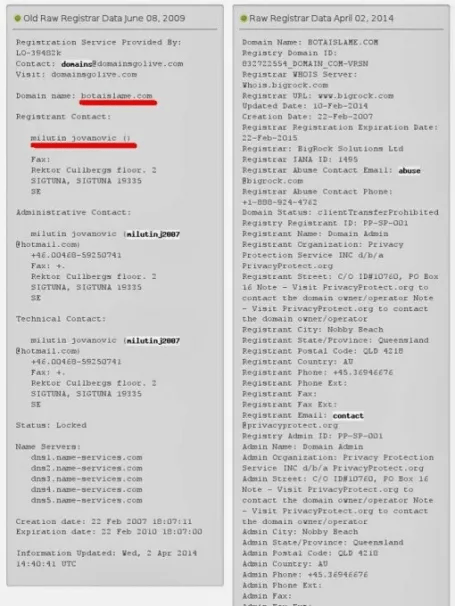
Gazeta Ora also writes that the Serb Milutin Jovanovic bought and opened the website botaislame.com

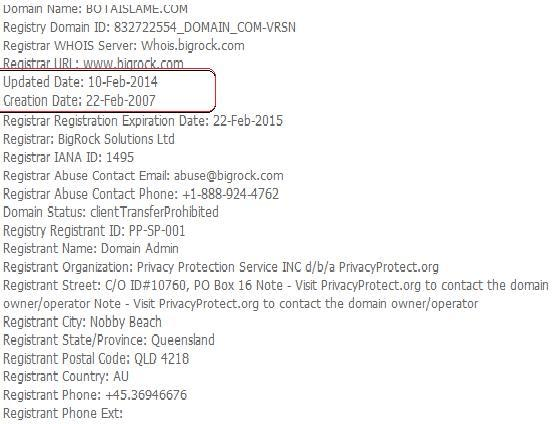
In 2007, the Serb Milutin Jovanovic, with directives from the Serbian government, bought and opened the website botaIslame.com. Since 2007, this website has been publishing news in Albanian on a daily basis and calling for Islamic extremism.
The well-known portal in Kosovo, especially for strengthening the Wahhabi and Salafi line in Kosovo, is botaislame.com. This portal was created by Milutin Jovanovic in 2007 from Sweden. Later, the website information was hidden for a fee.
There are other facts that Serbia has started organizing Islamic extremism in Kosovo, so that Kosovo loses American sympathy. Russia has also acted in this way with the Taliban, when the latter had American sympathy for a while.
The Serbian secret service is operating in Kosovo. Successful Albanian orators are being selected who work for Serbia’s interests, raising interfaith tensions, and creating Islamic extremism in Kosovo.
A data registry of botaislame.com where Milutin Jovanovic can be seen (read lines)
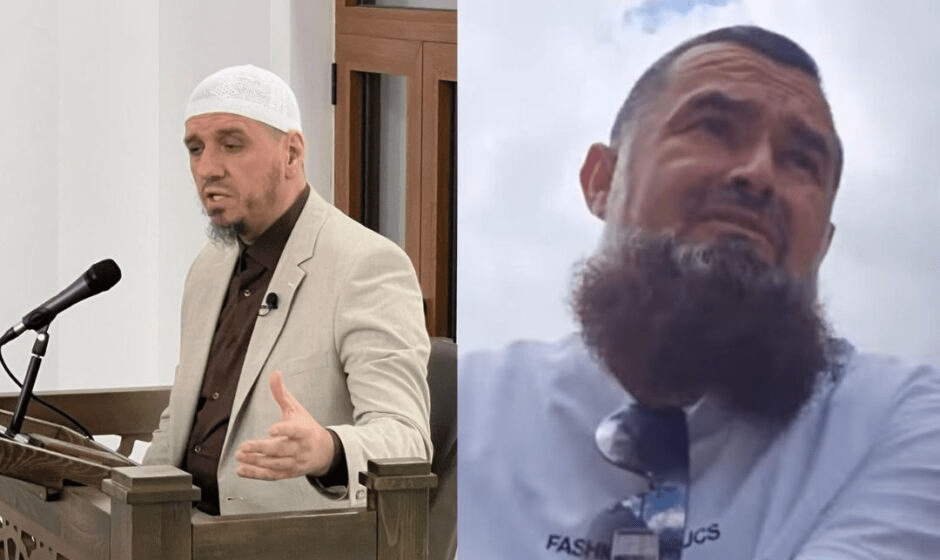
Are some imams in the service of Serbia?

Serbias president Aleksander Vucic and imams, somewhere in Macedonia.
Sources
http://gazetaora.com/serbia-organizo…ist-ne-kosove/
http://who.is/domain-history/botaislame.com
Gazeta Metro: Official: It is a fact that Serbia has financed imams in Kosovo
A senior official of the Vetëvendosje Movement, Boiken Abazi, has said that it is a fact that Serbia has financed and controlled some of the imams in Kosovo.
Abazi wrote this in a Facebook status, where he spoke about Sadri Ramabaja’s comment regarding iftar, and about which he said that his comment was hasty, ‘not explanatory and left room for misunderstandings that may have made people feel bad…’
Vetëvendosje senior official, Boiken Abazi, said in a status that it is a fact that Serbia has financed and controlled imams in Kosovo, thus saying that “this fact should not lead to Islamophobia, as this does not mean at any time that all imams… are like that”.
Read his full article:
It is a fact that Serbia has financed and controlled some imams in Kosovo, and every Muslim Albanian should be aware that there may still be such imams, but this fact should not lead to Islamophobia, as this does not mean at any time that all imams or Muslims are like that.
I disagree with Sadri Ramabaja’s comment about the iftar in Dardana, as I think it was hasty, not explanatory and left a lot of room for misunderstandings that could have made people feel very offended and hurt. However, those who then tried to insult and insult Sadri Ramabaja with the dirtiest words, and further those who directly threatened and intimidated him, these should be prosecuted, simply based on the laws in force.
Declaring yourself and feeling Muslim or Christian, or even atheist, does not automatically make you a better person for society. The history of our nation has seen many self-proclaimed Muslims, Christians and atheists who have openly worked against their nation, as it has also seen many Muslims, Christians and atheists who have sacrificed everything for the freedom of Albanians.
It is a fact that Serbia has financed and controlled some imams in Kosovo, and every Muslim Albanian should be aware that there may still be such imams, but this fact should not lead to Islamophobia, as this does not mean at any time that all imams or Muslims are like that.
This never justifies discrimination against a Muslim solely because of their religious beliefs. But, every sincere Muslim is clear that within the Islamic community there are people who are harmful to Islam itself and to society in general, and this also applies to all other religious or non-religious communities.
Source: https://gazetametro.net/zyrtari-i-vvse-eshte-fakt-se-serbia-ka-financuar-hoxhallare-ne-kosove/
The history of Greek and Serbian authorities funding islamism in the Balkans
Skender Jashari writes:
Serbia and Greece have learned lessons about the use of imams for their expansionist purposes from Russia. The Russian ambassador in Sofia in 1815 compiled a program for the use of Russian priests in the Balkan Peninsula. Serbia and Greece also adopted the same in their elaborations in Nacertani and Megali Idea.
After 1835, when the Ottoman Empire finally began the Ottomanization of Albanians on the one hand, on the other hand Serbia, Greece, etc., in accordance with their elaborations, acted to assimilate and strengthen Islamic sentiment among Albanians.
While Serbia and Greece of the years 1810-1850, territorially were very small, they sent contingents of agents who interacted, sometimes even in the eyes of the Ottoman authorities, to create suitable conditions for the future conquest of such territories. Such contingents served the Ottoman Empire as an aid. Let us not forget that a great contribution to the Ottoman armies was made by Serbian agents and Serbian minorities, in addition to the local Islamized ones, remember the battles of the Kaçanik Gorge, Silivove, etc.
During the occupation of the Albanian Territories, every military unit of the Serbian Army had an imam, starting from the smallest units, up to the “state imam”, while there was no Muslim in the Serbian army. Therefore, the Islamization of the crypto-Catholics of Karadak, the Presevo Valley, up to Skopje, is the work of the imam of the Serbian army alone, while the lowlands were Islamized even during the Ottoman occupation.
Unfortunately, we still remember today, in the Presevo Valley, that during the occupation by the Serbian armies, on October 16-18, 1912, a fez (an Ottoman soldier’s hat) was sold or exchanged for the entire real estate of an Albanian family, if they wanted to save their lives as Turks, and flee to Turkey, but even when they fled, they were killed for being Turks.
While ironically, there were some Jews, for example: Leo Freundlich, who witnessed this Golgotha of us Albanians, who proved to the Western world that they were not Turks, but that Serbia and its allies presented them to the West as Turks, when in reality they were Albanians.
After the Ottoman Empire was expelled from the Balkan Peninsula and due to the total ignorance and illiteracy among the Albanians, but on the other hand unable to exterminate them through ethnic cleansing and genocide during the years 1878-1912, nor during World War I, they saw it as advantageous to use mosques for the assimilation of Albanians.
Serbia created the Islamic Community after World War I,[1] where it was headed by: Hasan Rebac, Ahmed Mehmedbašić, Fejzi Haxhiamzik, Shečer Kadić and others who served Belgrade in the following projects. After 1937, the Islamic Community based in Skopje was taken over by “Albanian speakers” who, according to Vasa Čubrillović, who in his report “Problems of Minorities in the New Yugoslavia”,[2] claimed that: “the Albanian separatists gained a powerful weapon in their hands.
For two or three years they exploited it so much that they took into their own hands the entire religious and educational organization of Muslims in the south, through which they organized politically and went on the offensive…”[3]
In this case, we understand that the Albanians mistakenly, in the name of religion, began to organize political life as well – which was in the interest of Serbia, since it strengthened religious sentiment and weakened Albanian national sentiment.
While the Kingdom of the Serbian Orthodox Church did not allow any Albanian schools, it also closed the Albanian schools of the Catholic churches, and during the years 1912-1929, it killed all the Catholic clergy who were in the spirit of the Albanian National Renaissance, but also most of the Albanian leaders and insurgents (Kaçaks).
The Kingdom of the Serbian Orthodox Church, in 1925,[4] opened in Skopje an Islamic high school for the creation of imams for Serbian chauvinist purposes, which was called the Great King Alexander I Madrasah,[5] whose director was Mehmet Bašić from Bosnia who declared himself Serbian, all the teachers were Serbian and Russian who taught them Islam.[6]
Example: according to Turkish statistics of 1908, in: Peja, Gjakova, Prizren, Mitrovica, Vushtrri, Prishtina, Gjilan, Kaçanik, Ferizaj, Gjilan, there were no Turks, while in Skopje, Tetovo, Dibër, etc., Albanians were the majority, while Serbs were a minority, while Turks do not even appear as a minority. While Skopje was the capital for Albanians, where foreign diplomatic headquarters were located.[7]
Then came the period of Serbian occupation, when in our lands they raped and with the help of religious leaders from Russia, Serbia, Bulgaria, a large number of Albanians were assimilated. During the occupation, over 120,000 Albanians were deported to Anatolia as Turks, followed by the 1912-1914 displacements, there were 239,807 Albanians[8] while in the months of May-July 1914, another 565,472 Albanians were displaced,[9] the Yugoslav-Turkish Convention of 1938, in Article 4, provided for the displacement of 40,000 Albanian families (1939/ 4,000 families; 1940/6,000 families; 1941/7,000 families; 1942/7,000 families; 1943/8,000 families and 1944/8,000), the laws of the Serbian laws and colonization laws, then the colonization laws that the Turkish parliament approved in 1934, so that not only Turks but also Muslim populations could immigrate to Turkey.
Then, after World War II, in January 1953, between Fuat Kypril, who was the foreign minister of Turkey, and Tito, in Split, a verbal agreement was made, that in the years 1953-1959, about 400,000 Muslims/Albanians would be moved from Kosovo, Macedonia, Montenegro and Sandzak to Turkey.
During this period, imam led by Serbia were created, which we contemptuously called “bedni ocji” (wretched imam), who were part of the Islamic Community of Yugoslavia, who propagated the Turkification and Muslimization of Albanians. In North Macedonia alone, in 1948 there were 95,940 Turks, while in 1953, they became 203,938 Turks, while compared to this Albanian in 1948 there were 197,389, while in 1953 they fell to 162,254 Albanians.
This was also confirmed by the Commission for National Minorities of Yugoslavia in October 1959, where it said that Albanians mainly became Turks. The displacement of Albanians from 1956 to March 1959, from Kosovo, Macedonia, the Presevo Valley, Montenegro and the Sandzak, was 143,800 inhabitants, while in 1966 it reached over 250,000 inhabitants.
After 1966 (but even before) Serbia encouraged most Albanians to flee to the Western world, to find a better life. Thus, several tens of thousands of heads of families, who later withdrew their families, migrated to the USA, Belgium, France, the Netherlands, Austria, Sweden, Denmark, Norway, etc.
Therefore, since at first it was Serbia’s goal, the Morava-Vardar valley, in order to reach Thessaloniki, was engaged in the extermination of the Albanians who lived in that area. But then the same practice was also applied in Kosovo. Therefore, the Alaudin Madrasah and others are in the same vein.
From all this, we can see that in the territory of the Republic of Kosovo, the number of mosques that were at the end of the Ottoman Empire’s occupation was counted on the fingers of one hand. But during Serbian rule, this number multiplied, but this did not happen with schools in the Albanian language.
The activity of imams and mosques was not hindered in any way during the period of Serbian rule. Of course, Serbia has historically proven that it has destroyed and cleansed Muslim populations in times of war. We have such cases, for example: in Belgrade in 1576 there were 273 mosques, while at that time in Pristina there was none (despite the fact that some Islamic sources tend to mention a mosque opened by Sultan Bayezid, but this was actually a mosque around which the Ottoman army was stationed) and as such it served only for its own needs. Therefore, in the Kosovo War, Serbia destroyed over 250,000 Albanian houses, while according to different sources, figures of 130 to 218 mosques were destroyed.
Therefore, the goal is very easy to understand, that Serbia, through the Islamization and Wahhabization of Kosovo, attempts to:
Disable the functioning of the Kosovo state;
To break the Albanian-Western alliances, through our Islamized and radicalized population that will seek their (Kosovo’s) political representatives who will be pro-Eastern and anti-Western;
And at the most opportune moment, to re-conquer it militarily, as it did in 1878-1912. Therefore, I must have learned a lesson, that nothing, neither religion nor the paradise of individuals, is more important than our National Interest.
References
[1] State Archives of the Republic of Macedonia, Fund. Supreme Mufti’s Office-Belgrade.1919-1929. (hereinafter DARM.1.611.1.1/1-5).
[2] He read it on 3 November 1944 in Belgrade.
[3] Hamdija Sharkinovic, Bosnians from the Drafting of the Memorandum, Podgorica, 1997, pages 243-259.
[4] In September 1925, the Minister of Religion of the Kingdom of the Serbian Orthodox Church, by decree of King Alexander I dated 24 April 1924 (see: Archives of Yugoslavia (hereinafter AJ), Fund 66 /Ministry of Education of the Kingdom of Serbs, Croats and Slovenes, file 1101, arch. unit 1429 (Great Medresa of King Alexander I), no. 373, 11 April 1926, Skopje.)
[5] Archives of Yugoslavia (hereinafter AJ), Fund 66 /Ministry of Education of the Kingdom of Serbs, Croats and Slovenes, file 1101, arch. unit 1429 (Great Medresa of King Alexander I), no. 3846, 11 August 1925. in Belgrade, a meeting of the Ministry of Fes of the Kingdom of SKS, directed by the Ministry of Arsimit in Belgrade, through which it was announced on September 1, 1925, in the meeting of the Ministry of Education and the Great King Aleksandi and I-rë.
[6] A.J. Fond 66, /Ministry of Education of the Kingdom of SHS (Yugoslavia)/, Arch. one 1429 (Great Madrasa “King Alexander I” vi – Skopje) 1925/26; 1930/34.
[7] Hamit Kokolari, Kosova – Djepi i Shqiptarizmit, botuar në vitin 1962 nga Lidhja Kosovare në Mërgim, faqe 120.
[8] sipas document no. 1246 dated April 12, 1914, in the Archives of the Federal Secretariat of Foreign Affairs in Belgrade, in the Political Department of the Fund.
[9] Documents on the Foreign Policy of the Kingdom of Serbia”, K.VII Volume 1 Belgrade 1980, pages 617-618.
A Russian imam named Mulla Adnani served for 20 years in Prizren
Shefqet Cakiqi-Llapashtica writes:
The story of the well-known Kosovar writer in his historical book “Russian Mission” (KOHA publication, Prishtina, 2016) is very interesting, which explains how a imam named Mulla Adnani, had served for twenty years as an imam in the Bajrakli Mosque of Prizren, which is located, that is, very close to the memorial complex of the League of Prizren, where meetings of leading leaders and representatives from all Albanian regions were held (June 1878).
On that cold morning of November 10, 1912, the Serbian Army had occupied the city and massacred over 400 Albanian activists and patriots. The doors of the mosques were closed.
The Serbian army and officers, led by their commander and the Russian secret agent, had gathered in front of the door of the aforementioned mosque. To the surprise of all the believers, their imam, Mulla Adnani, that day had taken off his scarf and the imam’s hat and consulted very “friendly” with the army commander and the Russian agent and after a while addressed the Muslim believers with extremely surprising and unbelievable words.
He had announced to them that his twenty-year mission as their imam had ended precisely on that cold November day in the city of Prizren, covered by heavy snowfall. Then he told them that he was of Russian nationality, and his real name was Kazimir Olenko, and that his religion was Orthodox, and he had ordered the believers to return “quietly to their homes, since the city’s mosques will be closed”.
Because, Mulla Adnani, alias Kazimir Olenko, as a Russian agent in Albanian lands, had explained that now Prizren and all Albanian lands were “liberated” from the Ottoman Empire and that from now on the time had come for the rule of Serbia and its old friend Russia in Albanian lands.
From 1892 to 1912 the imam of the Sinan Pasha Mosque in Prizren, Mulla Adnani, was the Russian Kazimir Olenke. This was made public by the Russian officer Ruslan Nikolai when he addressed the crowd in Prizren with the words: “Kazimir Olenko has fulfilled his mission. We must thank him. This man, he said, will continue this mission but in some other place”.
Russian Kazimir Olenko, who for 20 years had served as an imam in the Sinan Pasha Mosque in Prizren, with the conspiratorial name Mulla Adnani, but also with another name and surname (Faruk Myrtaj), and for Catholic environments as Zef Kristi, with which surname he had operated in the village of Guror in the Shkodra Highlands. Such was also Tatjana Volovna, with the conspiratorial name and surname Emine Brajari, who operated among the female gender, who operated in Prizren supposedly as a teacher.

Imams registered under Yugoslav Serb registries.
TV Arberia writes: Serbian propaganda and the Islamization of Llapushnik
Are the imam people being encouraged to be baptized in Llapushnik with Arab-Turkish-Serbian propaganda?
Imam Enes Rama, has surprised with a statement calling the Arabic language the “mother of languages”, this has prompted strong reactions, especially from those who defend the Albanian identity and culture. In one of his statements, Rama has praised the Arabic language and its deep influence on the history of the Islamic faith, but this has brought a strong objection on some facts about the Albanian language, which is over 30,000 years old, is the language of God and the one that carries the most ancient tradition of the Albanian lands.
Imam Enes Rama declared that “Arabic is the mother of all languages, without it religion cannot be understood”
Also, another well-known religious figure, Imam Ladi from Albania, has raised questions regarding the figure of Sultan Murat, describing him as a “martyr” and not as an invader of Albanian lands. This statement has caused anger among those who have in their consciousness and memory the Ottoman occupation as a painful period for Albanians, including massacres, murders and violence inflicted on the local population.
These statements are coming at a time when many Albanians, especially from the regions of Llapushnik, have returned to Catholicism. Are religious figures precisely turning people away with these statements and are they directing Arab, Turkish-Serbian slander at Llapushnik?
This heated debate raises a big question for Albanian society: Should we agree with the interpretations of the imams on the figures of the Ottoman occupation and religious faith?
Source
Claim: Top Secret Document Leaked?
According to this leaked document in Serbian, we can read:
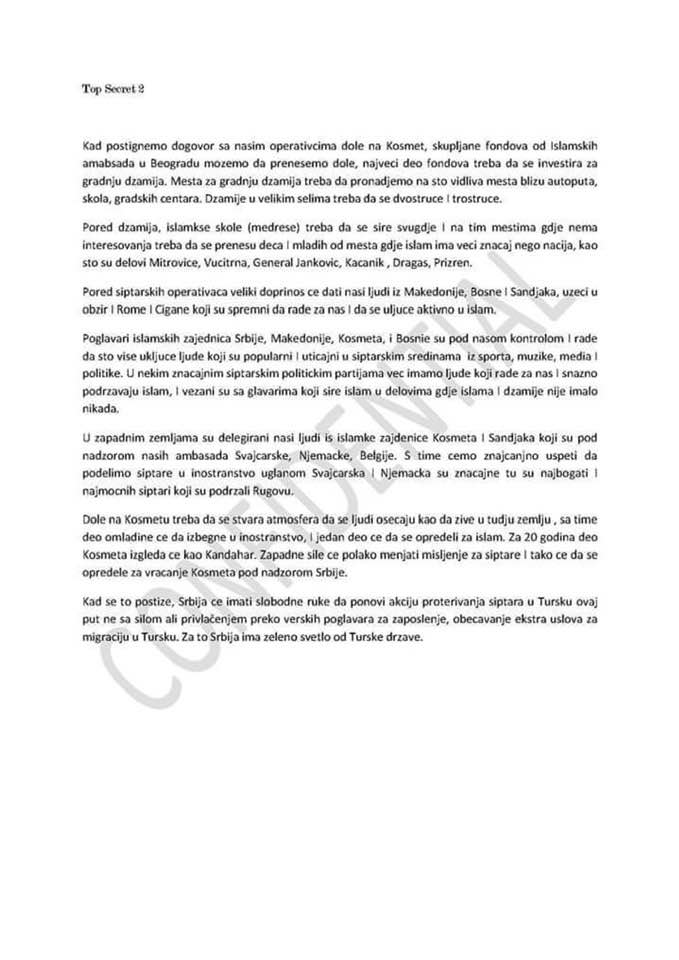
“Top Secret:
When we reach an agreement with our operatives down in Kosmet, we can transfer the funds collected from the Islamic embassies in Belgrade down there, the largest part of the funds should be invested in the construction of mosques. We should find places for the construction of mosques in the most visible places near the highway, schools, city centers. Mosques in large villages should be doubled | tripled.
In addition to mosques, Islamic schools (medreses) should be expanded everywhere, and in those places where there is no interest, children and young people should be transferred from places where Islam has greater importance than the nation, such as parts of Mitrovica, Vushtrri, General Jankovic, Kacanik, Dragash, Prizren.
In addition to the Albanian operatives, a great contribution will be made by our people from Macedonia, Bosnia and Sandjak, taking into account the | Roma | Gypsies who are ready to work for us and to actively join Islam.
The leaders of the Islamic communities of Serbia, Macedonia, Kosmet, and Bosnia are under our control and are working to include as many people as possible who are popular | influential in Siptar circles from sports, music, media, and politics. In some significant Siptar political parties, we already have people who work for us and strongly support Islam, and are connected to the leaders who spread Islam in areas where Islam | mosques have never existed.
Our people from the Islamic community of Kosmet | Sandjak have been delegated to Western countries and are under the supervision of our embassies in Switzerland, Germany, and Belgium. With that, we will significantly succeed in dividing the Albanians abroad, mainly in Switzerland and Germany, where the richest and most powerful Albanians who supported Rugova are located.
Down in Kosmet, an atmosphere should be created that makes people feel as if they are living in a foreign country, with that some of the youth will flee abroad, and some will choose Islam. In 20 years, part of Kosmet will look like Kandahar. Western powers will slowly change their opinion about the Albanians and thus they will choose to return Kosmet under the supervision of Serbia.
Once this is achieved, Serbia will have a free hand to repeat the action of expelling the Albanians to Turkey, this time not by force but by attracting them through religious leaders for employment, promising extra conditions for migration to Turkey. For this, Serbia has the green light from the Turkish state.”
Source: None
Serbization in Albanian lands, through Serbian and Russian “hoxhallars” or “imams”

Izmet Azizi writes:
How did the opening of the Serbian school come about, in which the name “Madrasa” is most diabolically used to deceive non-Serbian peoples, above all Albanians outside of today’s Kosovo?
When in 1912, Serbia occupied Kosovo and the Sandzak, the then Serbian authorities took the position that the education of other peoples (non-Serbians) is contrary to the interests of Serbian state policy. As long as they are at the level they were in terms of politics and education, they can be easily manipulated.
The Serbian tendency to keep oppressed peoples at a low level of education for as long as possible has been applied to Albanians as a “successful” model. This model has been applied to the population of Sandzak (today’s Bosniaks).
Around 1920, the Serbian ruling structure came to the conclusion that such a policy did not ensure the stability of the state regime, but deepened the conflicts between the Albanians, Sandžaklinje (today’s Bosniaks) and Turks who were subjugated on the one hand, and the Serbs in power. Then, the Serbian rulers realized that such a situation contradicted the Serbian national thought which was based on the fact that the Serbization of Bosniaks, especially the Sandžaklinje, was most quickly achieved through education.
Serbian geographer and ethnographer, Jovan Cvijić, has published numerous studies and books to explain how to ‘convert others into Serbs’. Jefto Dedijer, the successor of Cvijić (the father of Tito’s biographer, Vladimirir and Stevan), later published the book “New Serbia” where he talks about Albanians, Bosniaks, Turks, etc. The author says: “We will turn these into Serbs, but not with ‘city’, but through education and other means.”
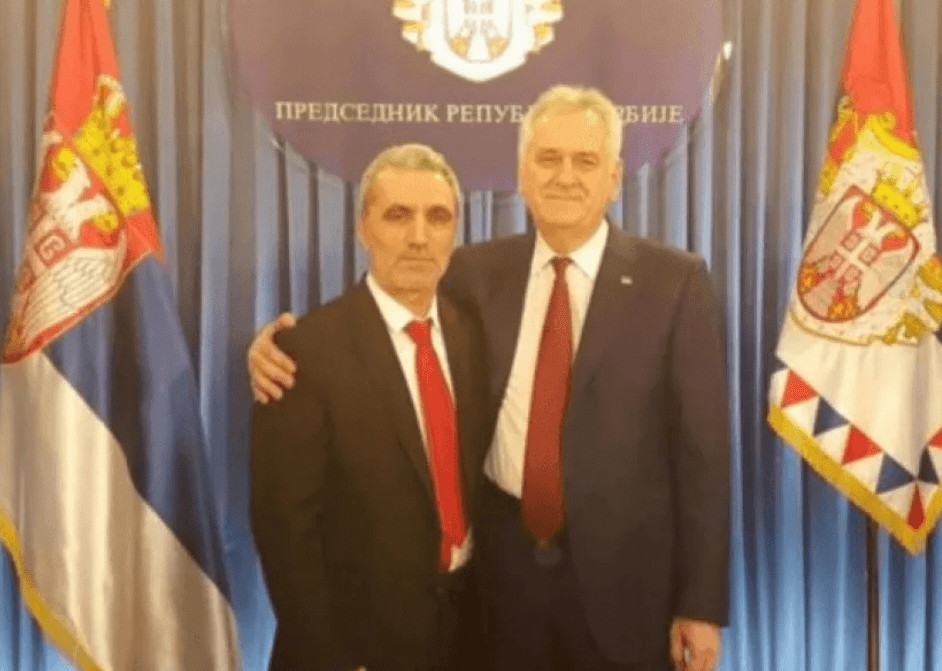
Former Serbian President Tomislav Nikolić, after awarding the “Za Otacbinu” medal to Mufti Nexhmedin ef. Saqipi from Bujanovac
The government of the Kingdom of Yugoslavia had declared Skopje the center of the “southern Serbian territories” or in the “Vardar Banovina” in the administrative sense.
Therefore, a large number of Yugoslav civil and military institutions were located here, such as: the leadership of the Banovina headed by Ban, the Center for the Implementation of Agrarian Reform, regional ministries, such as Education, Religion, Justice, Police, Agriculture, as well as the Third Army Command
At this time, the prevailing view in the Serbian regime was that there was a need to find new ways to benefit Slavic speakers, so that their children could be sent to schools in which the Muslim believers of Sandzak and those of Kosovo did not have faith.
For this reason, at the proposal of the Serbian Ministry of Religion, by royal decree of April 24, 1924, a Special High School was established, which was dedicated to Bosniaks, Albanians and Turks. In order to be better accepted, the school was named the “Great Madrasah of King Alexander I”, which opened in Skopje in 1925.
The Islamic Religious Community in the Kingdom of the Serbs, Croats and Slovenes, namely the Ulema Majlis of Skopje, which included all Albanian areas in Yugoslavia, played an important role in organizing the Muslim population.
Given this fact, the then Yugoslav government saw in this organization a powerful “tool” for the realization of its dark plans, such as: assimilation of the Muslim population, especially the Albanian and Turkish ones; the forcible expulsion of this population to Turkey and the colonization of these areas with Slavic colonists.
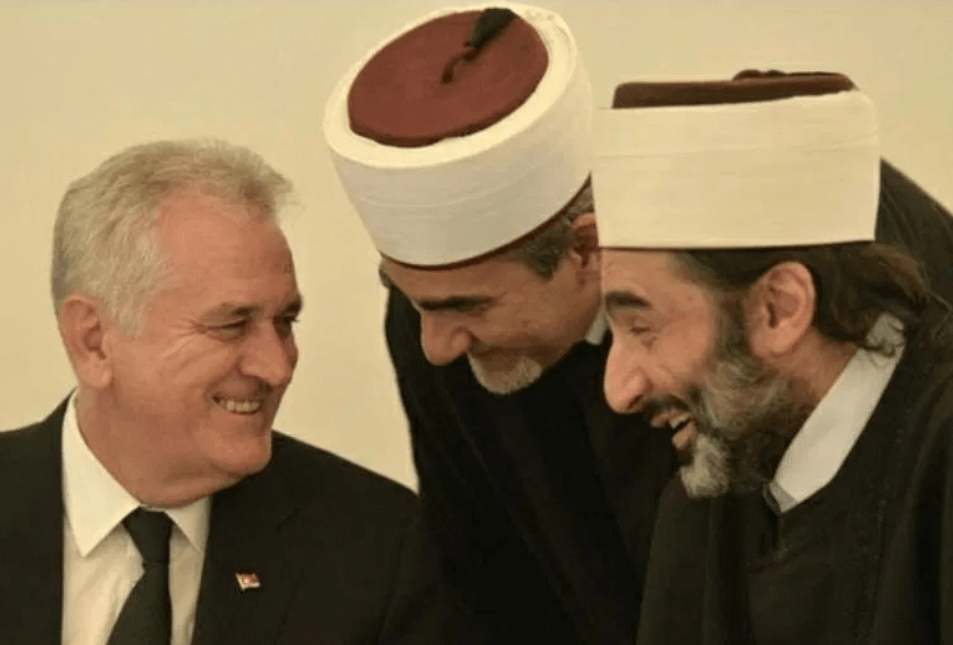
A smiling and in complete harmony photo-memories between the former President of Serbia, Nikolic, with the Chief Imam of Serbia, Abdullah Numan, or the former Serb convert to Islam, Ivan Trifunovic, and the Mufti of Sandzak.
To this end, Belgrade officials, immediately after the end of World War I, brutally intervened in the internal organization of the Islamic Religious Community, appointing their emissaries to all its governing bodies. These emissaries, who came from Bosnia and Herzegovina, such as Hasan Rebac, Ahmed Mehmedbasic, Fejzi Hadziamzik, Shecerkadic and many others, will meticulously carry out the tasks accepted by their Belgrade masters.
In addition, in order to realize the planned plans, the then Royal Government of the Serbian Socialist Federal Republic, in 1925, opened a secondary school in Skopje, supposedly to create a “religious cadre” for the Muslim population, for the – as it was said – “southern Yugoslav” areas. In this school, which was named “The Great Madrasah of King Alexander I”, apart from the director (Mehmedbašić, a Muslim from Bosnia and Herzegovina, declared as a Serb), there was no employee belonging to the Islamic faith. On the contrary, everyone was Christian, Serbian or Russian, including the teachers of religious subjects and educators.

Mufti Nexhmedin ef. Saqipi from Bujanovac, Ivan Trifunović or Abdullah Numan, the chief imam of the BI of Serbia, Erdogan with his wife, and Aleksandar Vucic.
The Serbian ideologues of that time were very aware of what the name “Madrasa” means for Muslim believers. This was the reason, even though it was a Serbian gymnasium, for using the name “Madrasa”, in order to attract the Sandzaks and other Muslims to enroll their children.
To make the deception even more perfidious, in the Serbian “Madrasa”, in addition to the gymnasium subjects, the teaching of the Quran, one of the oriental languages, was also added, but according to the school curriculum prepared by official Belgrade.
The main nursery for the Serbian majors was the Great Madrasa, which was founded in September 1925, at the proposal of the Ministry of Religion of the then Government of the Kingdom of the Serbian SSR, and by the decree of King Alexander I, dated April 24, 1924, which took the name: “The Great Madrasa of King Alexander I”.
The primary goal of this school was the assimilation of the Albanian population and that of Sandzak. We can see this in the annual report on the work of this school, sent on July 14, 1930, to the Ministry of Education. Dragoslav Jovanović, advisor to the minister, otherwise a university professor, clearly states: “Apart from the director Mehmedbašić, there is no teacher or educator of the Islamic faith, but all are true Orthodox, Serbian or Russian”.
In the following, he dwells in the report on the reasons for the establishment of the school where he expressly states: “In order to help the Muslim elements to go on the true path of education and progress, the renewal of the theological cadre, educated in schools in the spirit of our culture”.
Then he adds “the provision of cadres for our state needs and our national aspirations and ideals. To eliminate foreign propaganda among Albanians and Turks, in order to accelerate the assimilation process. The opening of the Great Madrasah school was seen as the most appropriate solution to our issue…”, concludes Jovanović.
The students of this school had free accommodation and food in the school dormitory. School uniforms were also free and mandatory. In addition to other subjects of the gymnasium, the students of this “Madrasha” also studied music and had two choirs and three orchestras, a drama section, a sports and literary section.
What the Serbian Falcons societies represented is best explained by this quote: “The Serbian Falcons represent a national movement which, through physical exercises, achieves its goal, i.e. the unification of all Serbian lands into one whole…”!
The rules of the Sokol Association were that all members of the association, regardless of where they came from, should be called “brother” among themselves, while the only greeting was “zdrav”. So, Bosniaks, Albanians and Turks, as members of the “Madrasa” Association, Sokol, were obliged to call “brothers” even those “whose lives were in their hands”. At the same time, in 1924, these “brothers” killed, then burned at the stake about 6000-7000 inhabitants of Šahović
The Great Madrasa of King Aleksandar Karađorđević I, in Skopje, had a fundamental task: to systematically suppress the national and religious feelings of the students and to form people who would serve the Serbian regime loyally.
The best proof of this is the fact that almost all the students of the royal “madrasahs” continued their “education” at some Serbian faculty and almost none of them ever became imams. None of them ever did any work for the Muslim community. As graduates of the madrasahs, when they returned to their countries, these Serbified Muslims founded various associations and not Islamic institutions.
It is no coincidence that in this Serbian “madrasah” in Skopje, the majority of the students were from Sandzak compared to other regions. The teaching was conducted in Serbian, and it was suitable for the population of Sandzak, a population that used the Serbian language!
Due to the unworthy attitude of the Bosniaks towards the obvious Slavism (Serbization) that the regime imposed on them, among the Albanian and Turkish people in Kosovo it was openly said that “the Bosniaks are Serbizing our children”.
This was especially emphasized in the meetings of “Xhemijeti”, the political party that gathered all Muslims from the Sandzak and Kosovo areas. Therefore, Aqif Effendi Blyta and Ferhat-bey Draga took the initiative to create a proper Madrasah in Skopje. This was achieved in 1925, as the only way to oppose the regime in the Serbization of Muslim believers.
The Isa Bey Madrasah, on the initiative of the religious leaders and intellectuals of the time, was rebuilt in 1932, so that in 1936 conditions were created to start regular work. At the same time, its program was reformed and it gained the status of a high school.
Among the numerous activities that religious organizations and cadres who came out of the Madrasah, during the period 1937-1941, the sensational campaigns against the migration of Albanians to Turkey should be singled out.
The then counties, Yugoslav police and military, they strongly accused the leadership of the Ulema Majlis of Skopje, for its political and organizational activity within the Albanian population, which according to them contradicted the “state policy” and that it was visibly irritating the religious and national relations in those areas.
According to them, the bearer of these activities was Ferhat bey Draga, who as it was pointed out “with the help of Mehmed Spaho has managed to Albanianize the Islamic Religious Community in Skopje and that “now he has been declared the undisputed leader of the Albanians in Yugoslavia”.
Source: https://dardaniapress.net/histori/serbizimi-ne-trojet-shqiptare-permes-hoxhallareve-serbe-e-ruse/
Frashër Demaj: Russian imams invited Albanians to go to mosques and not to schools
Frashër Demaj is part of the Academy of Sciences as a corresponding member. Invited to the show “Oxygen”, academician Demaj has spoken on many topics.
Naturally, he also spoke about Islam and Albanians, saying that there were imams of Russian origin who have propagated against sending Albanians to Albanian schools.
“The majority of the Albanian population in Kosovo has been of the Islamic faith and this is natural, but there have been imams who are also peasants, yes and Russians, absolutely yes. Even Russians, they spoke Albanian, and they trained them, they had special schools. They have also sent Orthodox priests to Bulgaria, to convince the Bulgarians that their salvation will be if they are part of Serbia. So it is a Serbian strategy” – he emphasized.
“He brought hoxhollari here to convince them not to send their children to school, they only go to mosques, even Albanians don’t go to school because they become sh*t and there is no one to look after their sheep in the meadows” – he continued, also using a term that incites hatred towards Serbs.
Mr. Demaj, although he is part of the highest scientific institution, cited oral history as evidence for his hypotheses about Russian hoxhollari.
“This is a fact, it is oral history, what is left is a story that Albanians have passed down from generation to generation” – he said.
Kadriu: Russian missionaries exploited naive and illiterate Albanians
As imams, teachers, soldiers and people belonging to employment agencies, the Russian missionaries who served in Kosovo were disguised. Writer Ibrahim Kadriu, through the novel “Russian Mission”, deconstructs historical facts, adding a dose of fiction. In the work for which he received the award for the best Albanian novel, “Rexhai Surroi”, Kadriu goes back to the time when Albanians received services from people who aimed to spread ideologies.
In an interview for “Kohë Ditore”, after accepting the award, Kadriu said that he has always been attracted to historical themes and many of his novels have this basis. He said that the issue of Russian missionaries had preoccupied him since an old man had told him that a Russian imam had served in the Sinan Pasha Mosque in Prizren for 20 years. Kazimir Olenko introduced himself as Mullah Adnani.
And with the entry of Serbian forces into Prizren, in 1912, Olenko had left the Mosque to serve elsewhere. Kadriu said that the Russians had exploited Albanian naivety to spread ideology. According to the author of about 70 literary works, the consequences of such missions are still noticeable today. He said that there are now Serbian villages where it is clear from the way they live that they were Albanians, adding that the aim of such missionaries was to offer Muslim Albanians more opportunities with Serbs and to distance them from Catholics.
He also mentions the fact that there are no Orthodox Albanians in Kosovo, even though the territories of this area belonged to Byzantium. All the Russian characters in the book have at least one Albanian name. Ruslan Nikolay used the name Zef Kristi in Catholic environments and Faruk Myrta in Muslim ones. Tatjana Volovna presented herself as a teacher, introducing herself as Emine Brajari.
Kadriu says that during his research he encountered Russians everywhere. He says that they are still present in Kosovo today, especially in North Mitrovica. He describes how historically Russia has been aligned against Albanians. He proves this with its lack of support during the League of Prizren. Kadriu also tells about the murder of two Russian consuls, where in the case of Mitrovica the perpetrator is called Ibrahim, just like the author himself, and comes from the same village.
Source: https://ekonomiaonline.com/kadriu-misionaret-ruse-shfrytezuan-shqiptare-naive-e-analfabete/

 Balkan Academia