

by Hamdi V. Thaci. Translation Petrit Latifi
Abstract
This study examines the history of the Domaneku family and their resistance to Serbian and partisan-Chetnik atrocities during the Second World War, particularly between 1943 and 1944. Through biographical narratives of key figures such as Vahide Domaneku, Iljaz Agushi, and Kadri Beba, the text highlights the role of prominent Albanian families in preserving national identity, territorial integrity, and communal solidarity in Kosovo. The monograph draws on oral history, genealogical records, and regional memory to document persecution, executions, and forced dispersal endured by the Domaneku family following their refusal to accept the reoccupation of Kosovo. The work situates their sacrifice within the broader Albanian national resistance and commemorates their moral resilience, patriotism, and enduring legacy.
Hamdi V. Thaci, co-author with Murtez Zogu, has written a book on the history of the family of Domaneku who resisted the Serbian atrocities in 1943.
Cited:
“With my heroes in the next book, where I co-author Murtez Zogu.
When I started researching for this monograph, I entered a strange story, a painful and proud story, unknown until then. Even today when I browsed it to post this commemoration, I entered the world of these heroes, who are unrepeatable in history.
Lokja Vahide, whose husband and brother-in-law were shot, then her son and other brother-in-law Islam Domaneku were killed, had kept half a sock that was left from her son’s burned body for half a century, and no one had ever seen tears in her eyes.
This Lokemadhja has the merit of reuniting the Domaneku Family, scattered after the murder of 4 men of the noble family, only because they did not agree with the reoccupation of Kosovo by the Partisan-Chetniks in 1944. Respect for the noble and patriotic Domaneku family.”
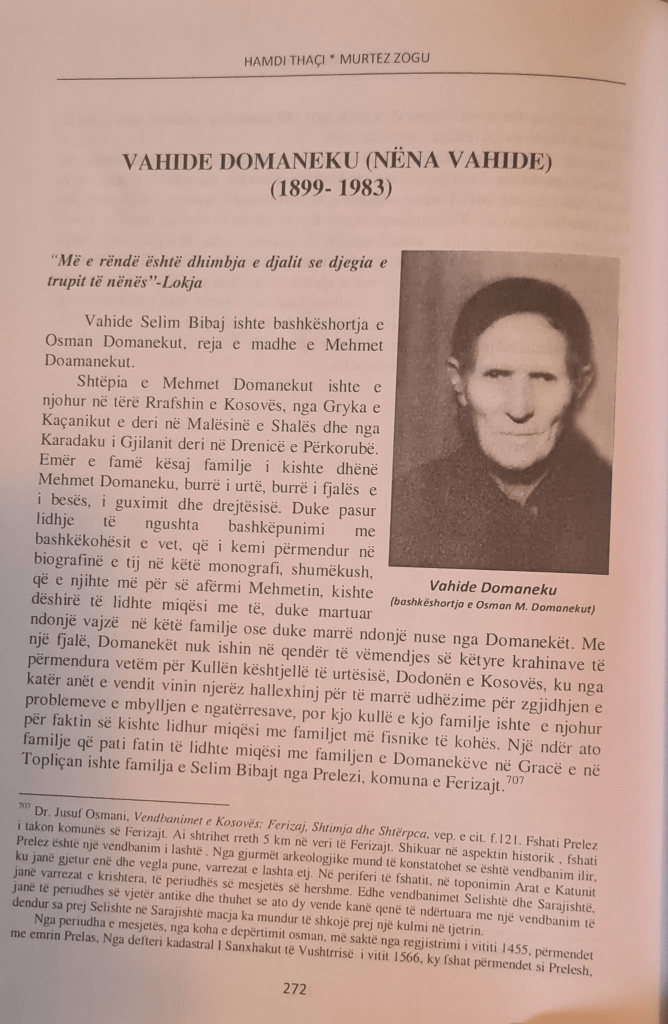
“VAHIDE DOMANEKU (MOTHER VAHIDE) (1899-1983)
“The pain of a son is worse than the burning of his mother’s body” – Loki
Vahide Selim Bibaj was the wife of Osman Domanek, the eldest daughter of Mehmet Domanek.
The house of Mehmet Domanek was known throughout the Kosovo Plain, from the Kaçanik Gorge to the Shala Mountains and from Karadak of Gjilan to Drenica and Përkorubë. Name and fame had been given to this family by Mehmet Domanek, a wise man, a man of his word and trust, of courage and justice.
Having close ties of cooperation with his contemporaries, which we have mentioned in his biography in this monograph, many who knew Mehmet more closely, wanted to establish friendship with him, by marrying a girl from this family or by taking a bride from the Domaneks.
In a word, the Domaneks were not at the center of attention of these regions mentioned only for the Tower of Wisdom, the Dodona of Kosovo, where people from all over the country came to seek guidance on solving problems and ending conflicts, but this tower and this family were known for the fact that they had established friendships with the most noble families of the time.
One of those families that was lucky enough to establish friendships with the Domanek family in Graca and Toplica was the family of Selim Bibaj from Prelez, municipality of Ferizaj.
The village of Prelez belongs to the municipality of Ferizaj. It lies about 5 km north of Ferizaj. From a historical perspective, the village of Prelez is an ancient settlement. From archaeological traces it can be concluded that it is an Illyrian settlement, where vessels and tools, ancient cemeteries, etc. have been found. On the outskirts of the village, in the toponym Arat e Katunit, there are Christian cemeteries from the early medieval period.
The settlements of Selishte and Sarajishte also date back to the ancient period and it is said that those two places were built with such a dense settlement that a cat could go from one peak to the other from Selishte to Sarajishte.
From the medieval period, from the time of the Ottoman invasion, more precisely from the census of 1455, it is mentioned under the name Prelas. From the cadastral register of the Sandzak of Vushtrri of 1566, this village is mentioned as Prelesh.”
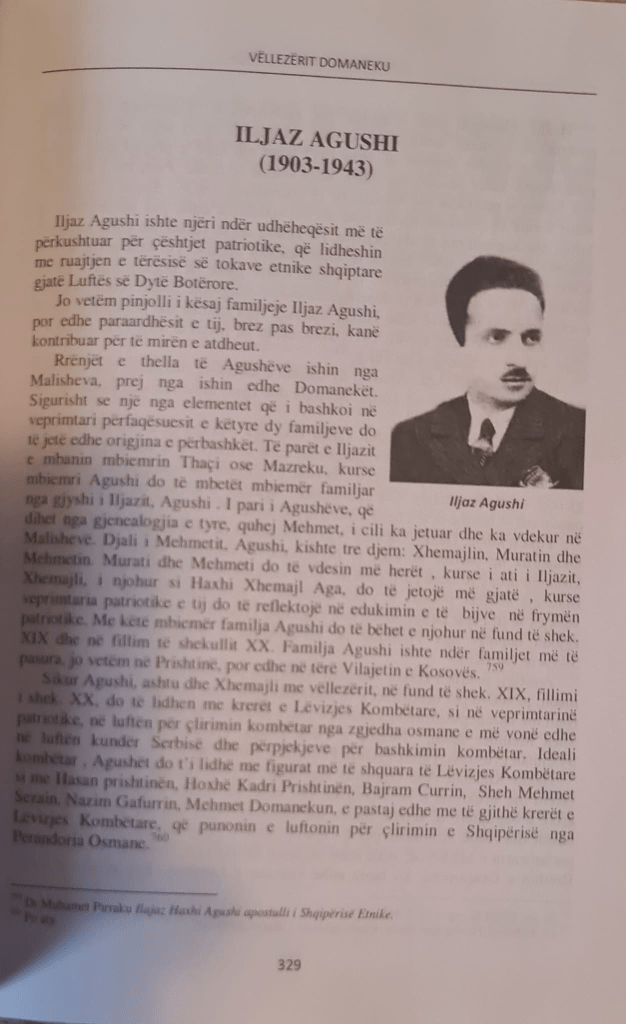
“ILJAZ AGUSHI (1903-1943)
Iljaz Agushi was one of the leaders most dedicated to patriotic issues related to preserving the integrity of ethnic Albanian lands during World War II.
Not only the son of this family, Iljaz Agushi, but also his ancestors, generation after generation, have contributed to the good of the homeland.
The deep roots of the Agushes were from Malisheva, where the Domaneks were also from. Of course, one of the elements that united the representatives of these two families in their activities will be their common origin. Iljaz’s ancestors bore the surname Thaçi or Mazreku, while the surname Agushi will remain a family surname from Iljaz’s grandfather, Agushi.
The first of the Agushes, known from their genealogy, was called Mehmet, who lived and died in Malisheva. Mehmet’s son, Agushi, had three sons: Xhemajli, Murat and Mehmet. Murat and Mehmet will die earlier, while Iljaz’s father, Xhemajli, known as Haxhi Xhemajl Aga, will live longer, his patriotic activity will be reflected in the education of his sons in the patriotic spirit.
With this surname, the Agushi family will become known at the end of the century. XIX and early XX century. The Agushi family was among the richest families, not only in Pristina, but also in the entire Vilayet of Kosovo.
Like Agush, Xhemajli and his brothers, at the end of the 19th century and the beginning of the 20th century, they will be connected with the leaders of the National Movement, both in patriotic activity, in the fight for national liberation from the Ottoman yoke and later in the war against Serbia and the efforts for national unification.
The national ideal will connect Agush with the most prominent figures of the National Movement, my Hasan Prishtina, Hoxha Kadri Prishtina, Bajram Curri, Sheh Mehmet Serai, Nazim Gafurri, Mehmet Domanek, and then with all the leaders of the National Movement, who worked and fought for the liberation of Albania from the Ottoman Empire.”
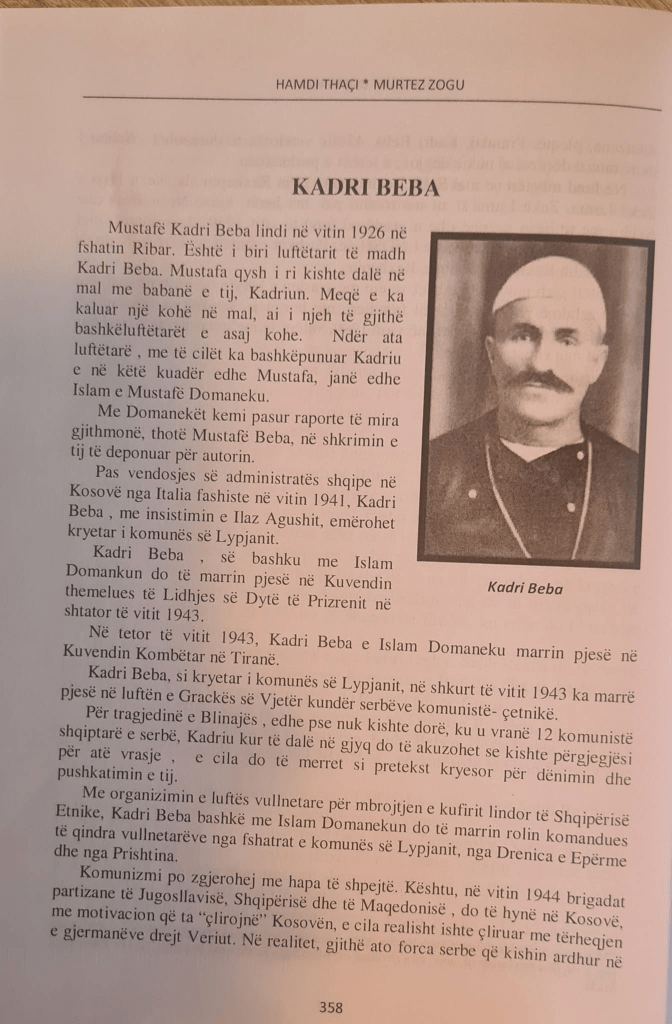
“KADRI BEBA (1926)
Mustafe Kadri Beba was born in 1926 in the village of Ribar. He is the son of the great warrior Kadri Beba. Mustafa had gone to the mountains with his father, Kadri, since he was young. Since he spent some time in the mountains, he knows all the fellow warriors of that time. Among those warriors with whom Kadri collaborated, and in this context Mustafa too, are Islam and Mustafa Domaneku.
“We have always had good relations with the Domaneks,” says Mustafa Beba, in his writing submitted to the author.
After the establishment of the Albanian administration in Kosovo by fascist Italy in 1941, Kadri Beba, at the insistence of Ilaz Agushi, was appointed mayor of the municipality of Lypljan.
Islam Kadri Beba, together with Domanku, will participate in the founding Assembly of the Second League of Prizren in September 1943.
In October 1943, Kadri Beba and Islam Domaneku participated in the National Assembly in Tirana.
Kadri Beba, as mayor of the municipality of Lypljan, in February 1943 participated in the war of Old Gracka against the communist-Chetnik Serbs.
For the Blinaja tragedy, even though he had no hand in it, where 12 Albanian and Serbian communists were killed, when Kadriu goes to trial he will be accused of being responsible for that murder, which will be taken as the main pretext for his conviction and execution.
With the organization of the volunteer war to protect the eastern border of Ethnic Albania, Kadri Beba, together with Islam Domanek, will take on the command role of hundreds of volunteers from the villages of the municipality of Lypjan, from Drenica e Epërme and from Pristina.
Communism was expanding rapidly. Thus, in 1944, partisan brigades from Yugoslavia, Albania, and Macedonia entered Kosovo, motivated by the desire to “liberate” Kosovo, which had actually been liberated with the German retreat to the North.”
Source
Vëllezerit Domaneku. 2020. Hamdi Thaci. Murtez Zogu.

 Balkan Academia