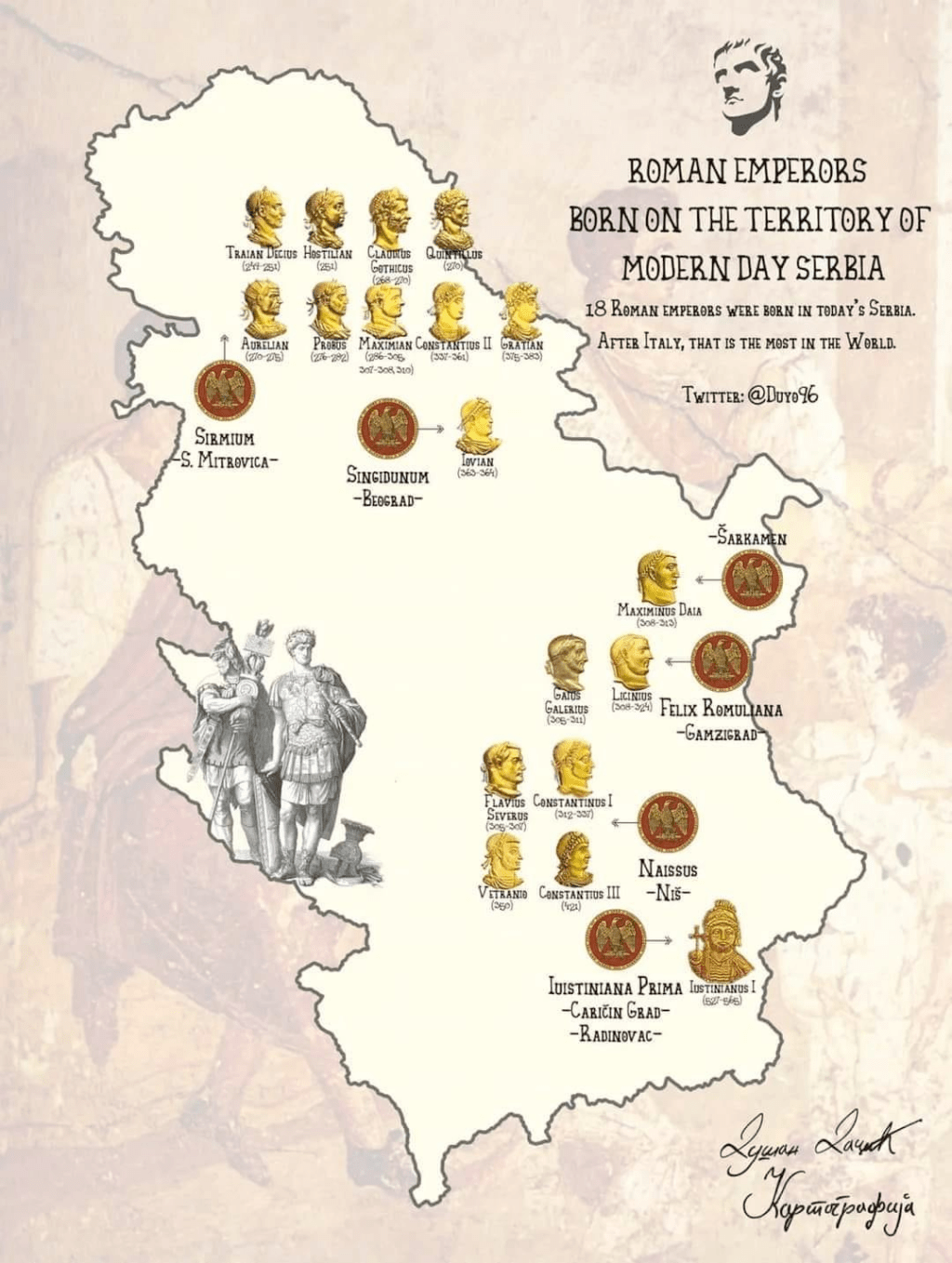

Even though the Slavs had not yet emerged, and the Serbian ethnos did not yet exist, in the land of Illyria and Dardania, which later became Serbia, there were Illyrian and Dardanian tribes. Out of these pre-Slavic and autochtonous tribes, 18 Roman Emperors emerged. After Italy, that is most in the world.
It should however be noted that these emperors did not identify as Serbs or Slavs, as these tribes had not yet formed. What constituts modern day Serbia, Macedonia and Montenegro was inhabited by Dacians, Thracians, Illyrians and Dardanians.
Emperors
- Trajan Decius (249–251)
- Hostilian (251)
- Claudius Gothicus (268–270)
- Quintillus (270)
- Aurelian (270–275)
- Probus (276–282)
- Maximian (286–305)
- Constantius II (337–361)
- Gratian (375–383)
- Iovian (363–364)
- Maximinus Daia (308–313)
- Gaius Galerius (305–311)
- Licinius (308–324)
- Flavius Severus (305–307)
- Constantine I (312–337)
- Vetranio (350)
- Constantius III (421)
- Justinian I (527–565)
Roman cities
- Sirmium – S. Mitrovica
- Singidunum – Belgrade
- Sarkamen
- Felix Romuliana – Gamzigrad
- Naissus – Niš
- Iustiniana Prima – Caričin Grad – Radanovac
Sources
Encyclopaedia Britannica, entry on Sirmium
Encyclopaedia Britannica, article “Illyrian emperors”
Encyclopaedia Britannica, entries on Singidunum, Naissus, and Felix Romuliana
Oxford Classical Dictionary, entries on Illyricum and individual emperors (e.g. Decius, Aurelian, Probus, Constantine I, Justinian I)
Cambridge Ancient History, volumes covering the 3rd–6th centuries AD
The Prosopography of the Later Roman Empire (PLRE), edited by A. H. M. Jones et al.
UNESCO World Heritage documentation for Felix Romuliana (Gamzigrad)
Roman Imperial Biographies in the Loeb Classical Library (e.g. Lactantius, Aurelius Victor)

 Balkan Academia