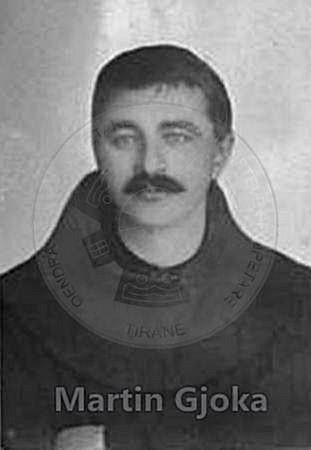

Father Martin Gjoka (Tivar, April 2, 1890 – Shkodër, February 3, 1940), was a Franciscan friar, teacher, composer, collector and researcher of the musical folklore of the northern highlands. He was born in Tivar on April 2, 1890, baptized with the name Matí, the son of Filip and Marie Siroviqi. His father was a captain in the seaport of Tivar.
He went to Shkodër at the age of 15 where he met Palokë Kurti and Frano Ndojen, who noticed his talent and kept him close. He entered the Franciscan school in 1906 where lessons had been given in Albanian since 1902, when Fishta was appointed director, and when he was 18, his superiors with foresight sent him to Salzburg in Austria, where in addition to philosophy and theology, he also attended the famous music school at the institute under prof. Hartmann.
There, in addition to theoretical subjects, he also deepened his study of the pianoforte, flute and violin and began to compose. He expressed his appreciation for the musicians Palokë Kurti and Father Shtjefën Gjeçov when he dedicated his first two compositions for pianoforte in 1910 to them, “Liberty” and “Homeland and Albanian Language”.
He returned to Shkodra a few days before the declaration of Albania’s independence. He taught at the “Illyricum” college of violinists in the subjects of history and geography, and German language. He created the “Illyricum” orchestra in 1922, which also won the national competition in 1930. He was the first to compose classical music in Albania in different genres.
Among Martin Gjoka’s most famous compositions are “Albanian Rhapsody”, the instrumental pieces “On the Bridge of Shala”, “A Violet from Shkodre”, the suite for symphony orchestra “Two Flowers on the Tomb of Skanderbeg”, a number of lyrical and epic songs, ballads, choral dances, etc.
Father Martin Gjoka’s students were Prenkë Jakova, Çesk Zadeja, Tish Daija, Tonin Harapi, Tonin Rrota, Pjetër Dungu, Abdulla Grimci, Simon Gjoni, Zef Gruda, Lukë Kaçi, Gjon Kujxhia.

 Balkan Academia