
by Dr. Qazim Nazmani. Translation Petrit Latifi
Summary
The text argues that Serbian statehood and national identity were shaped in the 19th century through Russian pan-Slavic strategy and the assimilation of Orthodox Albanians and Vlachs in the central Balkans. It links the Serbian project Načertanije (1844) to Russian influence and to rulers of alleged Albanian origin who later oppressed and displaced Albanians. The author accuses Serbian historiography of fabrications, particularly regarding demography, culture, and folk dress. Using Serbian academic sources, the text claims Serbian traditional clothing lacked an ancient tradition and was adopted from Albanian culture, reflecting broader cultural and demographic assimilation during the creation of the Serbian nation.
The Serbian nation was formed in the 19th century, based on the Russian project and strategy. This Pan-Slavic project originated in the Polish Club in Paris. The Polish Club was very active in the last decade of the 18th century and the beginning of the 19th century. Many students and young people from the Ottoman-occupied territories in Europe were members of this club.
In this club there were many North Germans, especially from Prussia who, because of Catherine, the wife of Peter of Russia, had developed a sympathy for the Russian Empire. The Serbian project “Nacertanja 1844” for a new Serbian state and nation, the project included all the Orthodox of the central Balkans, and in particular the Orthodox Albanians and Vlachs of this area.
The Nacertanja of Ilia Garashanin, was implemented during the time of King Alexander Karadjordjevic, who came to power during the years (1842-1858). This dynasty had Albanian origin.
It is important to know that, from the Albanian dynasty of Karadjorgje Petrovic, there was also King Petar Karadjorgjevic, who in the Balkan Wars of 1912, and the First World War, killed Albanians, displaced them and colonized Albanian lands with Slavs.
Also between the two world wars, the king of Serbia, Alexander Karadjorgjevic, of Albanian origin, oppressed Albanians, displaced them to Turkey, and colonized Albanian lands with Slavs, from the region and Western countries.
Serbs have written many books full of lies and forgeries and have sent them to fill the libraries of different countries of the world.
Some of the Albanians who do not read at all believe the writings of Serbian authors, some do not deal with their falsifications, pretending to be moderate, while some of us, who still try to read their lies, are surprised why the Albanian institutions are silent, and do not write, research the lies and falsifications of the Serbs.
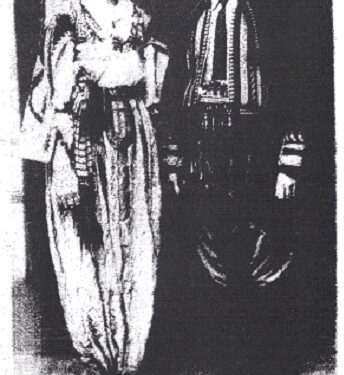
In this case, I am attaching a photo from the book: Pisma Serbskih Konzula iz Prishtine 1889-1900
This photo taken in the city of Prizren shows.
Below the photo is written: Serbian clothing of Varosh in Prizren in the 18th century.
Propaganda:
In the 18th century there were no photographs, because the first photographs with a camera were taken in the middle of the 19th century.
In the 18th century and in the 19th century, there was no Serbian population in the city of Prizren.
The population of the varosh in the city of Prizren, during the 18th and 19th centuries, was of Vlach and Orthodox Albanian origin.
The Vlachs of Prizren were Serbized during the 20th century.
Serbian researchers, who are known to be a little more serious, in describing the events in the region during the 19th century, have written about Serbian clothing that they do not have source data on what it looked like before the 19th century.
Data on the clothing of Serbian women can also be found in this book, page 559
Serbian authors write: However, until the records of 1826, we had no data on the clothing of women and ordinary citizens. The clothing of Serbian women since 1813 has been recorded, as evidenced by the personal belongings of Karadjorgjevic, which we are talking about. Among other things, a chest with women’s clothing was found. It was the wardrobe of Karadjorgji’s wife, Jellena, and her daughter, who was the wife of Antonia Plakiqi, Serbian authors write.
From this data we understand that this was also Albanian folk clothing when it is known that Karadjorgje Petroviqi had Albanian origin, as did his son-in-law Antonije Plakiqi. Among the Albanian population of Kosovo and the New Market, the surname Plakaj – Plakiqi is still preserved in some Albanian families today
Facsimile from the book published by the Academy of Arts and Sciences of Serbia
Facsimile of Serbian clothing from the book of Atanasje Urosevic, which proves that before the creation of the Serbian state, the Serbs dressed like Albanians
There is ample evidence and arguments that the Serbian state was created in the Illyrian lands, according to the projects of the most powerful world states, and especially according to the pan-Slavic projects of Russia. The Serbian nation was created in the 19th century, by assimilating all the Albanian and Vlach Orthodox who lived in the northern territories of the Illyrian Peninsula.
This nation, like the Greek nation, was created on the foundations of the material and spiritual culture of the Albanian people, by adopting the cult objects, clothing, food and folk traditions of the Albanian people.
As for the clothing and folk art, inherited for thousands of years by the Albanian population, we still find cult objects from antiquity, such as symbols carved in wood, stone and other materials, which today among Albanians are found in folk architecture, cemeteries, furniture and especially traditional national costumes in various regions of Illyricum.
In the costumes of Albanian women, pagan symbols, embroidery and other geometric, astral ornaments, and symbols with mythical significance have been preserved for centuries, from the Xhubleta and the clothing of women from different regions, which differ from each other, depending on the region with specific economic and climatic conditions.
As can be seen, the clothing of Serbian women does not have an ancient tradition, and it was not known until the 19th century, when the Serbian nation was created.
The Serbian nation was formed by assimilating the Albanian and Vlach Orthodox population, and by adopting Albanian culture and traditions, so as far as Serbian folk clothing is concerned, no specimens were known of what it looked like before the 19th century.
Transcribed and translated:
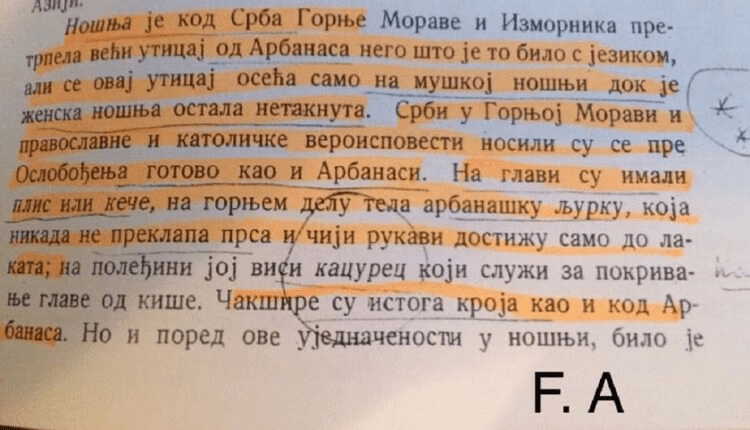
“The costumes of the Serbs of Upper Morava and Izmornik were more influenced by the Arbanasi than the language, but this influence is felt only on the men’s costumes, while the women’s costumes remained intact.
Serbs in Upper Morava, both Orthodox and Catholic, wore almost the same clothes as the Arbanasi before the Liberation. They wore a plis or keche on their heads, and on the upper part of their bodies an Arbanasi lyurka, which never covers the chest and whose sleeves reach only to the elbows; on the back of it hangs a katsurec that serves to cover the head from the rain. The chakshires are of the same cut as those of the Arbanasi. But despite this uniformity in costumes, there were […]

 Balkan Academia