
by Lulzim Osmanaj. Translation Petrit Latifi
The ancient Pelasgians constitute a very early layer of Balkan and Mediterranean civilization, emphasizing the connection between the Albanian language, mythology and terms that were later adopted by the ancient Greeks. The main argument is based on etymology, cosmogonic mythology and cultural heritage.
Chaos and the meaning of emptiness
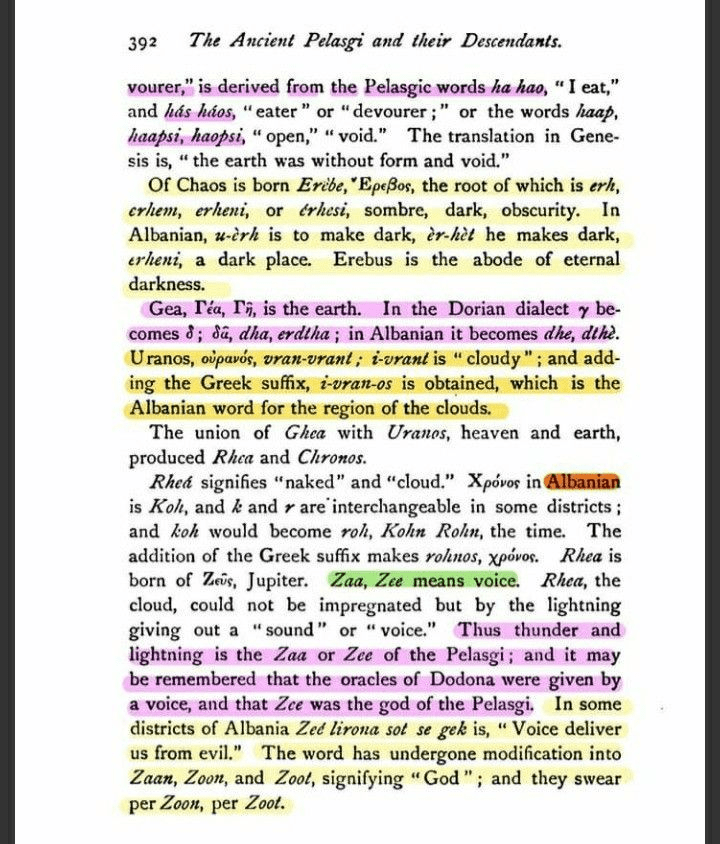
The concept of Chaos is explained as an initial state of formlessness and emptiness, which is related to Pelasgian roots such as ha, hao (“I eat”) and haap, haapsi (“open”, “empty”). This matches the biblical description in Genesis, where the earth is presented as “formless and void”. This suggests a universal understanding of the beginning of the world as emptiness and lack of structure.
Erebus – eternal darkness
From Chaos comes Erebus (Έρεβος), a symbol of darkness. The root of this name is related to words that express darkness and gloom (erh, erheni), which are also preserved in Albanian. Erebus is presented as the abode of eternal darkness, an essential concept in Pelasgian and Greek cosmogonic mythology.
Gea and Uranus – earth and sky
Gea (Γῆ) is identified as earth, while Uranus (οὐρανός) as sky. The text emphasizes that these terms can be explained through phonetic developments related to Albanian (dhe, re). The union of earth and sky symbolizes the creation of natural order and cosmic fertility.
Rhea and Kronos – time and cloud
From the union of Gea and Uranus, Rhea and Kronos are born. Kronos is related to the concept of time, being explained through phonetic developments that lead from time to chronos. Rhea is interpreted as the cloud, a symbol of celestial fertility, impregnated by lightning and sound.
Zeus – the divine voice
Zeus is presented as the god of sound, thunder and lightning. The root Zaa/Zee is related to “voice” and is preserved in Albanian traditions, as a popular expression referring to the liberating voice. The oracles of Dodona, which were given through the voice, are seen as evidence of the Pelasgian cult of Zeus. The word God also derives from this root, which carries a religious and linguistic continuity.
Greek mythology and its fundamental terms have Pelasgian roots, best preserved in the Albanian language. This heritage testifies to the antiquity of Albanian and the role of the Pelasgians in the formation of Mediterranean and European culture.
References
- Herodotus, Historia: përmenjet e Pelasgëve dhe pre-Hellenic peoples.
- Hesiod, Theogony, on Greek cosmogony (Chaos, Gaea, Erebus, Uranus).
- Aristotle, Meteorology, Dodona and the Pelasgians.
- Eqrem Çabej, Etymological Studies in the Field of Albanian for the Illyrian-Albanian Linguistic Continuity.
- Johann Georg von Hahn, Albanesische Studien for the Pelasgian and Albanian Connections.
- N. G. L. Hammond, The Pelasgians: The Pelasgians in the Historical Balkan Context.

 Balkan Academia