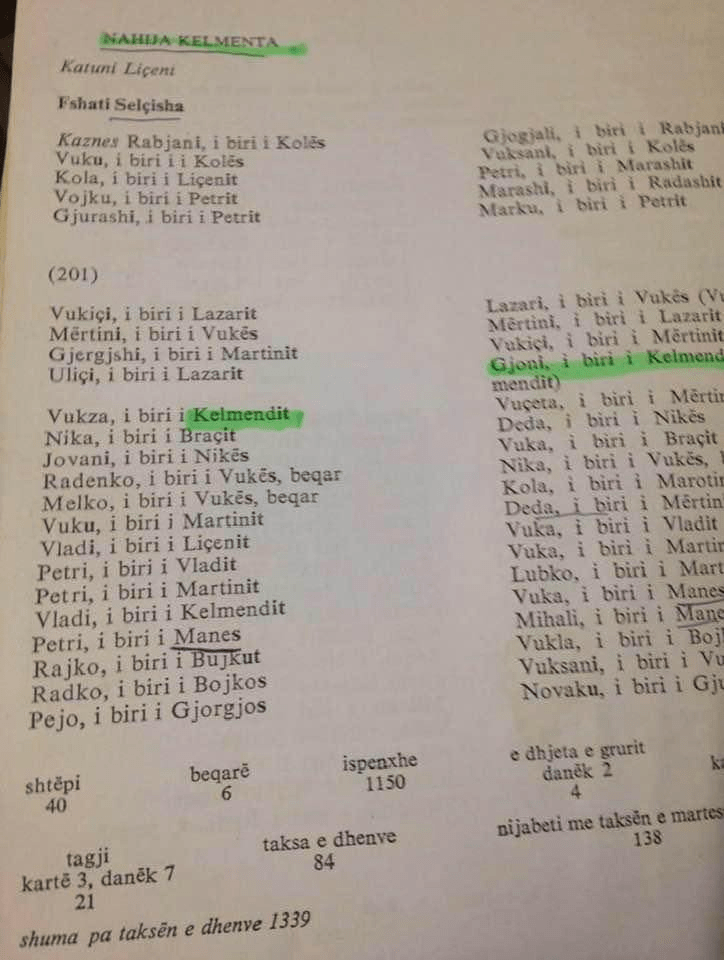

According to the Ottoman register of 1497, translated by S. Pulaha, in the Kelmendi district two villages are mentioned: Selçisha, with the village of Liçen, and Ispaja with the villages of Gjonović, Lešović, Murić and Kolemad (-h).
Also, individuals are mentioned who may be the founders of the main trunk of the tribe: Vukza, son of Kelmendit, Vladi son of Kelmendit, and Gjoni, son of Kelmendit, in Selçishë; Vuku, son of Kelmendit, in Içpajë-Gjonović; Deda, son of Kelmendit, and Stepani son of Kelmendit in Içpajë-Muriqe.
Slavization of the Albanians and “Slavic” names
The register contains Slavic sounding names and regions, but these tribes were not of Slavic origin. Rather, these names are evidence of the medieval Slavic Orthodox pressure which the Albanians tribes had to endure. In order to trade, survive and be exempt of high Church taxes, Albanians had to adopt secondary Slavic names and sometimes combine both Albanian and Slavic.
Names extracted that are Albanian
Gjin
Leka
Kola
Pjetër
Gjura
Lazar
Mërtin
Gjergj
Ulik
Ujk
Nikollë
Gjon
Raden (Bardh)
Mark
Vlad (Blas)
Rajko (Bardh)
Rado (Bardh)
Pejo (Pjetër)
Manë
Bujk
Bogë
Lubë
Mihal
Novak (Gjon)
Slavic names restored to their Albanian form
Kaznes → Gjon
Vuk → Ujk
Kola → Kolë
Vojko → Gjon / Ujk
Gjura → Gjura
Vukci → Ujk
Mërtini → Mërtin
Gjergjshi → Gjergj
Ulci / Ulici → Ulk / Ulik
Vukza → Ujk
Nika → Nikollë
Jovani → Gjon
Radenko → Bardh / Gjin
Melko → Mark
Vuka → Ujk
Vladi → Blas / Vlad
Petri → Pjetër
Rajko → Bardh
Radko → Bardh
Pejo → Pjetër
Gjojak → Gjon
Vukan → Ujk
Petri (Marashit) → Pjetër
Marash → Marash
Marku → Mark
Lazari → Lazar
Mërtini → Mërtin
Vukić / Vuki → Ujk
Gjoka / Gjoka → Gjon
Vuçeta → Gjin
Deda → Dedë
Nika → Nikollë
Kola → Kolë
Vladit → Blas / Vlad
Lubko → Lubë
Mihal → Mihal
Vuksani → Ujk
Novaku → Gjon

 Balkan Academia