
Abstract
Recent advances in applied biocomputing and population genetics have made it possible to reconstruct historical population processes using Y-chromosomal data. This study presents the results of the Albanian DNA Project “Roots,” based on 1,322 voluntarily submitted Y-chromosome samples from Albanians across all Albanian-inhabited regions. By comparing modern paternal lineages with ancient DNA from the Balkans and Europe, as well as with contemporary populations, the study reconstructs the temporal and geographic origins of Albanian paternal ancestry. Statistical analysis shows that approximately ten haplogroups account for 94.6% of Albanian paternal lines. The findings indicate three major demographic phases: a minor Neolithic component (under 4%) linked to early agricultural expansions; a dominant Bronze Age–Antiquity component (around 72–77%) associated with ancient Balkan populations such as the Illyrians, Dardanians, and related tribes; and a later contribution (16–19%) dating to Late Antiquity and the Early Middle Ages, reflecting Germanic, Slavic, and other migrations. Overall, the results support strong genetic continuity between modern Albanians and ancient Balkan populations, despite later admixture events.
In summary, it can be said that a small percentage of Albanian paternal lines (1-4%) have been established and spread in the Balkans for more than 4500 years, mainly with the spread of agriculture, the majority of 72-77% spread around 2500 to 4000 years ago with ancient Balkan tribes such as the Illyrians, Dardanians, Dacians, etc. The last wave that has left significant genetic traces, from which 16-19% of Albanian paternal lines come, arrived around 1200-1800 years ago, during the period of invasions of Germanic, Slavic, etc.
For years now, the advancement of applied biocomputing technology has enabled the use of genetic data for the study of history. Particularly through the analysis of the Y chromosome, which is passed directly from father to son, without genetic contribution from the mother, any family or tribe can trace the ancestry of the paternal line, or as it is known worldwide, the haplogroup. Meanwhile, the collection of a representative sample of genetic results also enables the research of ancestry on a provincial or national scale
Contents
1 Statistical summary
2 History of Albanian paternal lines
2.1 From the Bronze Age to Antiquity
2.2 Late Antiquity and the Early Middle Ages
2.3 Arbëro ethnogenesis
3 Conclusion
So far, the Albanian DNA Project “Roots” has voluntarily collected the results of 1322 members from all Albanian regions. From their comparison with both genetic analyses of ancient bones in the Balkans and Europe, as well as with results from modern-day peoples, several conclusions emerge clearly, which we present in a summarized manner below. In the meantime, we invite every Albanian family to perform a genetic test of the Y chromosome and to join the project.
For more information on how to register for the project, you can contact us directly through the “Roots Project” page on Facebook: https://www.facebook.com/Projekti-Rrenjet-101700961530810, or follow the instructions on our website: https://rrenjet.com/#Si_te_rejestiroheni.
Statistical summary
From the statistical balancing of 1322 results, it appears that about 10 of the most frequent haplogroups summarize about 94.6% of all Albanian paternal lines. Approximately one-quarter of the results are from members from Kosovo, Macedonia and other Albanian territories outside the Republic of Albania. As the number of members in these territories increases, especially in Kosovo, the percentages may change slightly, but should remain within the 95% confidence interval. Below you will find the frequency of each haplogroup:

Haplogroup Percentage 95% confidence interval
E-V13 27.7% 25.2 – 30.1%
R1b-M269 21.3% 19.1 – 23.5%
J2b-L283 15.3% 13.4 – 17.3%
I2a-Y3120 7.5% 6.0 – 8.9%
R1a-M417 5.9% 4.7 – 7.2%
I1-M253 5.5% 4.2 – 6.7%
J2a-M410 4.3% 3.2 – 5.4%
J1-M267 2.5% 1.6 – 3.3%
I2a-M223 2.5% 1.6 – 3.3%
G-M201 1.6% 0.9 – 2.2%
E1b-M123 0.7% 0.3 – 1.2%
Showing 1 to 11 of 11 entries
In summary, from the table we can see that a small percentage of Albanian paternal lines (1-4%) have been established and spread in the Balkans for more than 4500 years, mainly with the spread of agriculture, the majority of 72-77% spread about 2500 to 4000 years ago with ancient Balkan tribes such as the Illyrians, Dardanians, Dacians, etc. The last wave that has left significant genetic traces, from which 16-19% of Albanian paternal lineages come, arrived around 1200-1800 years ago, during the period of invasions of Germanic, Slavic, etc. tribes.
History of Albanian paternal lineages
Beyond general statistics, each haplogroup has its own history and must be studied in depth to understand the time and manner of settlement and spread. Therefore, below we present one by one the different archaeological and historical periods of importance for understanding the origins of Albanians.
Before the Bronze Age
It is thought that modern man arrived in Europe more than 30,000 years ago. Among the oldest paternal lineages found in Europe until the Mesolithic period are haplogroups C, I, F, then I1, I2-P37, I2-M223, I2-L596, R1b-V2219, etc.
The Europeans of this period were nomadic peoples who were mainly hunters, following their prey from one area to another. Although there are Albanians who carry some of the aforementioned paternal lineages, there is no genetic continuity in the Albanian people today, as the vast majority of these lineages have moved across Europe until they have managed to redistribute, in most cases from northern or eastern Europe, settling in the Balkans relatively recently.
The percentage of paternal ancestors of Albanians who have continuously inhabited the Balkans since the Mesolithic is below 0.5%.
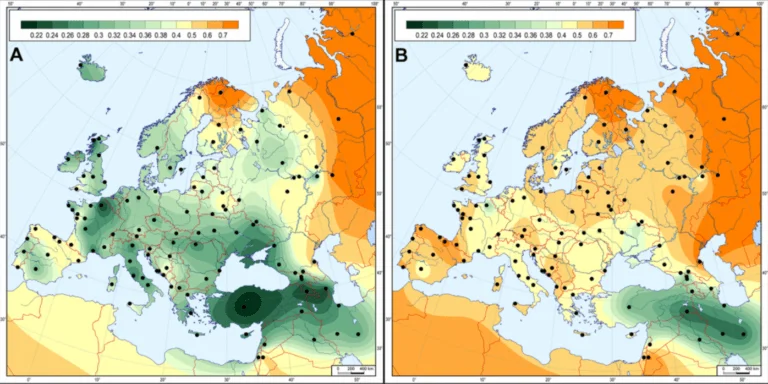
The spread of agriculture during the Neolithic also coincides with the degree of genetic closeness of today’s female lineages to those of the Neolithic from the Middle East. Haak et al, 2010.
From 7000-9000 years ago, peoples who had acquired agriculture in the Levant began to spread towards the Balkans and Europe in general. This movement has long been noted in archaeology, but recently we have also learned that the paternal lineages that arrived in Europe during this time were mainly branches of haplogroups G, E, J1, J2, T, etc.
The agricultural revolution, within a few years, drastically changed the genetic composition of southern and central Europe, replacing the Mesolithic paternal lineages with newly arrived ones from the east. Thus, haplogroup G is clearly dominant in all Neolithic findings in scientific studies in the Balkans, while other haplogroups found in the Balkans included certain branches of J2a, J1, etc.
Today, haplogroup G is carried by less than 2% of Albanians, while other clearly Neolithic lineages are found even more rarely. In northern and eastern Tuscany this percentage is slightly higher but still does not exceed 5%. Considering the fact that some of these lineages may have been established in later periods from different directions, we can safely say that less than 4% of all paternal ancestors of Albanians were found among the Neolithic (i.e., pre-Illyrian) peoples of today’s Albanian lands.
From the Bronze Age to Antiquity
After several millennia of the expansion of agriculture and the paternal lineages of the peoples who spread it, with the beginning of the Bronze Age, massive invasions of Indo-Europeans began. In their homeland in the Eurasian Steppes, this population with a patriarchal social structure was mainly engaged in beekeeping, and had also acquired the use of horses and later also of carts, and had acquired high immunity to animal diseases and tolerance to lactose.
From the Steppe area, the Indo-Europeans spread in all directions, extending in a few generations from Western Europe to China and India. The major language groups of modern Europe, such as the Latin, Germanic, Slavic, Celtic, as well as Albanian and Greek, have a common root precisely in the language spoken by this people. The arrival of Indo-Europeans in central Europe and the Balkans is well documented not only genetically, but also in archaeology.
The Yamnaya were the main group of Indo-Europeans that spread towards Europe and central and southern Asia. Narasimhan et al, 2019.
Among the Steppe peoples who moved westward during the Bronze Age, the main haplogroup was R1b-M269, while other haplogroups included R1a-Z93, I2-M223.
It is very likely that the expansion towards the present-day Albanian lands was not a uniform movement, but a series of displacements starting from the Bronze Age and continuing until Antiquity, assimilating and including other peoples in these influxes. The main paternal lineages of Albanians that have settled in the Balkans since this period from the north and northeast are R1b-PF7562, J2b-L283, E-V13, R1b-CTS9219, I2-L701, etc.
R1b-PF7562 and J2b-L283, in their vast majority, have settled in the present-day Albanian lands since the Bronze Age. Both the finds from antiquity and the diversity of modern lineages speak of a presence of over 3000 years. J2b-L283 has also been found in Illyrian bones from the Bronze and Iron Ages in Dalmatia, Slovenia and Vojvodina, from the Iron Age in the Puglia region, and in Late Antiquity in Moesia and Dardania.
In line with these findings, in the Roots Project database, it is observed that the R1b-PF7562 sub-branches among modern Albanians have been separated since 3400-4000 years ago, while those of J2b-L283 since 3100-3600 years ago. Today, R1b-PF7562 is found in similar densities (3-4%) throughout Albanian territory, while J2b-L283 is found much more densely in the north (15-30% depending on the area) than in the south (7-10%). These two paternal lines comprise about 20% of Albanian paternal lines.
Some Indo-European groups first settled in the Pannonian Basin, from where, after assimilating local peoples, they continued further south towards the western Balkans.
For the paternal lineages E-V13 and R1b-CTS9219, it is more likely that the settlement in the western Balkans started from the north, probably from the area between the European Alps and the Carpathians, starting from the end of the Bronze Age and throughout the Iron Age until Antiquity. R-CTS9219 has been found on the border of Roman-period Dardania, while lineages close to it have also been found in Vojvodina from the Bronze Age.
For this paternal lineage, the Pannonian Basin must have been a stopover between the Steppes and the Balkans. Whereas E-V13 was a rare paternal lineage surviving among the descendants of the agricultural peoples that the Indo-Europeans found in central and eastern Europe, but its spread also began during the Bronze Age.
The finding of close lineages in the northern Balkans and Hungary, and the massive presence of E-V13 itself in Moesia and on the border of Dardania in the late Roman period and less frequently in the Celtic cultures of central Europe, also indicates that it must have arrived in present-day Albanian lands mainly from the north and northeast. R-CTS9219 gare spread with uniform density (14%) in Albanian lands, while E-V13 has many sub-branches, each with its own specific distribution.
Both the present-day Albanian sub-branches of R-CTS9219, as well as those of E-V13, have genetic connections of about 2500-3500 years with paternal lines outside the Balkans, mainly in Central Europe. Therefore, the establishment of these two lines in the present-day lands can be assumed around the end of the Bronze Age or during the Iron Age. These two paternal lines constitute about 40-45% of all Albanian paternal lines.
In addition to the aforementioned lines, also sub-branches of I2-L701, R1b-L51, J2a-M410 and J1-M267 may have been established in the present-day Albanian lands between the Bronze Age and Antiquity. In summary, with the data so far, about 75% of all Albanian paternal lines must have been in the central and western Balkans since that time, being also part of the Illyrian tribes.
Late Antiquity and Early Middle Ages
With the weakening of the Roman Empire, various tribes from northern and eastern Europe began to penetrate the imperial borders, regularly flooding into the Balkans. Among the most famous invasions we can mention those of the Goths, Huns, Vandals, Avars, Slavs, etc.
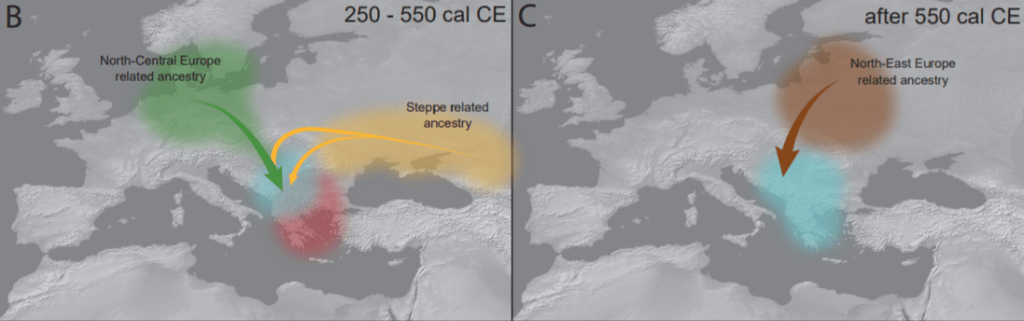
The ancient Balkan element managed to survive these floods, but also absorbing new influxes, sometimes less frequently and sometimes more densely. A recent study on the genetic heritage of ancient Balkans and Slavic invasions estimates that Albanians and Greeks were affected by these movements less than Serbs, Bulgarians, Romanians and Croats.
Genetic traces of the invasions that affected the Balkans in the 3rd-7th centuries according to Olade et al 2021.
The paternal lineages that merged in this period with those inhabitants of the Balkans who survived the invasions are I1-M253, R1a-CTS1211 and R1a-M458, I2a-Y3120, N-P189.2, etc.
All of these are found in ancient finds up to the Roman imperial period, and the modern lineages found among Albanians are usually connected to lineages from northern and eastern Europe at about 1400-2000 years. I1-M253 is more closely related to the movements of Germanic tribes, N-P189.2 to those of the Eurasian peoples (Avars, Magyars, etc.), while R1a-CTS1211, R1a-M458 and I2-Y3120 to those of the Slavs.
However, it is not excluded that a separate sub-branch of R1a or I2-Y3120 moved with the Germanic tribes, or a branch of I1-M253 with the Slavic ones. Today I1-M253 is more concentrated in mountainous areas such as Kurveleshi, Puka and the area between Mat and Mirdita, while R1a-M417 and I2-Y3120 are more often found in lowland areas. All these lines together constitute about 16-19% of the Albanian paternal lines today, of which about ¾ arrived with the Slavic tribes, while the rest mainly with the Germanic tribes.
Arbër ethnogenesis
After overcoming the turmoil of the fall of the Roman Empire, successive barbarian invasions and various epidemics, the present-day peoples of the Balkans began to take shape during the Early Middle Ages. The Arbër people, who appear in documents from the 11th century, managed to preserve a language that stemmed from the ancient languages of the Balkans. Even on the genetic level, we note that the last centuries of Antiquity were a difficult period for our ancestors, as most of our lines have undergone the bottleneck effect (thinning of the paternal line branches) during this time.
Today’s Albanians of all paternal lines, as a whole, are descendants of that shrunken population with origins in mainly Paleo-Balkan and heirs of an ancient language, which survived the upheavals of the 3rd-7th centuries. In line with this observation, a 2013 study states that Albanians are the most homogeneous people in Europe, and most descend from common ancestors that constituted a small but compact population about 1500 years ago.
Conclusion
In conclusion, it should be noted that the genetics of peoples is a new and developing discipline, so this article will be constantly expanded and improved, both with the increase in the sample of modern Albanians, and with the coming to light of new results from ancient bones.
On the other hand, the number of modern and ancient results now allows us to summarize with certainty the origin of Albanian paternal lines into three main groups: (1) a very limited minority, under 4%, who may be descendants of Neolithic peoples in the same lands as today; (2) a significant minority, about 20%, who come from tribes that settled here between the 3rd and 7th centuries; and (3) the vast majority, about 75%, coming from ancient Balkan tribes that arrived between the Bronze Age and Antiquity.
More detailed information about each haplogroup can be found here: https://rrenjet.com/linjat-aterore/. For questions or any uncertainties, you can contact one of the project volunteers via the Facebook page or email addresses found here: http://www.rrenjet.com/rreth-nesh.
Source
https://rrenjet.com/prejardhja-gjenetike-shqiptare/

