
by Damir Dibra. Translation Petrit Latifi
Summary
The text is a historical vignette set in Shkodra on 8 October 1912, the day Montenegro began its attack at the start of the First Balkan War. Through a street conversation between two local men, it captures the tense atmosphere of rumor, fear, and expectation spreading through the city. The men express deep resentment toward centuries of Ottoman rule and a hope that its end may be near, but they are also anxious that Montenegrin or Serbian rule could be even worse. Their debate is interrupted by the distant sound of a cannon from Deçiq, confirming that the fighting has begun. The scene ends with their cautious decision to stop talking, aware that in wartime even words can be dangerous.
Translation into English:
Tuesday, 8 October 1912
Through the streets of the city: fear, confusion, and whispered words from ear to ear… Around midday. The “Gurakuqi” quarter; Gjuhadol.
“Hey, Ndoc?” — a friend of his, Kola, stopped him on the road.
Both of them, dressed in short jackets, with fezzes topped by silky tassels on their heads, were heading toward the baker’s. As they greeted each other—
“Well then!” — Kola went on. — “Any news?… How do things look to you? Do you think it really broke out, or…?”
“It seems so, most likely!” — his companion replied. — “Only, what it might lead to… God knows! We’ll see! As for the Turk, from what it looks like to me, this kind of path will burn his skirts; but how much will it cost?… I’m afraid it’ll be oak instead of beech for musket balls! Well, the Turk and Montenegro: one scrape!”
“Come on, man! Let this sore finally be removed; after that, who knows what God will do. Let’s shake ourselves free of this filth; it’s enough now — nearly 500 years that it has dirtied this land! Montenegro? Serbia?… Damn this Albania, just let the Turk get off our necks!”
“Fine, fine; but I fear we may fall from rain into hail. I’m afraid we’ll regret it soon. And who has ever seen any good from Montenegro?”
“I know that myself; but it can’t go on like this either!”
His words were cut off by the dull boom of a distant cannon, which at that moment echoed from the direction of Deçiq. And in that sad, thunderous sound, I don’t know whether from fear or from joy, Kola burst out shouting loudly:
“By God, they’re coming! Lucky you, Ndoc — at most, in a week from today, we’ll see them roaming through the Field of Çelës and all along Parrucë, with their gold-embroidered caps, with King Nicholas I himself!”
“God forbid! No, no — a hundred times better the red fezzes! We’re used to them by now! There’s nothing worse than this, I tell you myself, this mess and that mess; but my mind tells me that under a new rule we’ll be far worse off. You don’t know what Montenegro is! By my soul, they don’t want to see Albanians alive!”
Word after word, they reached the baker’s. There they broke off the conversation, telling each other:
“Let this be spoken here and left here. Don’t dare mention such things to anyone; for now it’s wartime, and they could bring trouble down on you! You could lose your head for nothing!”
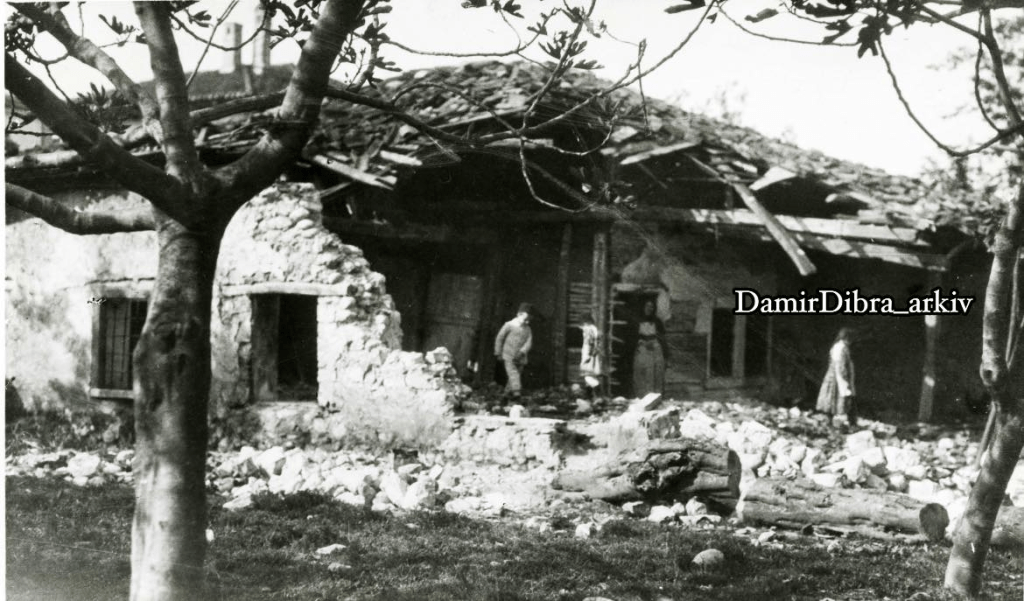
Photo: the ruined house of Halil Bey Dibra, destroyed by bombardments of the Montenegrin army (Baja e Vogël).

 Balkan Academia