
by Vasel Gilaj. Translation Petrit Latifi
Albanian Proto-Feminism: Equality through Renunciation in a Patriarchal Honor Society
The Virgins Vow is a religious vow with civil rights consequences, which carries weight, is the vow of a girl to remain unmarried. According to religious weight, we must distinguish between the vow of a virgin and a nun. When a girl swears to remain unmarried, she takes on a very serious responsibility, only that the vow is not made in a church as in the case of other vows. By means of this vow, the virgin gains some rights, which belong only to men.
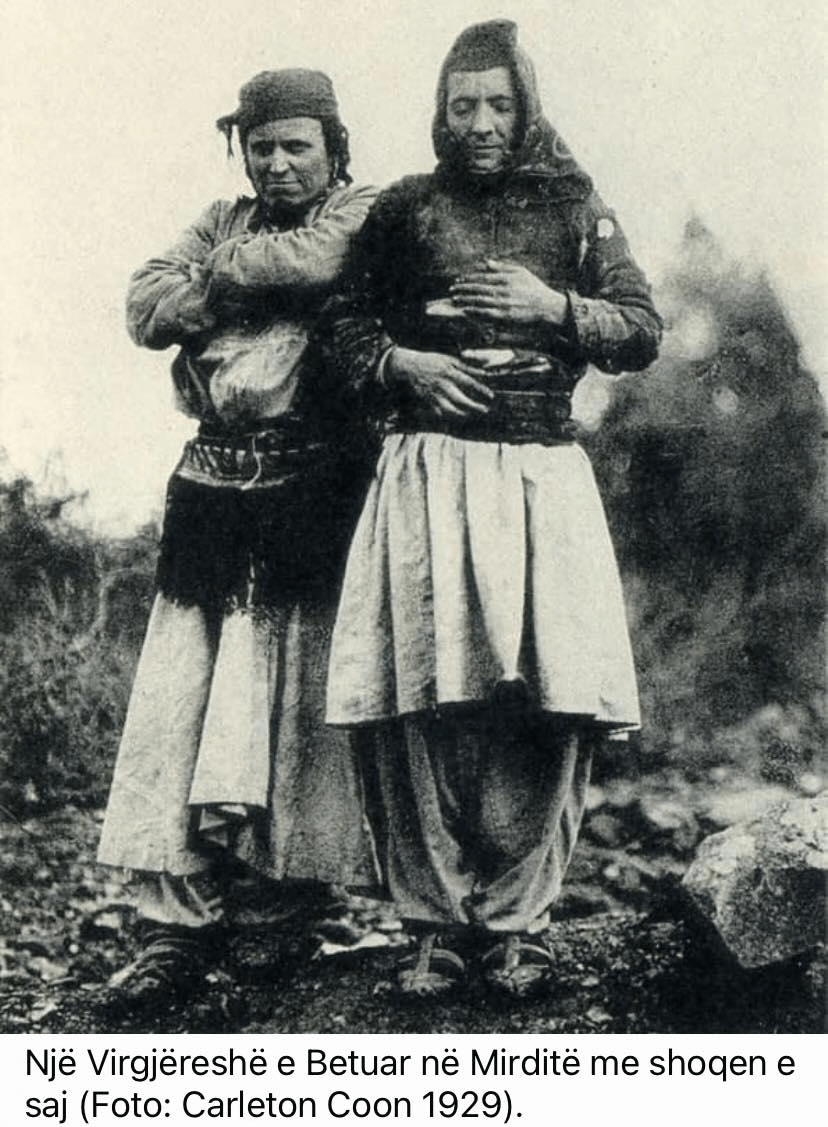
Virgins cut their hair, wear a turban like men, or tie their heads in the manner of men with a white cloth, then wear a necklace and sometimes dress completely like men, i.e. with panties, antlers and a turban. I. also noticed that virgins carried rifles. According to the data of Kozzi, in 1912 in Malesina e Vogel there were two virgins, who wore men’s clothes according to the occasion, and in Malesina e Madhe there were six of them of different ages.
The fact that they carry weapons and that they enjoy inheritance rights, which other girls and women do not enjoy. The institution of virginity extends throughout Northern Albania to Rresha, because I found the suicide of a virgin recorded in the parish register of the dead in 1902. When I asked specifically, in Rresha they assured me that virgins also take on the task of revenge.
Since Gozzi mentioned bloodshed in his work, he mentions many such cases, where girls and women, usually without weapons, have taken the blood. He even mentions cases that show that these murders were not random encounters, but systematic pursuit of the murderer, or his relatives.
The main point of the whole matter, how much is paid for the illegal murder of a virgin, remains of course to be asked. The institution of virginity, which reminds us of the Amazons, is certainly very old. These “women – men” around 1855 still existed in the Brda Mountains of Montenegro and in Bosnia. According to Zvorko’s notes, it is a tradition that there were (women – men) who dressed as men and whose most pleasant work was war.
The reasons that push a girl to declare herself a virgin are the desire to remain unmarried in her parents’ house and then, especially, the intention to withdraw from a boring engagement. The first reason is taken into account only in the Greater Highlands, in the Lesser Highlands it is not accepted, because a girl, who has not been able to marry a man, is a shame to have in the house.
This may be a memory of the fact that Dergumi (1883) shows, that in ancient Sparta a bride of a robber was handed over to a woman (the mother of the bride) and wore men’s clothes. In addition to the virgins, which we have visited, in the Northern Highlands there are also other virgins, who are called nuns and who have sworn to preserve their virginity. As Cozzi mentions, this is a memory from the assembly of nuns in Planti, which was dissolved by Pope Clement XIII in 1763 and which was founded in 1715.
The assembly was closed, because the then inhabitants demanded that the nuns live in their homes. Today, nuns are those girls who want to avoid an engagement. If an engagement has taken place, the vow of nuns is not valid. In memory of the religious origin of the institution, nuns dress in black and represent a secular type of nuns. They are particularly spiritual.
Most often, the opposite happens and the church, from a moral point of view, has the right to fight this institution. On the initiative of the archbishop, in 1912 the administration of the Catholic part of Shkodra took a position against nuns. There were especially many nuns in Shkodra.
A stay of nuns at home was not very possible in Malesia, and so many nuns went to Shkodra. In many places, the servants of the priesthood in Malesia came from these strata of the population.
Photo: A sworn Virgin in Mirdita with her friend (Photo: Carleton Coon 1929).
Information gathered from Franc Nopca (Perg; “Zani i Malsise”).

 Balkan Academia