
Translation by Petrit Latifi
Abstract
Haplogroup E-V13 represents the most frequent paternal lineage among Albanians, accounting for roughly 28% of male lines and showing a relatively uniform distribution across Albanian territories. This study reviews both modern genetic data and ancient DNA evidence to investigate the origin, spread, and internal diversity of E-V13, with particular focus on its relevance to Albanian ethnogenesis. The common ancestor of all E-V13 carriers lived approximately 4,900–5,100 years ago during the Bronze Age, following earlier Neolithic expansions of macrohaplogroup E into Europe.
While ancient and modern evidence suggests the initial spread of E-V13 occurred in the central Balkans—between the Pannonian Basin and Thrace—later dispersals took place during the Bronze and Iron Ages among Indo-European Balkan populations. Albanian E-V13 lineages likely derive largely from Dardania and surrounding regions, with significant diversification occurring in late antiquity and the early Middle Ages.
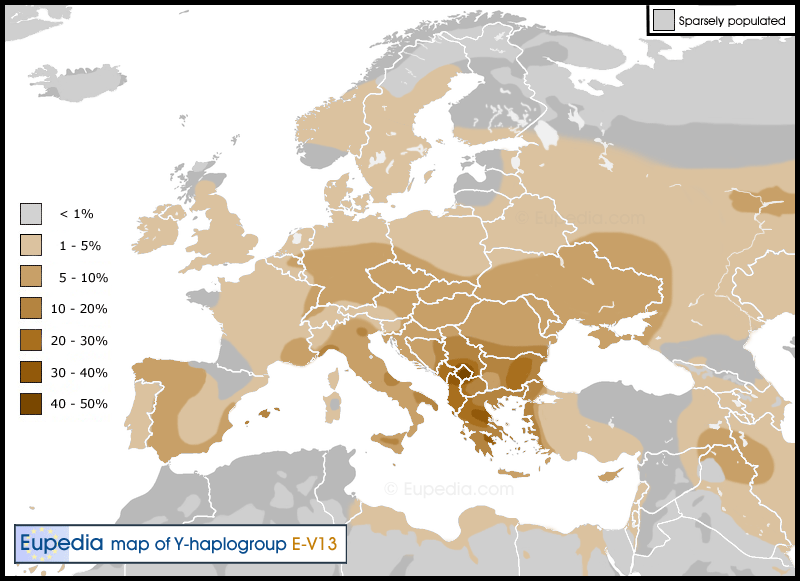
E-V13 is the most frequent haplogroup among Albanians, with about 28% of the paternal lineages in the project. It has a more or less uniform distribution and concentration in all Albanian territories, so it is important to investigate the general ancestry of the haplogroup. On the other hand, specific branches have different distributions and frequencies from each other and should be examined each according to its own history of spread.
Contents
Origin of E-V13
1.1 Modern results
1.2 Ancient results
2 E-V13 among Albanians
Ancestry of E-V13
All carriers of E-V13 have a common ancestor who lived about 4900-5100 years ago, that is, during the Bronze Age. Before this period, as part of macrohaplogroup E, the ancestors of E-V13 must have settled in Europe with the successive waves of Neolithic cultural expansion from Anatolia and the Levant.
Discoveries of branches ancestral to or close to E-V13 in antiquity include E-L618 from the Neolithic in Croatia, Hungary, Ukraine, etc., while the closest branches today are in Europe and northern Africa. It is likely that different lineages of macrohaplogroup E were part of different cultures from the Neolithic to the Bronze Age.
However, the trunk of the main branches of E-V13 began to take shape thousands of years after the spread of farmers, in the Bronze Age, at the same time as the Indo-European invasions from the Steppes. The main distribution of E-V13 in the Balkans also occurred in the Bronze and Iron Ages, when the historically known Balkan peoples (Illyrians, Thracians, etc.) were already Indo-European in language and culture.
Modern results

Possible area of distribution 4000-5000 years ago, according to current results.
Using the genetic results of modern peoples, the origin of a paternal line can be traced by assessing the diversity of its branches and subbranches. In this regard, the oldest branches that also contain old subbranches with a concentration in a certain area have the greatest weight, as these suggest an ancient presence in that area.
Today, E-V13 has several branches of pre-Roman age in different parts of Europe, but most have Balkan and non-Balkan subbranches that are connected at about 2400-3100 years of distance. A large part of the western sub-branches were probably established there in the Roman period, but a large number of branches must have spread earlier.
Since these are usually of Iron Age age and are now found on both sides of the Danube, it can be assumed that Pannonia was an important source of E-V13 spread during this period.
This includes the northern/central Balkans and the adjacent area in central Europe, a region that we have mentioned for years as a possible starting point for the spread of E-V13. It should be noted that up to this point we have only considered modern results, which provide an important orientation, but which must be combined with ancient bone data.
Ancient results

Ancient E-V13 results: >2500 years – red; 2000-2500 years – orange.
In studies published in the last 3-4 years, the findings of E-V13 in ancient bones have a more eastern distribution. The finds from the early Iron Age are a large number from Bulgaria and a single result from Slovakia, while from the later pre-Roman period there are other results from Sicily, Prague, Croatia, Moldova, Ukraine and again from Bulgaria, a country where E-V13 has been found continuously since the early Iron Age.
So, until now, E-V13 has a significantly higher pre-Roman concentration and diversity in the central/eastern Balkans, and was probably found densely among the Thracians and less frequently in north-western Illyria.
There are still no pre-Roman results from Dardania and the surrounding area, but later results suggest that it was found among the Dardanians, perhaps in high percentages (remains to be verified). It should be noted that these results appear a full 2000 years after the initial spread of E-V13, so the conclusions are still relatively preliminary. New ancient results, especially from the Bronze Age, may bring key innovations.
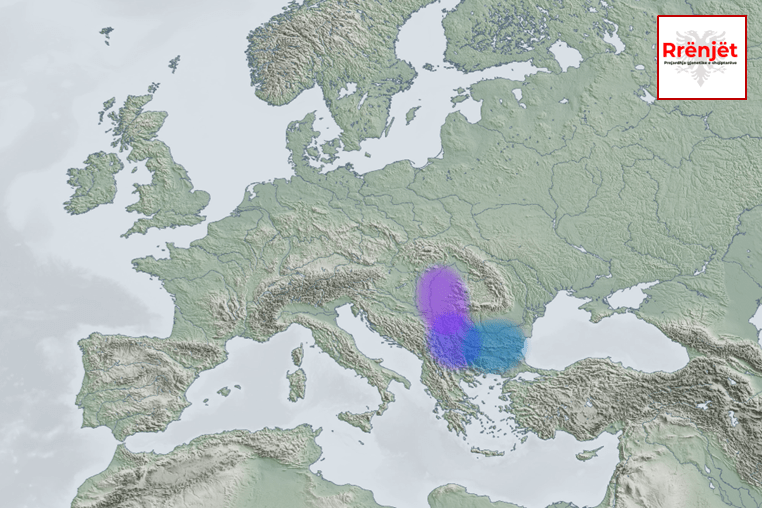
Possible area of spread of E-V13 according to modern and ancient results (Pannonia, Dardania & surrounding areas, Thrace).
From the diversity of modern results and from ancient results, it seems that the most likely area of the first spread of E-V13 was somewhere between the Pannonian basin (Vojvodina/Hungary & western Romania) and modern Bulgaria, including the entire central Balkans.
It was probably this intermediate area that initiated the spread in several directions, but details of this level require even more complete data. Regardless of which specific part of it was the starting point, this entire area must have been a crucial part of the early spread of E-V13, also serving as a source for E-V13 branches in other regions.
More qualitative modern results and especially more results from Bronze Age bones will be needed to determine precisely and how the highest stone the geographical origin of E-V13. In any case, looking at the rather scattered findings, it seems that all the main peoples of the Balkans had in their composition at least some branches of the E-V13 haplogroup since the pre-Roman period.
E-V13 among Albanians
Today, the E-V13 haplogroup has the highest density in the world in Albanian lands. The highest percentage is found in Kosovo, Malësi, Labëri, Tirana/Durrës. Most of the main branches, such as: E-BY4459, E-Y146085, E-PH2180, etc., have begun to spread since the period of Albanian ethnogenesis, in late antiquity and the early Middle Ages.
Since the origin of E-V13 in general has not yet been precisely determined, the placement of most of the E-V13 branches in Albanian lands remains controversial. However, between Pannonia and Bulgaria, from whatever region the spread of E-V13 originated, the closest connection to the Albanian lands is the former ancient territory of Dardania.
Most likely, many of the present-day E-V13 lineages among Albanians either have their origins around the Dardania area, or were initially established in Dardania (from the north or east) and then spread more widely to other lands.
It should be noted that the time and route of spread may differ from one branch to another, but the main periods are likely to have been the Iron Age and the period between Antiquity and the Middle Ages. As mentioned above, since the pre-Roman period, E-V13 must have been present in the Paleo-Balkan peoples from the Adriatic to the Black Sea. Specifically in Dardania, the strongest evidence for an ancient presence is the 3rd-5th century results from Niš and Timacum Minus.
At the branch level, there are quite large differences in the current distribution in Albanian lands. A large number of branches of E-V13 can be found in different regions, which suggests a presence in the Arbëro/Albanian population since the period of ethnogenesis. Among these are E-Y173822, E-Y146085, E-BY4459, E-PH2180, E-FT17132, E-Y159601, etc. The current diversity suggests that most of these lineages must have spread from the northeast about 1400-1800 years ago.
It is very likely that a large number of other branches have also been part of the Arbëro/Albanian ethnogenesis despite the later or more geographically limited distribution. For each of the main branches of E-V13 among Albanians, we have published separate articles where each is examined in more detail: E-BY4459, E-Y173822, E-Y146085, E-Y93102, E-PH2180, E-BY168279.
The articles will be constantly updated as data is added. In the meantime, we emphasize that E-V13 is the Albanian haplogroup with the highest number of results with insufficient quality for subbranch determination, with about 80 such results. We invite members of the E-V13 haplogroup to improve the quality of the analysis, so that the diversity and distribution of E-V13 branches among Albanians can be understood more deeply.
Reference

 Balkan Academia