
by Saqet Vejseli. Translation Petrit Latifi
Summary
This text examines a public debate sparked by a 2019 newspaper article concerning the origins of the world’s first alphabet. The discussion centers on conflicting claims that the earliest alphabet was Greek, Phoenician, or of an even earlier origin. While rejecting the view that the alphabet was originally Phoenician, the text also challenges the conclusion that it was Greek. Drawing on ancient sources such as Herodotus and Apollodorus, it argues that the alphabet introduced into the Aegean world predates the formation of the Greek people and language, and was instead associated with the Pelasgians or related pre-Greek populations. The text further claims that Pelasgian linguistic remnants survive in pre-Greek toponyms and inscriptions, which are argued to be interpretable through Arvanite (Albanian). On this basis, the alphabet is presented as Pelasgian in origin, and modern linguistic expertise is questioned when detached from this perspective.
In the newspaper “ESTIA”, on Tuesday 22.1.2019, the speech of Academician Z. Kounadis, held on 14.1.2019 at the Academy of Athens, was published, in which he claims that the first alphabet in the world is “Greek”. This post has provoked dialogue in the electronic media and the intervention of Z. Γ. Babiniotis, who, after mentioning the fact that Z. Kounadis is not a “linguist”, but an engineer, opposed this view, and as an “expert” himself, made it clear that the alphabet we use today is “Palm-Semitic”.
But Z. Babiniotis, by characterizing Z. Kounadis, as a “non-expert” and as someone who deals with issues beyond his knowledge, ignored the principle, according to which, “an expert in a matter is the one who has dealt with that matter”.
We, intervening in this dialogue, and without mentioning details and sources, declare that we initially agree with Mr. Kounadis, regarding the fact that “the oldest alphabet is not Phoenician”, for the same reasons that he mentions, but we disagree with his “final” conclusion, that “the oldest alphabet in the world is Greek”.
The first alphabet in the world was most likely Pelasgian
We support our disagreement for the following reasons: According to Herodotus, the first alphabet used in the area of Ancient Greece was that of Cadmus, king of Thebes. Since it is not known, the inhabitants of Thebes (and Boeotia in general), who were sometimes called Leleges, Avantes and Aeolians, were of Pelasgian origin.
Since, even according to Herodotus and Apollodorus, the Greeks, before “evolving” into Greek, were Pelasgians (or Leges), it is natural and then, based on this tradition, that the Greek language comes from the “evolution” of the language of the ancient Pelasgians (and Leges).
Therefore, at the time when the alphabet was introduced by Cadmus, there were neither “Greeks” nor “Greek language”, but only “Pelasgians” (or Leleges) and “Pelasgian language”
To the question now, what was the language of the Pelasgians (or Lelegians), according to well-known linguists (of the whole world), the answer is that the language of the Pelasgians (or Lelegians) is the one with which the “pre-Greek” toponyms, names and inscriptions were formed, which are considered remnants of the Pelasgian language, and which cannot be interpreted, neither in the ancient language, nor in the modern Greek one.
The language, however, that interprets these “pre-Greek” toponyms, names and inscriptions, is nothing other than the present-day unwritten language of the Arvanites, which some, with naivety and stupidity, have been forced to eradicate.
Therefore, the people of the “Monsters” (or Leleges), are not a mythical and unknown people, who disappeared and no longer exist, but are a people who live even today in the villages that are near and around the ancient centers of civilization, Athens, Thebes, Corinth and Sparta etc., namely in the villages known as Arvanitocoria.
The Boeotian-Pelasgians, as they are also known, called the “letters” of the first alphabet “dots”. So, these are the “holes”, interpreted by the US of the Albanian language “group-a” (holes), as “small scratches” or “small holes” in the stones, on which the texts were originally written.
So, from the “holes”, with the intervention of the “squid”, the words “letter” and “writing” came out, which, however, have no interpretation in the Greek language. Therefore, Mr. Babinioti, any modern Greek linguist who does not know Arvanite cannot be considered an “expert” in linguistics.
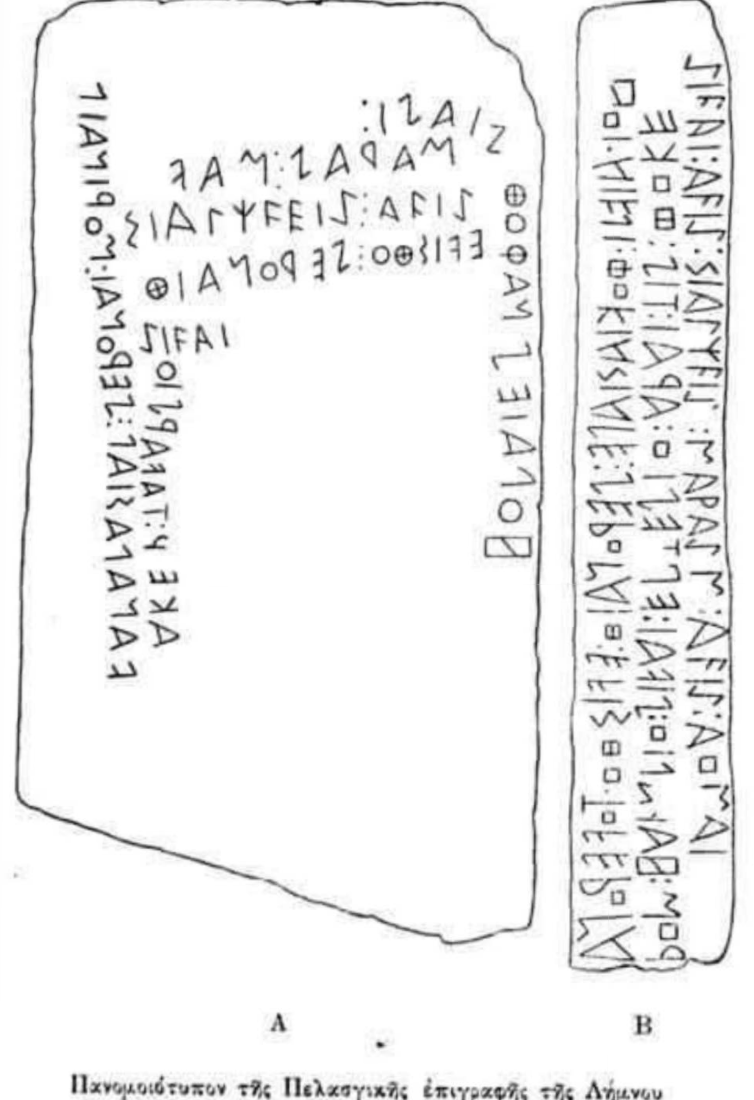
Note: The photo shows the inscription of Lemnos (6th century BC), which is written in the Pelasgian or Phoenician alphabet, and which has been interpreted, by Dr. Jacobos Thomopoulos, with the help of the Albanian language.

 Balkan Academia