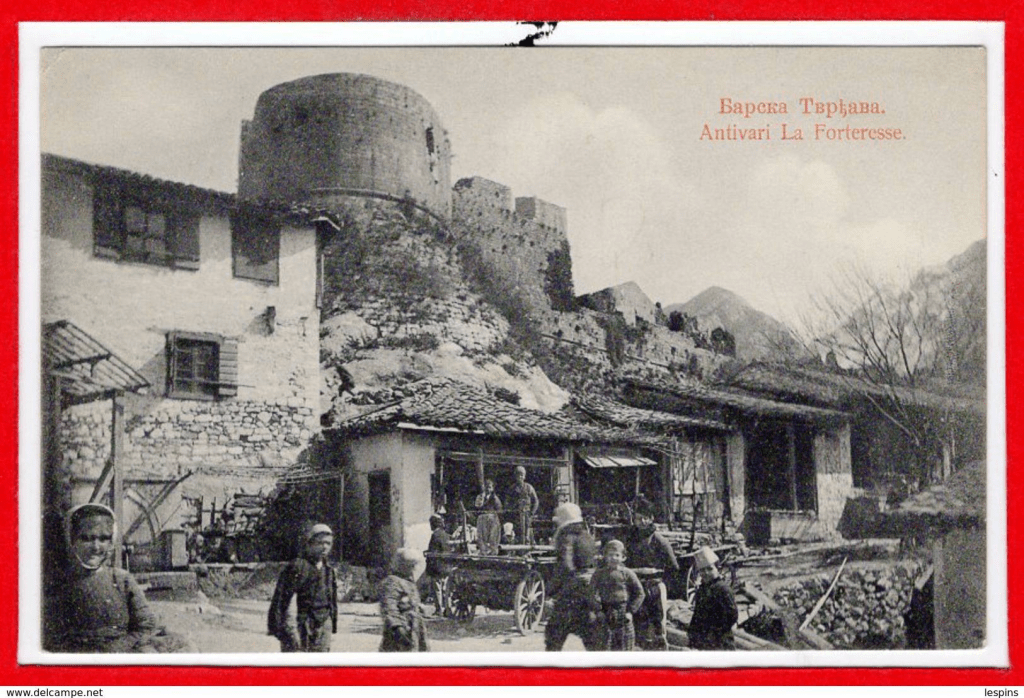

Familjet mesjetare shqiptare të Tivarit (Antivari)
Abstract
This article examines a range of noble and notable families associated with the medieval city of Antibari (Bar/Tivar), one of the most important urban centers of medieval Albania. Drawing on archival documents and historiographical works, it identifies families of diverse ethnic backgrounds—Albanian, Dalmatian-Venetian (Romance), and Slavic—and traces their presence, social status, and roles in ecclesiastical, political, and economic life. While many of these families appear frequently in medieval sources, the fragmentary nature of the documentation limits a full reconstruction of their histories and interrelations. The study focuses on the medieval period and does not address developments following the Ottoman conquest of Antibari.
Albanian medieval families of Tivar (Antivari or Bar)
As one of the most important cities of medieval Albania, Bar (Tivar) produced many documents related to its history, in which numerous noble and influential families stand out. In this article I will present some data on these families, limiting myself to those most frequently encountered in the available documents and studies. The families of Bar belonged to several ethnic groups: Albanian, Dalmatian-Venetian (Romance), and Slavic.
As the first family, I may mention the Bruni family, who in fact did not have an origin in Bar. It is said that they came from Vicenza in Italy, and that their ancestor Nicolò Bruni, having entered the service of the Byzantine imperial court, came and settled initially in Shkodër together with his family, later becoming castellan of Medun (today in Montenegro).
One of his descendants, Antonio Bruni, fled Shkodër after the Ottoman conquest of the city in 1479 and settled in Ulcinj. Nevertheless, as we shall see below, various figures from this family were connected with the history of Bar, which entitles us to include this family among those directly linked to the city.
An important figure of this family was Giovanni Bruni, who served as Archbishop of Bar for many years, from 1551 to 1571. As Archbishop of Bar, he dealt with the problems of a diocese in Ottoman-occupied territories and with the competition of rivals from Serbian Orthodox confessions. Giovanni’s position, working on the front line against changes considered “heresy” by the Church, attracted the attention of the Papacy, which in 1562 summoned him to take part in directing the Counter-Reformation at the Council of Trent, that is, in the Catholic Church’s effort to restore order within itself and respond to the challenge of Protestantism.
Regarding his presence as Archbishop of Bar at the Council of Trent, we encounter a problem that for the moment cannot be satisfactorily clarified. According to a geographic-historical description of the Kingdom of Serbia (Kosovo, etc.) and surrounding regions by an anonymous author from 1651, in the catalogue of archiepiscopal legates under Julius III during this council there appears as present “Gjon Bruti … of the Kingdom of Serbia, Primate Archbishop of Bar,” rather than Giovanni Bruni.
Giovanni Bruni thus followed his ecclesiastical path, while his brother Gasparo Bruni took up the sword and in 1567 joined the Knights of Malta, precisely at the time when Sultan Selim II threatened a major naval campaign against Malta and Spanish-Venetian interests throughout the Mediterranean.
In the period 1571–1572, Ulcinj and Bar were conquered by the Ottomans and were among the last cities of Venetian Albania to fall under the rule of this empire. Giovanni was initially imprisoned by the Turks, but later appears to have been released. Gasparo, who became second-in-command of the Christian naval alliance and faced the Ottoman fleet in October 1571, was killed at the Battle of Lepanto.
For his bravery he had been rewarded with a command in the late 1570s to defend the papal enclave of Avignon from another heretical enemy, this time the French Protestant Huguenots. He sent his son, Antonio Bruni, to a Jesuit school in Rome, where he studied law and from 1580 onward assisted his cousin Bartolomeo Bruti in administering Moldavia.
Misfortune also befell the aforementioned Giovanni, Archbishop of Bar. He was killed perhaps one hundred yards from his brother Gasparo, aboard a papal ship. Although the ship did not fall into Ottoman hands, it was captured by Spanish pirates, who executed him while he was crying out: “I am a bishop, I am a Christian.” The descendants of the Bruni family are later found in Capodistria (Koper) in Slovenia.
Another important family was the Borisi family. The Borisi family originated in medieval Bar, from which it appears to have departed some years after the Ottoman conquest. From the pre-Ottoman period, documents mention Mirko, son of Lord Peter Borisi of Bar. From this Mirko, on 15 December 1401, the head of the Franciscan Minorite friars of Dubrovnik received eighteen perpera bequeathed by will by Lord Dominik Skanjiboriski, also from Bar. Further on, besides Marin Borisi and his father Mirko Borisi, documented in 1434, there is also mention of Resti Borisi, who appears likewise to have been a daughter of the aforementioned Mirko Borisi.
This family is later documented in Capodistria (Koper) in Slovenia as early as 1595, with the first documented person there being Bernardo Borisi. In that same year he was granted the fief of Fontane near Vrsar. Before coming to Capodistria, he had served as majordomo and advisor to the voivode of Wallachia and Transylvania, as well as general of the cavalry of the ruler of Moldavia.
Later he is documented as a captain in Motovun in Istria. This family continued until the mid-twentieth century. The last descendant was Armando Borisi, an actor in the Italian language, specifically in the Venetian dialect, who died in 1943. Regarding their history in Bar, despite research in many documents, we have not yet been able to find further data.
In Bar we also find documented members of the Engjëlli family from Drisht, among whom we may mention Pal Engjëlli and his brother Pjetër Engjëlli, who were also connected with Bar. Indeed, with regard to Pal Engjëlli, some historians assume that he also wrote a history of Skanderbeg, whose author the Italian scholar Giammaria Biemmi calls “Tivarini.”
Some Albanian historians are of the opinion that the anonymous writer whom Biemmi names “Tivarini” must have been Pal Engjëlli (Paulus Angelus, 1417–1469). Biemmi strengthens this view when he writes that he came from the Engjëlli family, which once ruled in Bar.
Regarding the existence of a “History of Skanderbeg” written by Pal Engjëlli, according to Kolë Ashta we are also informed by the Ragusan historian Pietro Luccari in his work Copious Abridgment of the Annals of Ragusa (Venice, 1605), where he writes that he had this work in his hands and used it.
However, for the sake of truth, it should be said that with regard to the limited data Luccari provides on the life and activity of Skanderbeg, he does not mention sources. Therefore, in conclusion, the question concerning the existence of such a work and its authorship has not yet received a definitive answer.
Another noble family from Bar that may be mentioned is the De Elia family, documented in the fifteenth century. From this family is mentioned Lady Sbisso, the wife of Ser Marin De Elia. As another example related to this family, one may mention Juro Elia from Bar, who had certain obligations toward the Ragusan Marin de Gradi. In order to collect these obligations, on 5 March 1404 in Dubrovnik, Marin appointed the citizen of Ulcinj, Vasil Luka, as his procurator.
As for other nobles of Bar, there are also surnames such as Ballius, Balius, Bali, or Valius/Vali, which are mentioned as such also in Ulcinj. The Bezan family (Beçan, genitive Beçiani, Baxan, Bazano) likewise belonged to the noble stratum of Bar during the fourteenth and fifteenth centuries.
Another family ranked among the noble families of Bar is the so-called Goje family (Goye, Goie), which is mentioned in the fifteenth century, but for this family we have not yet been able to find further data.
Another family documented in Bar is the one with the surname Zogi. A documented individual from Bar bearing this surname is a certain Pjetër Zogi from Bar (Petrus q. Zogy de Antibaro), who is mentioned in the year 1380 as a person originating from this city. However, it should be added that the Zogaj family is also well documented in Drisht and in Ulcinj, near which there is a village called Zogaj. Another village also called Zogaj is located in the Shkodër region, approximately 10 km from the city. Whether all of these are related to one another remains a matter yet to be examined.
Gulielmi was another well-known family in Bar. Several individuals from this family are documented; for example, the merchant Nichus Guihelmi de Antibaro, who traded with the Ragusans and is documented in the year 1372.
The surname de Çare is also documented in Bar, as well as in other cities farther north, such as Budva. Since individuals bearing this surname held important positions, such as judges and magistri, I am of the opinion that this must certainly have been a noble family. In connection with this surname, one may mention Ser Schagno de Care of Bar in 1348, or Scagnus de Antibaro, magister and portulanus of rivers and merchants of Slavonia in 1335. Another person from this family was Grube de Çare, who is likewise documented in Bar in the years 1319 and 1333.
Another family surname is Martha (Marta). In Bar, a canon named Sergius Marta, Canon of Bar (Sergius Martha, canonicus Antibarensis), is documented in the year 1338.
Another family for which we are not certain whether it truly originated from this city is Basilius (Basili, Basilii, de Basilio, Bassello, Baseglo, Baseyo). However, this family is also documented in Kotor, Budva, and Durrës. Among the members of this family, one may mention Dominik Bazili, Canon of Bar (Dominicus Basilius, canonicus Antibarensis), who is documented in the year 1338.
Another little-known family which, in my opinion, lived in Bar was the family with the surname Rina. This family is documented in the year 1441, but we have no further data concerning it.
The family with the surname Comi (Komi) was also part of the citizenry of medieval Bar. Whether this family had any connection with the Comis family of Split does not emerge from the materials currently available to us.
Among other little-known families we may also mention the one called Kuriaku (Curiacus). A member of this family was the cleric Dom Dominik Kuriaku from Bar (Dompnus Dominicus Curiace de Antibaro), whose name appears in a Ragusan document dated 7 April 1405.
Furthermore, we may briefly mention the noble Domagna family, which is documented in the fourteenth century also in Kotor, and the Gabro family, which was present in Bar and in Ulcinj. The name of this family originates from a shortened form of the name Gabriel.
Another family that lived in Bar was the one with the surname Ruçi. Members of this family include Dominicus Ruçi and his son Zanin (Zane). These individuals from Bar are documented in the year 1392.
Two families with typically Albanian names were those called Kuribarda and Barda. Kuribarda is documented in the thirteenth century, and as its representative a judge bearing this surname is mentioned (iudex Curibarda, 1245–1267).
The Barda (Bardha) family is documented in Bar in the year 1437 through one of its members named Michoz Barda. However, this surname is documented throughout the region; as examples one may mention Kozma Bardha from Shirgj in the Shkodër area, or Kosta Barda (Bardha) from southern Albania, who in 1402 is found in Dubrovnik as an envoy of Merksha, lord of Vlora.
The family with the surname Marusco is also documented as originating from Bar. From this family one may mention Marin Marusco and his father Marrcolin de Marusco, who are mentioned in Ragusan documents in the year 1441. During the fourteenth to sixteenth centuries, another apparently important patrician family is documented, called Samuelis or Samoili. From this family are mentioned Lorenzo Samoili and his wife Samoila (Donna Decho, wife of Lorenzo Samoili), who appear in the year 1432.
Another patrician family from Bar is the one with the surname Orsi, documented in the fourteenth century and also found in Kotor. From this family in Bar, Grube de Orsi is documented in 1367 and is said to have been a judge, while in 1387 Miro de Orsi from Bar is mentioned. Whether these belong to the same family cannot be verified due to the poor state of the documents that have come down to us.
The surname Bolica is also mentioned as a family name in Bar. In this connection, one may mention Johannes (Çanni), son of Peter de Bolieç or Bolicii, who is mentioned in the year 1320. According to Jireček, this family should not be confused with the noble Bolica family of Kotor, because its surname derives from the word Buualiça, whereas the Bolicas of Bar derived their name from the word Boleslav. Jireček thus assigns this family a Slavic origin.
Another family that appears to have been of Slavic origin is the Nikolić family. In a Ragusan document dated 17 January 1405, a certain Simeon Nikolić from Bar (Symione Nicholich de Antibaro) is mentioned. On that date he gave about 150 perpera as a dowry, according to Ragusan custom, to Frank Živko Dabojević, the husband of his niece Stana. In another Ragusan document dated 9 May 1406, Sime Nikolić is mentioned in connection with a debt of fourteen perpera, for which four pairs of silver earrings had been taken as pledge. One year earlier, on 6 May 1405, several valuable items belonging to the same Sime Nikolić from Bar had been confiscated in Ragusa, among them a small silver vessel.
Also originating from Bar but residing in Ragusa is the Niković family, which may likewise have been of Slavic origin. From this family one may mention Sime Niković from Bar (Sime Nichouich de Antibaro), who lived in Ragusa and owned a house in the quarter of St. Nicholas in Dubrovnik, where he lived together with his wife Miloslava.
In the fifteenth century, the name Dabojes is also documented, which in my opinion may be connected with the surname Dabaj, still found today from the Krajë region of Ulcinj to Shëngjin, in various forms such as Dabaj or Dabović, among both Catholics and Muslims. Several individuals with this surname are documented.
First, Frank Živko Dabojević is mentioned in a Ragusan document dated 17 January 1405, stating that he received from Simeon Nikolić of Bar, the uncle of his bride Stana, about 150 perpera as a dowry, according to Ragusan custom. Another person from this family documented in 1441 is Anton Daboje from Bar.
Another family that appears in the documents is the one with the surname Dabro, which in this form is documented in Ulcinj and in Bar. However, there the surname also appears in the form Dabretić or Dobretić, to which belonged Miko Dobretić from Bar (Micho Dobretić of Bar), who owned property (land and vineyards) in Vremo. This variation in form may depend on the language in which the documents were written.
Likewise, due to the languages of the documents, the family de Grupsa from Bar appears written in two forms, also occurring in the Slavic form Grupsich or Grubsich. This family is documented especially in the fourteenth century.
Another family that appears in documents under various forms is the Mila family (Milla, Milo), which apparently lived both in Ulcinj and in Bar, but whose surname is also found in Kotor and in Split. Therefore, we have nothing certain regarding the origin and ethnicity of this family.
Another family from Bar mentioned in the fifteenth century is the one with the surname Mirko, which must have been of Slavic origin, judging by the form of the name.
The Valni family is also documented in Bar. As a representative of this family one may mention Pjetër Valni from Bar, who is documented as a resident of Kotor, but in the document it is explicitly stated that he was from Bar.
Likewise, the Zare family is documented as residing in Bar. A member of this family was Dom Andrea Zare, who is mentioned in a Ragusan document dated 14 February 1407 in connection with the receipt of money from the distribution of a testament.
The Mirushi family from Bar is also documented in many forms. It appears as Mirossio, Miros, or in the Slavic form Miroš; thus the surname changes depending on the language of the document. This family is documented in Bar from the fourteenth to the fifteenth century.
As an example, we may cite a document dated 17 January 1407, in which Marusha, the wife of Marince Miroshi, is mentioned. She complains through her representative that the son of Lord Marin de Resti attempted to dishonor her servant, who was carrying on her head a jug filled with water, causing the jug to fall to the ground and break into pieces.
The merchant Marince Miroshi from Bar is also mentioned in another Ragusan document dated 19 February 1407, in connection with payment owed to him for pack animals and warehouses for the grain that he was to bring to Ragusa by April 1407. If he did not deliver the grain within the prescribed deadline, he was to pay a penalty of one perper for each day to the commune of that city.
His name is mentioned in many documents, including one dated 7 April 1407, where it is stated that he was not permitted to enter into the palace of the Archbishopric of Ragusa, and in addition to this he had to pay a fine of 100 gold ducats, which were to be paid to the commune of Ragusa.
Another family from Bar was the one bearing the surname Mortichiul. From this family are documented Luka (Luce Mortichiul) from Bar and his daughter Stana, who appears in the documents as a nun in Ragusa in the year 1400 (Stana, daughter of the late Luce Mortichiul of Bar).
Another family from Bar is the one with the surname Tichoje. From this family there is mention of Lady Jaka or Jakusa, the wife of Marin Tichoje (dona Jacha, Jakussa, wife of the late Ser Marin de Tichoie, 1433–1435).
The Mordokur family also originated from Bar. From this family, in the year 1388, Vela is mentioned as the wife of Mence Mordokur (in Bar, Vela, wife of Mence de Mordokur).
Under the surname Zhupani, a family is known in Bar in the fifteenth century (Zuppan, Xupan), which appears to have been of Slavic origin.
These, therefore, were some of the many important and noble families of medieval Bar.
Source
Edmon Malaj. 2016. Hylli i Drites. Ubi Spiritus Domini, ibi libertas
(II. ad Cor. III.17) Ku asht Shpirti i Zotit, aty asht liria. VOTËR
KULTURE SHQIPTARE. JETI XXXVI SHKODËR.

 Balkan Academia