
Summary
In 1861, Montenegrins launched a series of violent raids on Albanian villages, including Muriqi, Shestan, and Rjepshi, as well as Cetinje, Morača, Podgorica, and Žabljak. Triggered by trade restrictions imposed by the Ottoman authorities, the raids involved killings, beheadings, plundering, and the burning of houses. Some Albanian communities, including Catholic inhabitants of Upper and Lower Shestan, successfully resisted, killing attackers, capturing prisoners, and defending fortified positions. Disguised Montenegrins also attempted attacks near Scutari and Lake Shkodër but were repelled. Ottoman forces, including Baschi-Bozuks, intervened to counter the incursions. The conflict caused widespread fear, destruction, and unrest in northern Albania, with no decisive victories for either side.
Montenegrins attack Muriqi, Shestan and Rjepshi in 1861
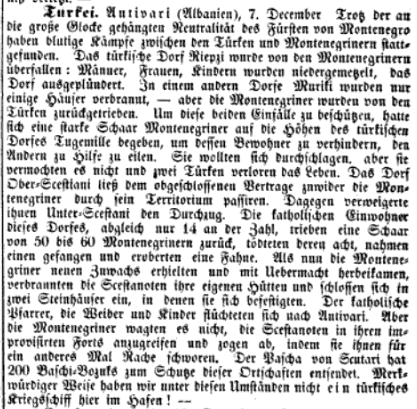
“Turkey: Antivari, Albania, 7 December: In the wake of the much-vaunted neutrality of the Prince of Montenegro, bloody battles took place between the Turks and Montenegrins. The Turkish village of Riepzi (Rjepçi or Rjepsh) was attacked by the Montenegrins; men, women, and children were slaughtered, and the village was plundered. In another village, Muriki (Muriqi), only a few houses were burned, but the Montenegrins were driven back by the Turks.
To counter these two incursions, a strong contingent of Montenegrins had gone to the heights of the Turkish village of Tugemille (Tudjemillë) to prevent its inhabitants from rushing to the aid of the others. They wanted to break through, but they could not, and two Turks lost their lives. The village of Ober Scestani (Upper Shestan), contrary to the concluded treaty, allowed the Montenegrins to pass through its territory.
In contrast, Unter Scestani (Lower Shestan) refused them passage. The Catholic inhabitants of this village, numbering only 14, drove back a contingent of 50 to 60 Montenegrins. They killed eight, took one prisoner, and captured a flag. When the Montenegrins received new reinforcements and arrived with overwhelming force, the Szestanos (Shestan Albanians) burned their own huts and locked themselves in two stone houses where they fortified themselves.
The Catholic priest, the women, and the children fled to Antivari. But the Montenegrins did not dare attack the Szestanos in their makeshift fort and withdrew, vowing revenge for another time. The Pasha of Scutari sent 200 Baschi-Bozuks to bombard these villages. Remarkably, under these circumstances, we do not see a single Turkish warship here in the port of Constantinople.”
Source
Hermannstädter Zeitung. Hrsg. von Heinrich Schmidt Part 2 by Heinrich II Schmidt. 1861
Montenegrins in disguise raid Shkodër in 1861
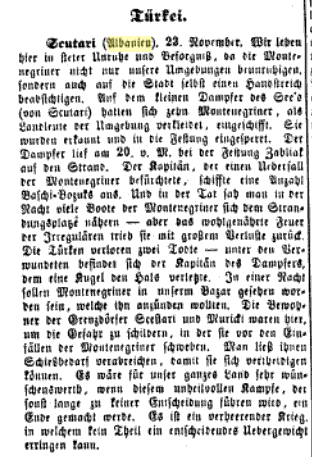
“Scutari, Albania, November 23. We live here in constant unrest and anxiety, as the Montenegrins not only disturb our surroundings but also intend to launch a coup against the city itself. Ten Montenegrins, disguised as local farmers, had boarded a small steamer on Lake Scutari. They were recognized and imprisoned in the fortress.
The steamer ran aground on the beach near the Zabliak fortress on the 20th of November. The captain, fearing a Montenegrin attack, launched a number of Bashi Bozuks. And indeed, many Montenegrin boats were seen approaching the beach that night, but the well-fed fire of the irregulars drove them back with great losses. The Turks lost two dead; among the wounded was the captain of the steamer, whose neck was cut by a bullet.
One night, Montenegrins were reportedly seen in our bazaar, intending to set it on fire. The inhabitants of the villages… Scestari (Shestan) and Muricki (Muriqi) were here to describe the danger they faced from the Montenegrin invasions. They were given ammunition so they could defend themselves. It would be highly desirable for our entire country if this disastrous conflict, which otherwise will not lead to a decisive outcome for a long time, could be brought to an end. It is a devastating war in which neither side can gain a decisive advantage.”
Source
Laibacher Zeitung, 1861
Montenegrins raid Albanian villages of Cetinje, Moraca, Podgorica and Zhablak and kill Albanians in 1861
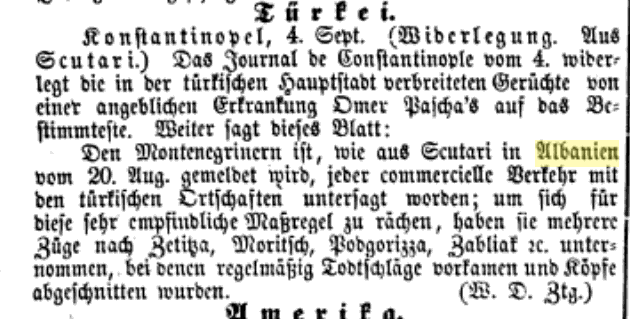
“Turkey. Constantinople, September 4 (Refutation. From Scutari.)
The Journal de Constantinople of the 4th categorically refutes the rumors circulating in the Turkish capital about the alleged illness of Omer Pasha. The paper further states:
As reported from Scutari in Albania on August 20, the Montenegrins have been forbidden all commercial contact with Turkish towns. To avenge this very sensitive measure, they carried out several raids on Zetiza, Moritsch, Podgorizza, and Zabliak, during which killings and beheadings regularly occurred. (W. D. Ztg.)”
Source
Donau-Zeitung Passau1861. 7/12.

 Balkan Academia