
by Artur Vrekaj. Translation Petrit Latifi
Albanians have never suggested an election of an Albanian national representative. From the perspective of a new ethnological map of Greece, Albanians are exterminated as a nationality.
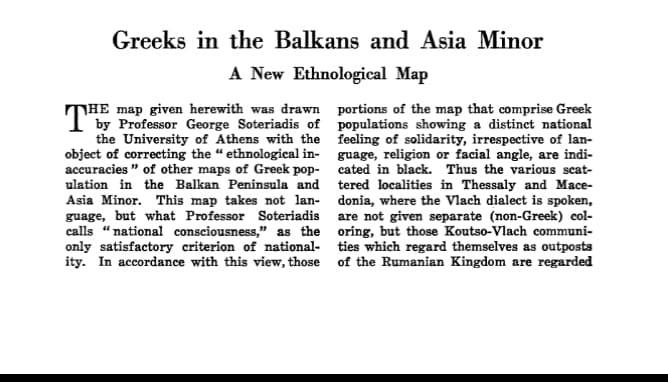
The following map was made by Professor George Soteriadis of the University of Athens to correct “ethnological inaccuracies”.
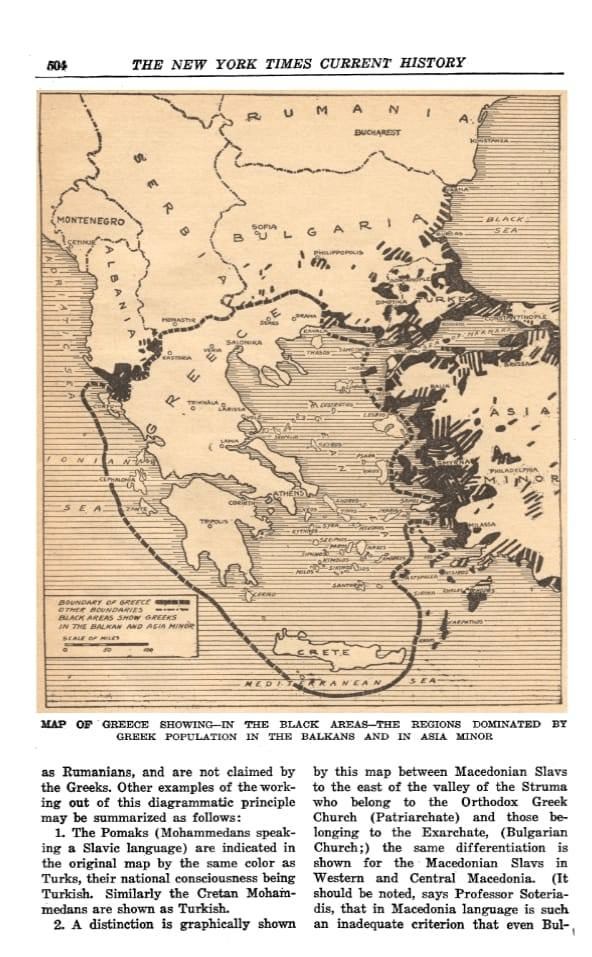
This map does not show language, but Professor George calls “national consciousness” as the only criterion that satisfies nationality.
Those parts of the map that include the Greek population, present a national sense of unity, the respective language, religion or facial features, are illustrated in black. For the localities scattered in Thessaly and Macedonia where the Vlach dialect (not Greek) is spoken, no special colors are given, but the communities that the Kuço-Vlachs who define themselves as outside the borders of the Romanian kingdom, are defined as Romanians and are not declared by the Greeks.
The Pomaks (Muslims who speak a Slavic language) are distinguished on the original map by the same color as the Turks, being their national Turkish consciousness. Similarly, the Muslims of Crete are shown as Turks.
A geographical difference shown by this map is between the Slavs of Macedonia east of the Struma valley, which belongs to the Ecumenical Patriarchate, the Greek Orthodox Church and the Exarchate, the Bulgarian church; the same difference is reflected for the Macedonian Slavs in Western and Central Macedonia.
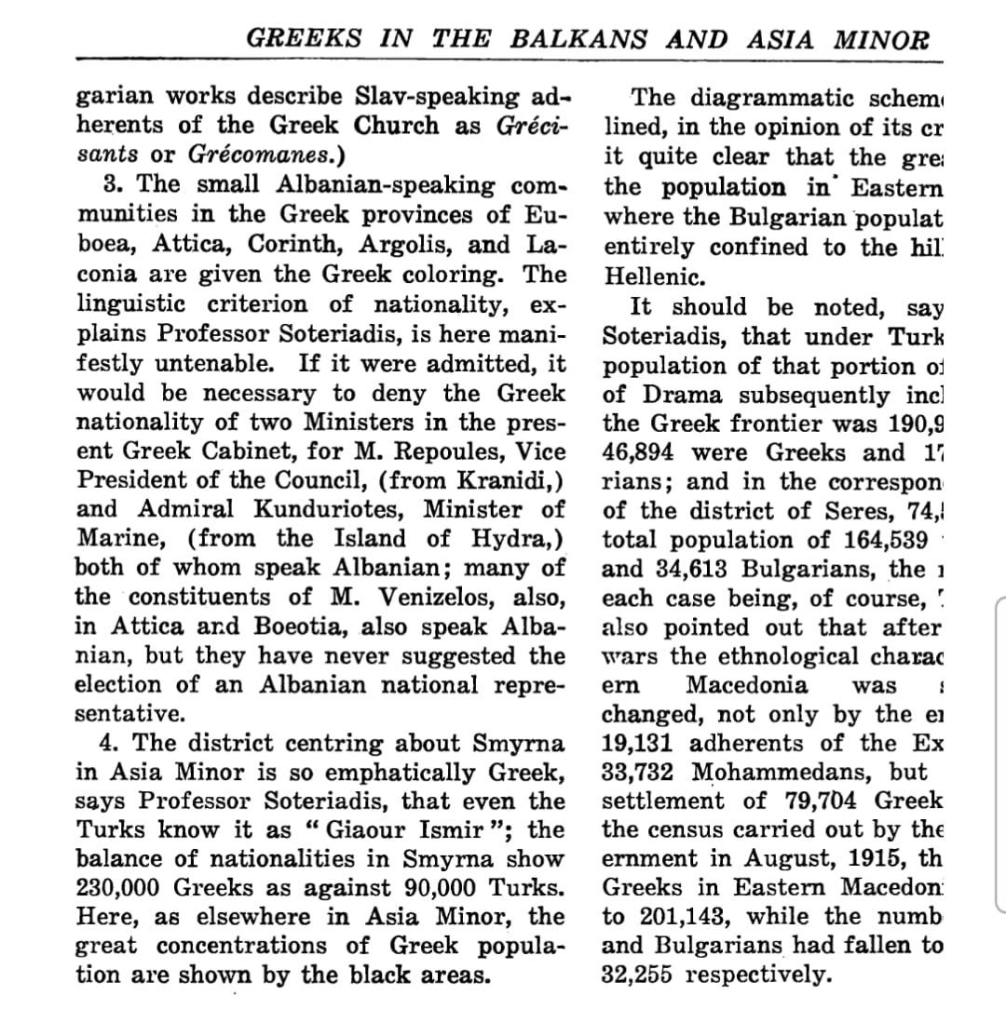
It should be noted, says Professor Soteriadis, that in the Macedonian language it is an ambiguous criterion, that even Bulgarian writings describe Slavs as non-worshipping members of the Greek church as Grecisans or Grecomans.
The small Albanian-speaking communities in the Greek provinces of Euboea, Attica, Corinth, Argolis and Laconia are given a Greek color.
The linguistic criterion of nationality, explains Professor Soteriadis, is clearly untenable.
If it were accepted, it would be common to deny the Greek nationality of the two ministers in the present Greek cabinet, Mr. Repoules, vice-president of the Council, (from Kranidi) and Admiral Kounduriotes, minister of the Navy, (from the island of Hydra) both of whom speak Albanian; many of Mr. Venizelos’s constituents, also in Attica and Boeotia, speak Albanian, but they have never suggested the election of an Albanian national representative.
Source
This is an excerpt from Professor George Soteriadis’ publication “The Greeks in the Balkans and Asia Minor” in “The New York Times Current History”, 1919.

 Balkan Academia