
Written by: Dr. Harun Crnovršanin. Translation Petrit Latifi
I have written about the suffering of the Bosniak-Muslim population of the Bijelo Polje district (Donji Bihor) on several occasions. It is known that at that time, according to the first report of the Chetnik voivode Pavle Đurišić sent on January 10, 1943, to his commander Draža Mihailović, 1,400 Muslims were killed in the Bijelo Polje district , of which 400 adult men and 1,000 women, children and the elderly. This Chetnik offensive was planned in detail and was launched, the day before Orthodox Christmas, on Christmas Eve, January 6, 1943.
In a simultaneous action, armed to the teeth, three thousand (3,000) Montenegrin and Serbian Chetniks surrounded the entire Bijelo Polje district. From the north, from the direction of Prijepolje and Gornja Peštera, Vojislav Lukačević and his Chetniks advanced.

Pavle Đurišić , commander of the Lim-Sandžak Chetnik Detachments (Vasojević Chetniks), set out from the south . The Chetniks began their bloody feast before dawn on January 6, 1943. Đurišić attacked from the direction of Lozna, Zaton and Bijelo Polje towards Bistrica. In the winter morning hours, they attacked the Muslim guard, about twenty of them, who were located in the village of Ušanovići, overpowered them and, via the Serbian village of Pećarska, moved to the Sjenica villages on Pešter, where they joined up with the Serbian Chetniks.

First, they attacked the village of Korita, where the numerous Ličina brotherhood lived. There, according to researcher Fehim Džogović, the Chetniks suddenly killed 69 Muslims while they were sleeping. Sixteen people were killed from the Novčići house alone. Bega Ličina’s houses were filled with incense sticks and set on fire. While Bega was burning alive, the Chetniks sang:
“On Christmas Day, forty-three,
For the Chetniks, here’s luck,
instead of wood and Christmas tree,
“They will behead the Turks.”

Also, from the direction of Pešteri, Rade Korda and his Chetniks attacked the border villages of Visočka, Sjeničke Bare, Treskavica and Borisišići. In Visočka, twelve women, children and elderly people were killed in the house of Lat Bučan. Lat’s daughter Emina put up heroic resistance , killing several Chetnik neighbors, but in the end, when she ran out of ammunition, the Chetniks caught her and killed her. They threw her into the house with the others, to burn next to her father Lat, mother Kima and brother Meho, who was eighteen years old.
The Chetnik assault forces found the poor in the Muslim villages of the entire Lower Bihor completely unprotected and helpless. Pavle Đurišić’s Chetniks committed terrible atrocities against Muslim civilians. They threw children, women and old people into houses, filled the houses with straw or hay and then set them on fire, and shot children who were running away. They nailed old people alive to oak trees, grabbed children by the legs, beat them to the ground and threw them into the fire. They raped women and cut off their breasts. Before setting fire to Muslim houses, they thoroughly searched and robbed them. They also took large and small livestock with them. All Muslim villages on the right bank of the Lim River were burned. Đurišić listed 33 villages in his report, however, according to the statement of the late Prof. Murat Mahmutović, over 60 villages and hamlets were burned.
We will list the burned villages of Lower Bihor: Voljevac, Gubavač, Rodijelje, Ušanovići, Presečenik, Buturići, Donji Vlah, Mirojevići, Šolja, Radojeva Glava, Pobretići, Mediše, Donja Kostenica, Stubo, Vrh, Zminac, Šipovice, Negobratina, Osmanbegovo Selo, Dupljaci, Jasen, Kostići, Kaševar, Ivanje, Godijevo, Žilice, Gornja Crnča, Gornji Radulići, Vrba, Crhalj, Kradenik, Sipanje, Ličine, Laholo, Žurena, Kamine, Raklja, Dubovo, Pašića Polje, Pišanje (today Brestovik), Zaton, Klinac, Brijeg, Odrin, Vitače, Brežđe, Mojstir, Dolac, Mokri Lug, Jablanovo, Bijedići,
Podbreže, Brčve, Žiljak, Holuja, Boljhanina, Rastoka, Kahve (Bistrica) Stojanovići, Sušica, Bioča, Zahumsko, Sjeničke Bare and Visočka.

It is true that the Muslim militia, commanded by Ćazim Sijarić , was caught off guard in this area, but a large part of the blame lies with the Italians who were aware of the Chetnik plans and did not react. The Italians pursued a two-faced policy throughout the territory of Sandžak. Their policy was “Divide et impera” (Divide and rule). On the one hand, they portrayed themselves as protectors of the Bosniak population, and on the other, they did not prevent the Chetniks’ crimes against them, because they did not want to spoil relations with the Chetniks who were their auxiliary armed formation, which they armed, fed and paid. A similar situation occurred during the aggression on Bosnia and Herzegovina (1992-1995), when the so-called international forces, instead of preventing Chetnik crimes against Bosniaks, with their passivity played into the hands of Karadžić’s and Mladić’s Chetniks to do what they did.
The only thing Ćazim Sijarić could do at the moment of the fierce Chetnik offensive was to provide a corridor for the passage of columns of several thousand Muslim refugees fleeing from Donji in the direction of Gornji Bihor.

At the same time, one can also ask how much the Partisans could have done to prevent this genocide, because the Partisans had grown into a respectable force in the Bijelo Polje district at that time. If Rifat Burdžović-Tršo had been alive, he would certainly not have calmly watched as the Chetniks slaughtered his people and burned their villages in the Bijelo Polje district, where he himself came from. However, the Montenegrin, let’s call him the Partisans, led by Ars Jovanović and Milan Peruničić, in a treacherous manner, in agreement with the Chetniks, liquidated him on October 2, 1942, in the village of Trnovo near Mrkonjić Grad (formerly Varcar Vakuf). So that no one would suspect Tršo’s murder, the Partisans also sacrificed the commander of the Third Proletarian Brigade, Vladimir Knežević Volođa and Tomaš Žižić.
Successful defense of Gornji Bihor led by Hodja Osman Hrastoder
Many today believe that the late Mullah Osman Hrastoder (1895-1946) was most responsible for the defense of the Bosniak population of Gornji Bihor (Petnjica Municipality) from the Chetnik sword during World War II. The militia founded by Mullah Osman had a purely defensive character. He was the imam of the mosque in Petnjica, a highly respected and intelligent man. He organized the people of Gornji Bihor and armed them with weapons he received from Ćazim Sijarić and Albanian brothers from Kosovo. During July and August 1941, he successfully defended Petnjica from attacks by the Vasojević Chetniks from Berane and Police, after which his reputation with the people grew even more.

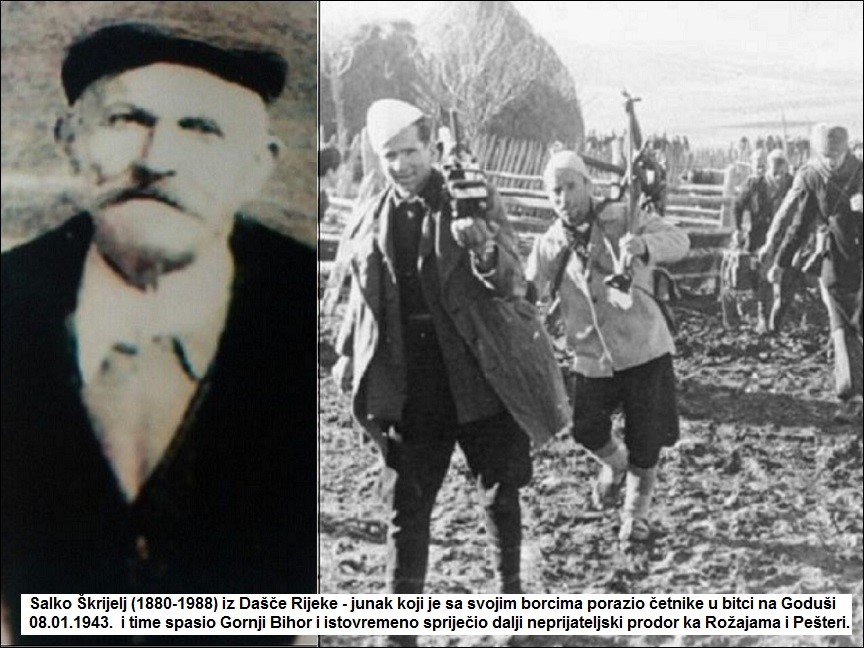
Mula Osman organized companies in the mountain villages of Gornji Bihor, and appointed experienced fighters and proven warriors as their commanders. One of them was Salko Škrijelj from Dašča Rijeka. Thanks to Salko Škrijelj and his fighters, the Chetniks suffered a defeat on January 8, 1943 near the village of Goduša, and were thus prevented from continuing their bloody campaign towards Rožaje and Peštera.
Who was Salko Škrijelj?
Salko Škrijelj was born in 1880 in the mountain village of Dašča Rijeka in Upper Bihor to father Adil Škrijelj and mother Altuna Rastoder. Salko was married to Raza Tahirović, from the neighboring village of Đerekara, and had four children: Muj, Hasim, Pemba and Hava. During the Kingdom of Yugoslavia, this highlander was a member of the Sandžak Komit movement led by Jusuf Mehonjić. For the area of Upper Bihor, Mehonjić appointed Sait Hadrović, in whose unit Salko Škrijelj also fought.
During World War II, Mullah Osman appointed him as a war chief for several mountain villages: Dašča Rijeka, Javorova Murovac, Poroče, Savin bor, Bor, Dobrodole and Kruščica. All of the above villages are located at an altitude of over 1280 meters above sea level. The highest altitude is the village of Kruščica (1,475 meters), which borders the village of Đerekare in the Tutin municipality. Salko was a machine gunner in the war and distinguished himself in the Battle of Goduša on January 8, 1943, where, with his fighters, he went behind the Chetniks’ backs and defeated them. He survived the war and lived to a ripe old age. He died at the age of 108. May his mercy be upon him.

Description of the Battle of Goduša
(08. 01.1943.)
The Battle of Goduša is one of the most important battles that saved Sandžak. Two Bihor residents, participants in this battle, left their testimonies about it. They are Ramiz Zverotić (1923-2004) from the village of Vrševo and Sabro Sijarić (1925-2020) from Godijevo. Both are deceased.
“Frantic columns of Muslim civilians from the Bijelo Polje district (Donji Bihor) were fleeing in front of the Chetnik camp, seeking safety in the retreat towards Gornji Bihor (Petnjica) and Rožaje. From the north, from the direction of Peštera and Korita, a strong Chetnik formation led by Vojislav Lukačević was approaching, tasked with intercepting and killing Muslim refugees from the Bijelo Polje district. Murat Mučić and Asim Kajević were the first to learn about the Chetnik plan and quickly organized the residents of Goduša and the surrounding villages. They went out to the highest elevation called “Krši” and there they awaited the Chetniks who were confidently advancing towards Goduša. Murat’s and Asim’s rifles opened fire first, followed by the other defenders. After a short time, fighters from neighboring Gornji Bihor, led by the famous machine gunner Salko Škrijelj from Dašča Rijeka, arrived to help the people of Goduša. Salko was one of the most capable commanders of the Gornji Bihor militia led by the mullah Osman Hrastoder.” (From a statement by Ramiz Zverotić given to the author Crnovršanin in the summer of 1996 in Istanbul.)

“… Salk’s group consisted of these fighters: Ličina Elmaz, Ličina Šaban, Kalić Suljo, Škrijelj Elez, Škrijelj Ragip, Škrijelj Fazlija, Škrijelj Desto, Škrijelj Šabo, Škrijelj Sadik, Škrijelj Hajriz, Škrijelj Hazir, Škrijelj Mustafa, Škrijelj Hivzo, Škrijelj Sefo, Škrijelj Džemo, Škrijelj Abaz and Selmo Kalender.

This group came to Lađevac, where they had an overview of the villages of the Bjelopolje region. After they saw that Korita was burning, and that Goduša was still preserved, they turned the “Kršim” towards Goduša. The Chetniks were piling up looted cattle on Sipanje. The Bihors of Gornji Bihor spread out, and one group went towards the fleeing people. They asked the Chetniks to surrender because they had nowhere to go, but the Chetniks fired. Then the defenders shouted and fired. The Chetniks fell silent, and after two hours the fire lit by the Chetniks on Bukvica was extinguished. The people of Bihor continued to shoot, and then people came and said that the Chetniks had escaped via Lim. The defenders entered Korita and bought dead Bosniaks that they buried only the second day. Thus, the Chetnik attack from the northern side of Gornji Bihor was repelled, which also thwarted the intention of the Chetniks to attack from Berane and Police and to join up with those who were advancing from Korit and Pešteri…” (From the book by Salija Adrović, Gornji Bihor, p. 108, Berane, 1995.)
Refugee columns from Donji Bihor gathered on a plateau above the village of Crhlja, located between Sipanj and Goduša. Sabro Sijarić from the village of Godijeva described what happened on that plateau and how a huge number of refugees found themselves in the Chetnik encirclement.
“Several thousand exiles found themselves unprotected, surrounded on all sides, machine guns barked from the heights and spread death, bullets whizzed by from all sides, everywhere there were moans, screams and wails of the wounded, blood poured down and stained the snow, it was boiling as if in a cauldron. Terrified mothers called their children who were lagging behind or sat in the snow exhausted. Children screamed, looking for and calling their dead parents.

The total catastrophe was approaching its end, bullets were raining down on the unprotected people. There was no help from anywhere. There was no way out for the terrified people, they were in an iron ring of fire of Chetniks determined to kill everyone. Suddenly, Salko Škrijelj from Dašča Rijeka and his group rushed in behind the Chetniks on Ploče above Goduša. Somehow, he and his fighters managed to push the Chetniks away from Ploče and the Goduški Krs, free the way for the exiles across Goduša and prevent further Chetnik advances into Gornji Bihor. ” (Statement by Sabar Sijarić from the text of an unpublished book by Fehim Džogović) .
Regarding how he deployed his defenders in the mountain villages under his control, Commander Salko Škrijelj points out: “On one hill alone, there were 32 of us fighters. On a stretch of one kilometer, 82 of us fighters were deployed. On the remaining part of the front of 7-8 kilometers, I deployed 120 fighters. A group of 23 fighters on Potajnica above the village of Korita was commanded by Džemo Rastoder.” (From the book “Rožaje and the Surroundings, People and Events (1912-1945), p. 133, by Alija Matović, Rožaje, 2009.)
On January 8, 1943, after a very fierce battle, the defenders of Gornji Bihor managed to push back the Chetniks with the help of the arriving fighters from Donji Bihor, commanded by Ćazim Sijarić.
The author of this text visited Godusa and its surroundings in the summer of 2016 and talked with the locals about this life-saving battle.

“SANDŽACKA SREBRENICA 1943”
Continuation of the Chetnik offensive in the Pljevlja, Priboj, Čajnički and Foča districts
After the massacre in the Bijelo Polje district, the Chetniks continued their genocidal offensive northwards – towards the Sandžak towns of Pljevlja and Priboj and the Bosnian towns of Čajniče and Foča. There they finally slaughtered, killed, looted and raped until mid-February 1943. In the second report by Pavle Đurišić dated 13 February 1943, addressed to commander Draža Mihailović, it is written that:
“…The action in the Pljevlja, Čajnički and Foča districts was completed successfully… The Muslim casualties were 1,200 fighters and around 8,000 women, elderly people and children.”
So, in these three districts alone, 9,200 Muslims were killed. It is obvious that Đurišić omitted to state the number of Muslims killed in the Priboj district where, according to research by former JNA Colonel Safet Hasanagić , another 3,708 persons of Bosniak ethnicity were killed!
To this day, it remains a mystery, both to the scientific community and to the general public, why no written record of the Chetnik crimes in the Priboj district has been left anywhere? A record has been left for the victims of the Sandžak and Bosnian districts: Bijelo Polje, Pljevlja, Foča and Čajniče, but there is none for Priboj, even though all the villages in this district were burned down and the Muslim population decimated!
So, by simply adding up the numbers of Muslims killed in the aforementioned districts, we arrive at the incredible number of 14,308 killed in just one month!
Reflecting on this “silent genocide” under communism, Sandžak Mufti Muamer ef. Zukorlić stated:
“How is it possible that most Bosniaks don’t know about the genocide in which several hundred more of our compatriots were killed than in Srebrenica? What history did we learn in schools and what is it that our children are learning today?”
How much did our enemies contribute to the darkness of ignorance about ourselves and our past, and how much did we ourselves?
The Bosniak people certainly don’t, and who has an interest in pushing such terrible truths into oblivion? And finally, is freedom possible with so much buried truth?
Answers to these questions await the Bosniaks on their long and painful journey of regaining their freedom and dignity.
Reference

 Balkan Academia