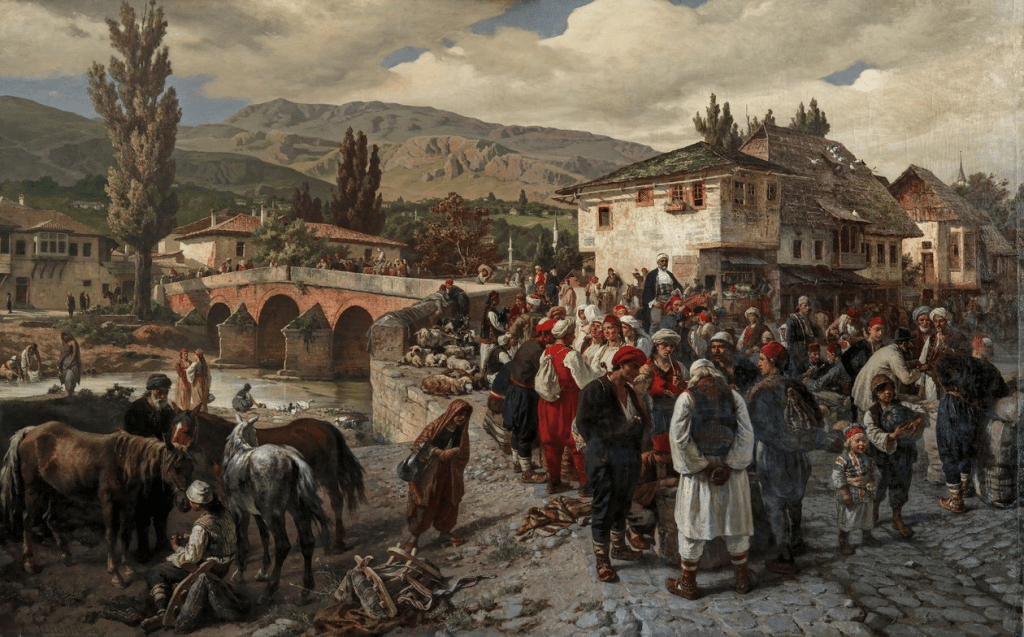

Painting is titled “At the Latin Bridge in Sarajevo”, Friedrich Alois Schönn, 1883, oil on canvas, 172 by 270 centimeters. Source Axanel
Albanians have been present in Bosnia and Herzegovina for centuries and, together with Jews and Roma, they were the largest minority community in Bosnia and Herzegovina, both during the Ottoman Empire and the Austro-Hungarian Empire’s occupation of Bosnia (1878-1918). Even today, a sizeable Albanian community lives in Sarajevo, made up of families who mainly came from Gjakova and who are now largely assimilated.
Merchants from Gjakova were particularly skilled in trade and in the 19th and 20th centuries they founded numerous colonies in the Balkans in the cities of: Shkodra, Skopje, Thessaloniki, Serez, Sarajevo, Istanbul, Sofia, Niš, Manastir, Jenin Pazar (Novi Pazar), Mitrovica, Belgrade.
One of those Gjakova colonies also existed in Sarajevo, Bosnia and Herzegovina in the 20th century, composed of families who came mainly from Gjakova since the 19th century and in the early years of the 20th century, although even before that, Albanians from Gjakova lived and traded in Sarajevo and Bosnia and Herzegovina in the 19th and 20th centuries. They mainly traded with Sarajevo, but also with other cities of the Ottoman Empire of that time.
They were skilled merchants, pipers, silk weavers, tailors, craftsmen, and grocers. The first traces of the Gjakova people in Sarajevo date back to the Ottoman Empire. Based on documents from the Sarajevo Historical Archive, it can be seen how the Gjakova colony was formed in Sarajevo, with dozens of Gjakova families settling in this city.
Sarajevo as a center of guilds
Sarajevo represented in the Ottoman Empire a developed and powerful center of guilds and craftsmen in this part of the Balkans, in the west of the great empire, while trade between Albanians from Arnautllëk (Arbënia) also developed with the largest western city of the Ottoman Empire – Sarajevo.
Gjakova, Shkodra and Prizren, back in the 19th century, represented three cities alone and without economic competition in the entire region of Northern Albania.
Jakova, as Gjakova was called then until the name change in the 20th century, during which time it was ruled by the Kryeziu family, who encouraged and supported the development of trade with all the cities in the region, aiming to improve the well-being of its inhabitants. For this reason, Gjakova became an important economic center in Ar-nautllëk (Arbëni).
Thus, merchants and craftsmen from Gjakova traded extensively with Sarajevo, especially after 1852, when the modernization reforms of the Ottoman Empire were implemented, and especially during the rule of the Ottoman governor Sherif Topal Osman Pasha (1861-1869) in the vilayet of Bosnia and Herzegovina, who improved economic conditions in Bosnia and Herzegovina. On this occasion, trade ties between Jakova (Đakovo) and Sarajevo will expand.
The first Gjakova residents in Sarajevo
At that time, from the middle of the 19th century, trade between Sarajevo and Gjakova flourished, and
merchants and craftsmen from Gjakova began to settle in Sarajevo. In the well-known local guest cemetery in Alifakovc in Sarajevo, there are tombstones of merchants from Gjakova (then Jakov) buried there, who died during that period in Sarajevo, and on which are written information about the city they came from. On two preserved tombstones from that period, the following inscriptions are carved:
Adem, son of Hajrulahu, merchant from Jakova 1279 (1862/1863) (1) Hajrulah Jakovali (Gjakova), son of hajji Mustafa 1297 (1879/1880) (2)
It is not mentioned which families the buried belonged to, since at that time people were mostly registered only by their names. As documents and notes in old books on the history of Sarajevo testify, one of the crafts in which the Gjakovars were represented was the craft of gajtanxhinj and that of processing silk (ipekçi). Represented were
also the Saraçs, as well as other merchants with various goods. More information about the merchants and families from Gjakova who stayed and lived in Sarajevo in the 19th century can be found in the Historical Archive of Sarajevo, which preserves documents mentioning Gjakovars who worked as merchants in Sarajevo and who were found in Sarajevo during the Austro-Hungarian occupation of the city in 1878 and the following years.
With the occupation of Bosnia and Herzegovina by Austria-Hungary, the entry and exit of travelers into Bosnia and Herzegovina, which is now part of the Austro-Hungarian Empire, will be controlled, as well as the circulation of the population in the city of Sarajevo.
All this is confirmed by numerous documents preserved in the collection of the Historical Archive of Sarajevo. The industrial development of Sarajevo during the Austro-Hungarian period was very intensive, and for this reason Sarajevo attracted merchants from Gjakova to trade with a West ern empire.
Documents from 1879 mention the following Gjakova residents who were in Sarajevo and engaged in trade:
The first traces of Gjakovars in Sarajevo date back to the Ottoman Empire. Based on documents from the Historical Archive of Sarajevo, it can be seen how the Gjakovar colony was formed in Sarajevo, with dozens of Gjakovar families settling in this city.

 Balkan Academia