
Abstract
This text examines the origins of the Greeks, known to the Romans as Graikoi, a name derived from an Illyrian mountain people and later applied to all Hellenic tribes. These groups, originally known as Danai, Achaeans, Hellenes, and Dorians, migrated from the northeast into the Aegean region. Initially culturally undeveloped, they absorbed advanced elements of Asiatic civilization through contact with peoples of Asia Minor, as well as Babylonian, Phoenician, and Egyptian influences. Writing systems, arts, religion, and technical knowledge were largely adopted from these cultures. During the classical period, Greek civilization surpassed its early teachers and spread widely across the Mediterranean and Near East.
Cited:
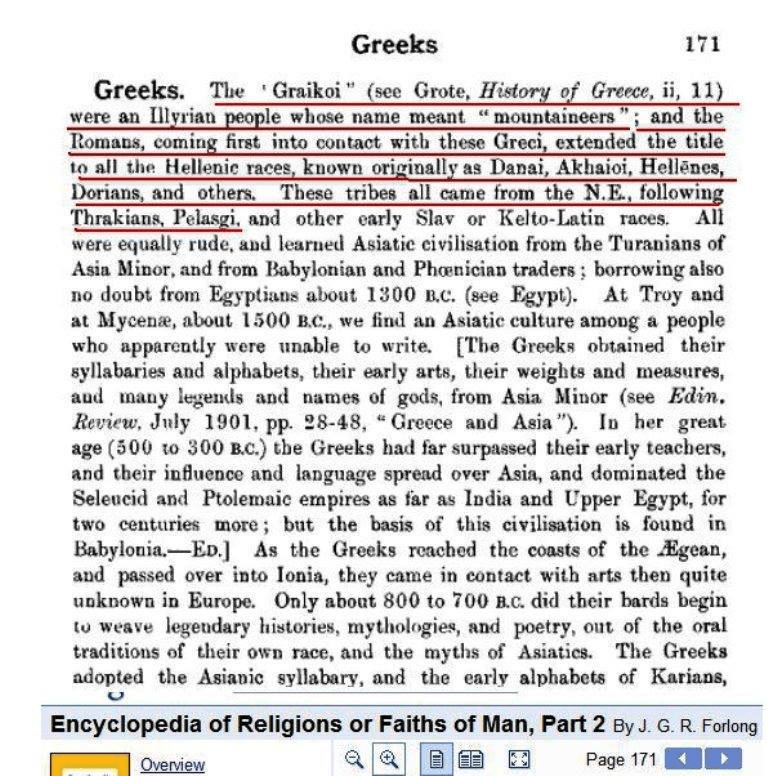
“The ‘Graikoi” (see Grote, History of Greece, ii, 11) were an Illyrian people whose name meant “mountaineers”; and the Romans, coming first into contact with these Greci, extended the title to all the Hellenic races, known originally as Danai, Akhaioi, Hellēnes, Dorians, and others. These tribes all came from the N.E., following Thrakians, Pelasgi, and other early Slav or Kelto-Latin races.
All were equally rude, and learned Asiatic civilisation from the Turanians of Asia Minor, and from Babylonian and Phœnician traders; borrowing also no doubt from Egyptians about 1300 B.C. (see Egypt). At Troy and at Mycenæ, about 1500 B.C., we find an Asiatic culture among a people who apparently were unable to write. [The Greeks obtained their syllabaries and alphabets, their early arts, their weights and measures, and many legends and names of gods, from Asia Minor (see Edin. Review, July 1901, pp. 28-48, “Greece and Asia”).
In her great age (500 το 300 B.C.) the Greeks had far surpassed their early teachers, and their influence and language spread over Asia, and dominated the Seleucid and Ptolemaic empires as far as India and Upper Egypt, for two centuries more; but the basis of this civilisation is found in Babylonia. ED.]
As the Greeks reached the coasts of the Ægean, and passed over into Ionia, they came in contact with arts then quite unknown in Europe. Only about 800 to 700 B.C. did their bards begin to weave legendary histories, mythologies, and poetry, out of the oral traditions of their own race, and the myths of Asiatics. The Greeks adopted the Asianic syllabary, and the early alphabets of Karians.
References
Grote, History of Greece, ii, 11.
Encyclopedia of Religions or Faiths of Man, Part 2, By J. G. R. Forlong, p. 171

 Balkan Academia