
Discovery by Saqet Vejseli. Translation Petrit Latifi
Abstract
This text examines a revealing episode from early modern Greek history illustrating the linguistic and social realities of Athens shortly after the establishment of the Greek state. In 1837, the Despot (Metropolitan) of Athens, Neophytos Metaxas, issued a public ecclesiastical condemnation (“taxation” in the sense of an anathema) against a Bavarian official connected to Count Joseph Armansberg for an illicit marriage. Because the majority of Athens’ inhabitants and the population of Attica were Arvanites at the time, the decree was written and read in the Arvanite language to ensure comprehension. The document highlights the widespread use of Arvanite in Athens, the authority of the Orthodox Church, and tensions between local populations and the Bavarian-dominated administration of the early Greek kingdom.
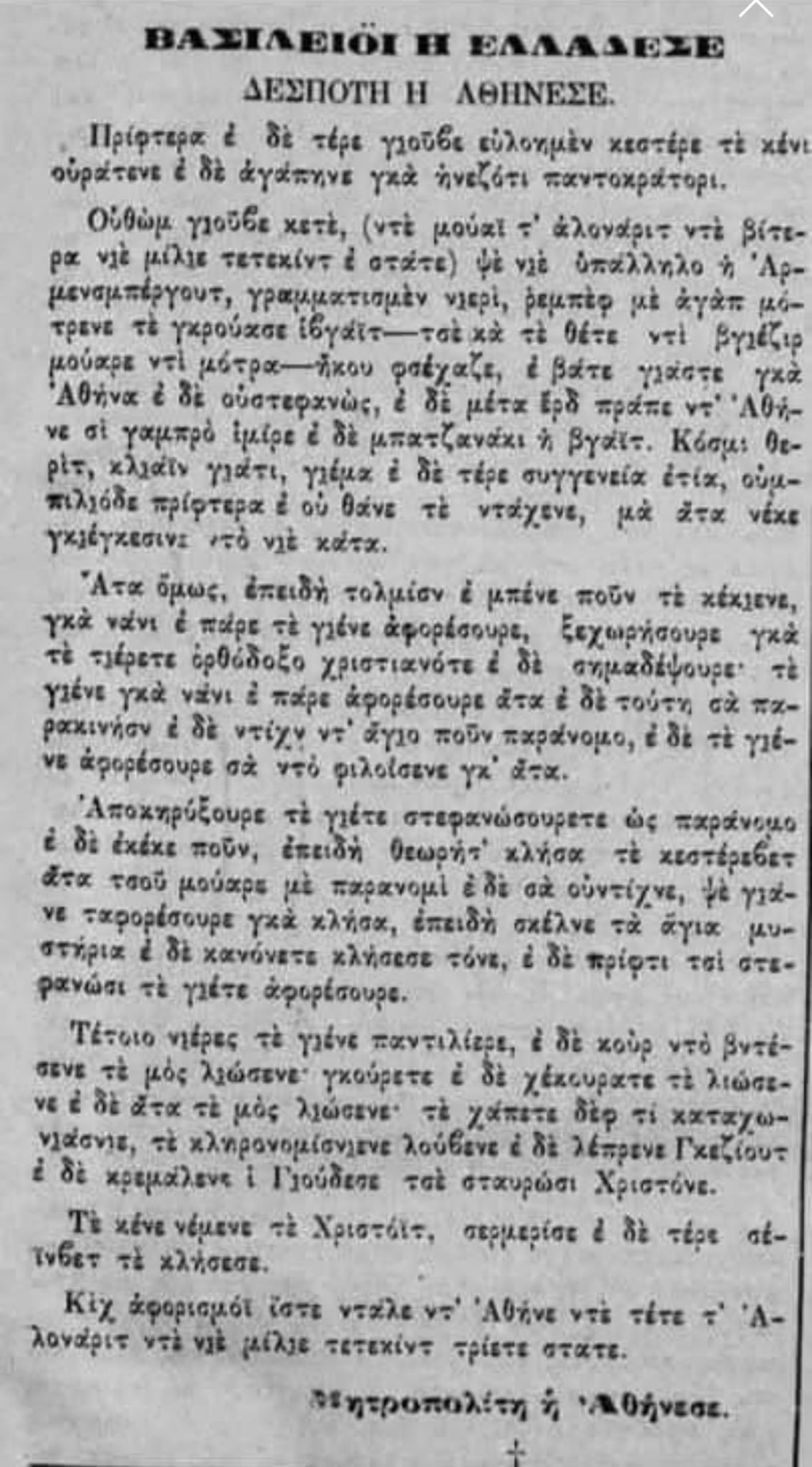
In 1837, a few years after the founding of the modern Greek state, the Despot of Athens, who was then Neophytos Metaxas, former Bishop of Talant, was forced to “tax” an official of the Bavarian Count Joseph Armansberg. And since this taxation had to be read in all the churches in Athens, the majority of whose inhabitants, at that time, were Arvanites, as well as all the inhabitants of the villages of Attica, in order to be understood, it was written in Arvanite (or even Arvanite).
The translation of the text of his tax, which is presented by this person in the photograph below, is as follows:
“KINGDOM OF GREECE
THE DESPOT OF ATHENS
Priests and all you blessed Christians, have the desire and love of our Almighty God.
I am telling you this (in the month of Alonari, in the year 1837) because a clerk of Armansberg, an educated man, lovingly abducted the sister of his brother’s wife – who says that two brothers took two sisters – he went secretly and went out of Athens and was crowned, and then returned to Athens as a good son-in-law and the eggplant of his brother.
The people are crying, the father, the mother and all their relatives are crying. The priests gathered and told them to separate, but they do not listen to any of them. But they, because they dared and did evil deeds, from now on they will be taxed, separated from all Orthodox Christians and marked, from now on they will be taxed and all those who incited and helped them in this work are illegal, and will be taxed with heavy taxes and those who speak with them.
The coronation has been declared an illegal and evil deed, because the theory of the Christian church calls those who were illegally taken and those who helped them, because they are deprived of the church, because they violated the holy mysteries and the rules of our church, and the pope who crowned them is consecrated.
May such people be without blessing, and when they die they cannot melt, stones and iron can melt and cannot melt, that the Earth may open and they may disappear, that they may inherit the Throne and Leprosy of Gezio, and the hanging of Judas who crucified Christ. May they be the curse of Christ, the Virgin Mary and all the saints.”
This taxation was made in Athens on the 8th of Alonari (July), 1837.
The Metropolitan of Athens”*.
*Note:
That is, according to the rules of our church, Kostis Stephanopoulos, the former President of the Hellenic Republic, because he too had been subjected to the same criminal offense as that of an employee of Armansberg, he too should have been accused and not have taken the high office he later held.
Source
“Rambagas” Newspaper (1882)

 Balkan Academia