
By Dr. Qazim Namani – Memories from my grandfather’s stories. Translation Petrit Latifi
My grandfather, born in 1909-2004, in Prapashtica, municipality of Prishtina, had in his memory many interesting stories about the past of our people. Today I am writing a story that he had heard in his room between the two world wars. He had heard this story at that time, from a Brahim, from the village of Lluga, municipality of Podujeva. Brahim had told a very interesting story about the “Sahit Pasha” of Slatinë, in the Kosovo Plain.
After the fall of the feudal system of pashas, in the middle of the 19th century, all the beylers, agallars and ajans, who enjoyed large properties, from the local population, were often called pashas. This tradition had remained with them, since the more distant past of the Ottoman rule. Albanian beylers who behaved among the people as pashas.
In fact, “Sahit Pasha” had been one of the most prominent beylers in the Kosovo Plain, and who had a great desire to be called pasha.
Like many Albanian pashas in all Albanian lands, “Sahit Pasha”, during the Ottoman rule, had exploited his privileges from power, to vent his lusts, on the poor Albanian population. These pashas, from the Albanian Christian population (Raja), would choose some poor families, who had beautiful daughters or wives, and bring them to work, for a piece of bread on their properties.
For such immoral and uninhibited actions, in the territory of today’s Kosovo, the pashas who came from the Gjinolli family dynasty were known. The model of the Gjinolli family was also followed by “Sahit Pasha” from Slatina, who also brought several Albanian Orthodox families to his fiefs during the Ottoman rule.
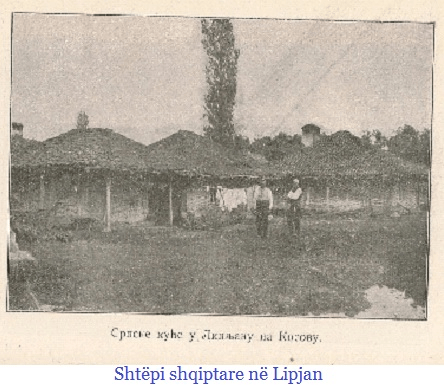
Albnaiian house in Lipjan
With the opening of Serbian, secular and church schools for the Orthodox in Kosovo, all Albanian Orthodox families began to be registered as Serbian families. I am starting with the story of my grandfather, to whom Brahimi from Llugave in Llapi had told it.
In the thirties of the twentieth century, Brahimi had a housemate in the village of Dabishec, municipality of Prishtina, but whenever he took his wife to her family, he would stay in the house of my grandfather’s family in Prapashtica.
Brahimi had told that, after the Serbian army entered Kosovo in 1912, “Sahit Pasha” of Slatinë had begged Ibrahim to go together to an Orthodox Albanian family, who at that time of crisis had remained on the properties of “Sahit Pasha”. The reason for going to this family was to ask him for some flour for the family of “Sahit Pasha”.
“Sahit Pasha” together with Brahimi of Llugave of Llapi, had gone to the house of the Orthodox Albanian (now registered as Serbs). The entire conversation between them had taken place in Albanian, since the “Serbs” spoke Albanian better than Serbian, which they had learned in the seminars held in the church.
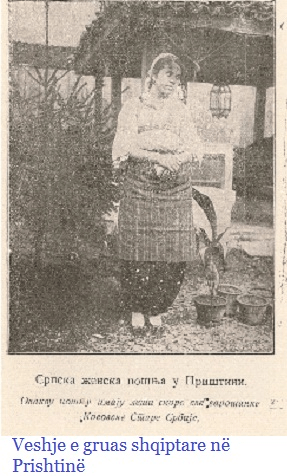
Albanian female dress in Prishtina
In the family of the Orthodox Albanian (Serb), “Sahit Pasha” was very well received, as was the case with Albanian folk traditions.
The “Serbian” was sitting by the fireplace, had made them coffee, had given them dinner, while the “Serbian”’s two sons, who were over 20 years old, had washed the feet of the two guests, and were standing, serving them until late in the evening. Once the “Serbian” had told his two sons to go to bed, and the two sons, after saying goodbye, went to sleep.
That night they had talked about various topics the whole time, but while the boys were there, “Sahit Pasha” did not bring up the topic for which they had gone to his guest house. Meanwhile, “Sahit Pasha” began to confess his troubles to the Serb, calling him by name: The power has changed, but you know very well that you are in my land.
-“Serbi” is saying to “Sahit Pasha”, it is the same, Pasha, that when you came and took us, we had no bread to eat. We were very happy then, when you brought us to your land. -“Sahit Pasha”, now I have come to give me some flour, because my family has nothing to eat.
-“Serbi” replied, I understand you very well, and I remember very well, that my family once had no bread to eat, and we were very happy, when you brought us from the dry hills to your fertile land, to the Kosovo Plain. Here in your land we worked hard, but we were happy, because we did not suffer for bread. Sahit Pasha” remained in memories and in silence.
“Serb”, I saw you know very well that I went to work in your fields, every day before sunrise, and returned on the eve of the golden sun. I saw you remember that often, when I returned home from your fields, I saw your red hat hanging on the hook in front of my door, I knew that you were inside my house, making a shroud with that piece of my hair.
I saw that I went hungry to the farm, and I did not sleep all night. The next day I would wake up before the sun rose, and with the tools in my hand, I would go to your fields to work. I would work tiredly, until he woke up, and he would bring me bread to the fields, towards the middle of the day that day.
Despite all these events, I saw you, I would have helped you, and I would not have turned my hands away, but I know very well that these two boys, who served you until late last night, are not my sons, but your sons, so today they have grown up and I do not dare to give flour to anyone from them. Throughout the entire conversation of the “Serb”, “Sahit Pasha” had kept his head down.
The next morning, the two of them had left the “Serb’s” house. They said goodbye to the “Serb” for the last time, without taking with them a single kilogram of flour from his fields. Thus, the fields of “Sahit Pasha” became the property of a Serb of Albanian origin.
Source


 Balkan Academia