
by Diana Doci.
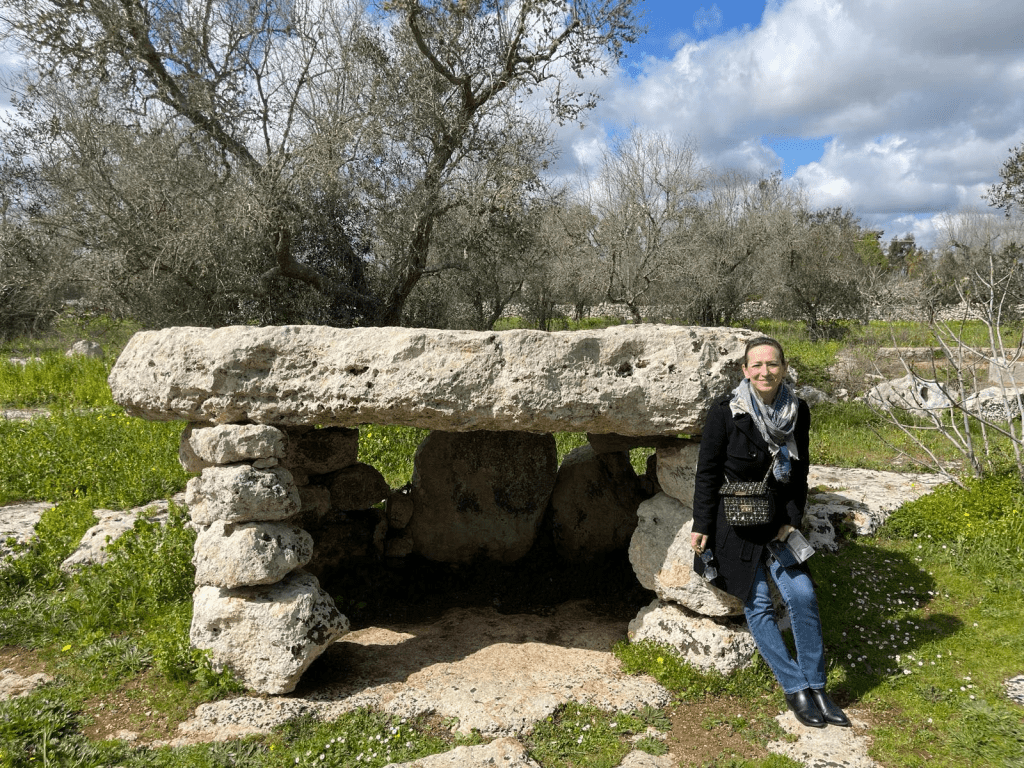
The presence of megalithic structures in Salento — menhir, dolmen and Archaic litical constructions — fits into a broader Mediterranean picture that takes us back to pre-classical populations, before the Greekization and Romanization of southern Italy. Among them, ancient sources insistently remember the Pelasgi, an enigmatic people, defined by Greek authors as autochthon and spread throughout vast areas of the Aegean, the Balkans and archaic Italy.
The menhir photographed in the Salentino territory should not be interpreted as a simple isolated manufact, but as part of a symbolic and cultural system connected to the sacralization of space. The erection of large vertical stones is attested in many regions considered Pelasgian or pre-Hellenic: Epirus, Tessaglia, Beozia, Crete, Sardinia and southern Italy. Such structures respond to a sacred cosmic and telluric conception, in which stone serves as an axis of connection between heaven, earth and human community.
Classical sources (Herodotus, Strabone, Dionigi of Alicarnassus) agree to describe the Pelasgi people as bearers of a very ancient culture, preceding Hellenism, characterized by an archaic language, natural cults and monumental architectural forms in stone. It is no coincidence that many megalithic areas of the Mediterranean were later reinterpreted, reused or “hellenized”, losing their original attribution.
In the context of Salentino, megalithism appears as a material testimony of cultural continuity, more than as an imported phenomenon. The persistence of archaic placeonyms, cave cults, astronomical orientations and rituals related to the sun and fertility strengthens the hypothesis of a deep cultural layering, in which the Pelasgian element represents one of the oldest levels.
In this perspective, the menhir is not just an archaeological repertoire, but a document of memory, a mark engraved in the landscape that refers to a civilization prior to historical writing, but not for this devoid of order, knowledge and symbolism. Its survival to the present day questions contemporary research on the need to overcome exclusively classical or colonial readings of the Mediterranean past.
Reconsidering the role of Pelasgi and megalitism means, reopening the debate on the plural origins of Europe, recognizing that history does not originate with the Greeks, but comes from much further.

 Balkan Academia