
From MekuliPress.com. Jan 3, 2026. by Jusuf Buxhovi. Translation Petrit Latifi
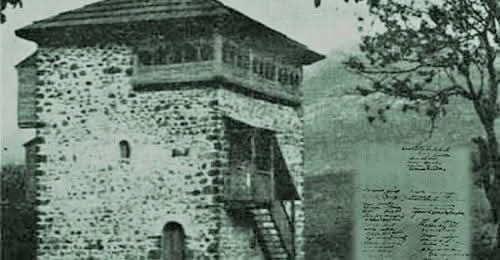
The Bujan Conference, held from December 31, 1943 – January 2, 1944, represents an important event from the anti-fascist national liberation war. The conference was held in the tower of Sali Man, the Bannerman of Krasniqa, near the base of the Main Headquarters of the UNC of Kosovo and the Provincial Committee for Kosovo and the Dukagjin Plain, where 49 delegates (43 Albanians, three Serbs, two Montenegrins and one Turk) participated, representing all regions and social classes of Kosovo. Among the participants were communists, nationalists and other democratic patriots, representatives of the Armed Forces, anti-fascist youth and women, etc. aligned within the framework of the Anti-Fascist National Liberation Front of Kosovo.
The conference examined the problems arising from the war against the occupier for three consecutive days. It elected a 9-person presidency: Mehmet Hoxha (chairman), former prefect of Elbasan, Rifat Berisha (vice-chairman), Pavle Joviqeviç (vice-chairman), Xheladin Hana (member), Fadil Hoxha (member), Hajdar Dushi (member), Zekeria Rexha (member), Milan Zeçarin (member), Xhevdet Doda (member).
At the end of the proceedings, the Bujan Conference issued a political proclamation on the duties of the national liberation councils within the framework of the joint anti-fascist front.
In a passage, in a generalized descriptive form, it is said:
“Kosovo and the Dukagjin Plain are a region, which is populated for the most part by the Albanian population, which, as always, wants to unite with Albania today. Therefore, we feel it is our duty to point out the true path on which the Albanian people must walk to realize their aspirations. The only path to unite with Albania, for the Albanians of Kosovo and the Dukagjin Plain, is the joint struggle with the other peoples of Yugoslavia.”
The Bujan Conference and the political proclamation, with its sequel “on the desire for unification”, must be seen as an ideological concept of the Albanian left, led by the Yugoslav communists, which on the one hand aimed to oppose the creation of the Albanian state that emerged from the reports that connected them within the framework of the Axis powers in October 1943, in accordance with the resolution of the Second Assembly of the Albanian League of Prizren that annulled the occupation of Albania by the Italian fascists and returned most of the Albanian lands occupied by the Serbs, Greeks and Montenegrins in 1912.
And, on the other hand, the proclamation of an ideological nature, aimed to prevent the confirmation of the idea of Albanian unification within the framework of democratic concepts, as foreseen by the Atlantic Charter, to which the NDSH and other nationalist forces, however scattered during and after the war, were committed, which failed.
This because they lacked Western support, since at the Yalta Conference, in agreement with Stalin and the new division of spheres of interest, Roosevelt and Churchill had agreed to preserve the Versailles Yugoslavia under the AVNOJ format, imposed by Tito.
This was best seen with its devaluation, at the Prizren Conference, on July 10, 1945, when the concept of “joint war with the other peoples of Yugoslavia”, after the Yugoslav partisan forces had penetrated Kosovo, with the reconciliation of Enver Hoxha with Tito in November 1944 and, in the circumstances of a curfew and a state of war, under the pretext of the emergence of “counter-revolution”, had settled scores with all the patriotic forces that fought the Albanian-Yugoslav communist alliance, as happened in Drenica, Tivarë and elsewhere, where about 50 thousand Albanians were killed.
So the ideological alliance between the Albanian and Yugoslav communists, the right to self-determination, always according to the ideological box, turned into a “declaration for unification with Serbia”!
However, we must not forget the fact that the Prizren Conference of July 1945, with the decision to create the region (province), although experienced by the Albanians as a re-occupation by Serbia, legitimized Kosovo as a political entity, which over time, created political subjectivity for it, in Serbia and finally in the Yugoslav federation (from 1974).
Despite this epilogue, the ideological formula of Albanian unity, inspired by the proclamation of the Bujan Conference, continued to appear in the sixties, seventies and until recently, reincarnated in ideological irredentism, even though the demand for the Republic of Kosovo had displaced it from the tracks of political legitimacy on which the state-building process of Kosovo, concluded on February 17, 2008, would be established.
Source
https://mekulipress.com/konferenca-e-bujanit-dhe-rezoluta-per-vetevendosje/


 Balkan Academia